
Trending
On a cold winter evening, a very long time ago, an entire family was savagely murdered here -- and to this day, the mystery remains unsolved. The January 10, 1894 edition of the Marietta Times reported that "the city and surrounding neighborhood was thrown into a fever of excitement" when news broke that three people had been killed just outside Marietta, near Pinchtown, also known as Unionville. No longer there today, this small community had thrived undisturbed for many years, with several homes, a school, a church, and a blacksmith shop making up the little settlement near the Muskingum River, before it was swept away in the 1913 flood.
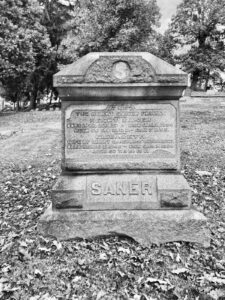
The crime happened about a half a mile up what today is Route 821, not far from where it splits from State Route 60. The Henry Saner family farm rested quietly on a hillside in a place remote from neighbors, but in sight of several farm houses. Henry Saner, a Civil War veteran, and his wife, Elizabeth, and their 20-year-old son, Rufus Putnam Saner, were all murdered on a Monday evening. The kitchen table had been set for dinner, with food prepared.
The Saner family had come from Germany to settle here. Mr. Saner was a wealthy farmer and a good citizen, well-respected in the community. He was thought of as a thrifty man who "feared banks," although robbery was not considered a motive since no money was taken. Mrs. Saner was known for her "intelligence and womanly character." The son, an only child, was a quiet, industrious young man.
About six o'clock that evening, a neighbor saw that Saner's barn was on fire, and upon investigation, found that it was too engulfed in flames to save it. It was full of hay, causing it to burn quickly. Several cows and horses were lost in the fire. Near the animals lay the body of young Rufus, burned beyond recognition. A watch on the corpse's arm, which had stopped at 6:25, was identified as belonging to Rufus. An empty pistol, his own, was found beside him. Across the yard was a large pool of blood, a shattered gun stock, and evidence of a struggle having taken place. A trail of blood led up to the porch, across it, and into the kitchen where the bodies of Mr. and Mrs. Saner were found on the floor. Both had been shot several times; Mr. Saner's skull had been crushed. Oil had been poured over the bodies and the house set on fire.
Who, then, could have done this? Newspaper reporters from all over the country got wind of the tragedy and ran articles about the murders. A New York City newspaper, The Sun, seemed to indict the boy on the basis that he was "an inveterate reader of yellow-back literature" and dime novels, which, the reporter insinuated, reflected poorly on his character. This account suggested that a quarrel with his mother over feeding the chickens, and a reprimand from his father, could have made him angry -- enough to kill them both. This theory, though, was hearsay and was never substantiated.
Nearly 1,000 people gathered for the Saners' burials on a quiet hillside at Oak Grove Cemetery.
The enigmatic crime remains unsolved 130 years later. The Wheeling Register, January 25, 1894 concluded:
"The murder has become one of those mysteries which will never be revealed. No evidence at all can be found which would even throw suspicion on anyone."
Judith Piersall is a WCHS member. To learn more about Washington County Historical Society services and membership, call 740.373.1788 or visit wchshistory.org.