
Battle of the Muskingum
Trending
Mississippi River Valley Late 1806: A national emergency was brewing, and Marietta was at ground zero. Former Vice President Aaron Burr was about to begin a military action that might remove states from the Union and start a war with Spain. Burr's goal was creation of a new empire in the lower Mississippi River valley.
Mariettans had been, often unwittingly, part of Burr's plan after he gained the support of Harman Blennerhassett. He, like many others, naively believed that Burr's plan was legitimate. His friend Dudley Woodbridge contracted with locals for expedition supplies. He hired Joseph Barker, who built the Blennerhassett Mansion, to construct 15 bateaux (40 foot long boats).
Aaron Burr had commitments, he thought, of 10,000 U. S. Troops, many prominent people, and a legion of young volunteers. But many others became alarmed at Burr's loose talk of rebellion and treason. Was it bluster, exaggeration, or for real? Rumors were rampant; reliable facts were not.
November 25, 1806: President Thomas Jefferson ordered emergency measures to stop the Burr threat. Directives, written in Jefferson's own hand, specifically included Marietta. Treasury Secretary Albert Gallatin was to order Marietta officials "....to seize the gunboats building in that neighborhood..... and call in the militia." Those "gunboats" were actually the equivalent of long rowboats designed for hauling freight and people, not for military action.
December 6: Ohio Governor Edward Tiffin ordered the militia under General Joseph Buell to seize the boats.
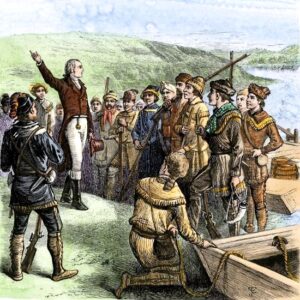
December 9: Most boats were commandeered at Joseph Barker's shop about 6 miles up the Muskingum River. The process was disorganized. It was dark. Two of the boats were guided by Clark Green, who was blind in one eye. One other boat was controlled by his two sons, aged 11 and 12. At least one boat escaped. The captured boats were anchored at Goose Run and guarded 24/7.
The emergency response of Federal and State authorities was well intentioned. But the actual execution of orders by the Ohio and Virginia militias became an embarrassing farce. Historian James Parton described the Ohio militia as a rude, undisciplined...horde of young backwoodsmen." They were stationed along the Muskingum River as guards. It was freezing cold, and there was little to do. They kept warm and amused themselves by drinking whiskey. Vigilance ceased; pranks began.
One night someone set a barrel on fire and floated it downstream. Sentinels below shouted at and then fired at the phantom "boat." No response. They plunged into the water to stop it, embarrassed to learn they'd been fooled. On another night, rowdy locals couldn't resist scaring the sentries guarding the captured boats. Lacking firearms, the perpetrators buried a sack of gunpowder with a fuse. When the sentries were asleep after fighting off whiskey and brandy, a huge explosion shook the earth. They scattered in panic.
Episodes like this prompted Edward Tupper to write a poem titled "The Battle of the Muskingum," mocking the militia's "battle " against practical jokers, boredom, and hangovers.
The Virginia militia in Wood County, under Colonel Hugh Phelps, waged a similar battle. After learning that the Blennerhassett party had fled on the Ohio River, one group went downriver to intercept them. They watched along the river near present-day Point Pleasant WV while partying around a roaring bonfire. They were soon oblivious. The fugitives glided silently past as the militia slept. Back at Blennerhassett Island, another militia group invaded the wine cellar with predictable results. Sadly, they vandalized the mansion.
Aaron Burr was tried on treason charges and acquitted; several Mariettans testified at the trial. The Blennerhassetts never returned to their island. The mansion burned in 1809. It was a sad chapter in our national and local history. Fortunately, some items from the mansion were saved and can be viewed at area historical sites.