
Sunday School Lady
Trending
Mary (Bird) Lake and her family couldn't find a place to call home. This lady pioneer of strong faith cared for the sick and wounded in the Revolutionary War and eventually lived in Marietta. She was born in England about 1728 and at age 20 married Archibald Lake. They emigrated to Newfoundland then moved to New York where Archibald worked in shipbuilding industry. He became an ardent patriot.
When the British occupied New York in 1776, the Lakes moved again. Their home for several years was with the Revolutionary War hospitals at Fishkill NY and other locations. They were a team. Archibald served as a commissary to procure supplies. Mary was a matron at the hospitals in charge of nursing care for the care of the sick and wounded. Historian Samuel Hildreth reported that George Washington personally thanked Mary for her "tender, vigilant, and unremitting care…" of soldiers.
After the war, they returned to New York, but there was no shipbuilding work. The Lakes heard about Marietta from Rufus Putnam. They moved here in 1789 with their eight children and lived in the enclosed stockade at Campus Martius. Not long after they arrived, smallpox broke out. Hildreth: "Her nursing experience was of great use, even to the (local doctors)….who had seen but little of this disease except in books…."
Mary cared for others, too, especially the poor. Her normally calm demeanor was once disrupted by a "poor" man whose wife had died. Mary had cared for her and was selecting clothing for the funeral and burial. She discovered a stocking leg stuffed with silver coins. She confronted the man, who had faked being poor and needing her help. He said dismissively, "Oh, that is to buy land with."
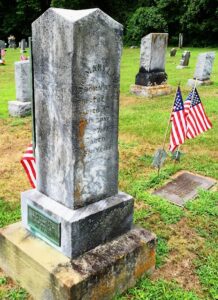
Mary noticed that children at Campus Martius had nothing to do while adults worshipped on Sundays. She gathered a few of them together in 1791 and began telling stories from the Bible. Hildreth: "Her explanations of scripture were so simple and child-like that the smallest of the little ones could understand them." Thus began the first Sunday school in the new territory and one of the first in the country. She taught at Campus Martius from 1791 to 1795 and continued teaching at Rainbow where the family moved. She died in 1796.
Her classes were crowded into the single blockhouse room where the Lakes lived. Kids sat on beds, benches, stools, even a bag of meal. That was where 4-year-old Horace Nye ended up one Sunday. Nancy Allison Frost, then 7 years old, was there. Horace had wandered out of class. Mrs. Lake went out to find him; the kids waited. "Then in came Mrs. Lake, leading Horace, and sat him down on a bag of meal away from the door where he couldn't get out!" Nancy remembered Mrs. Lake as kind and gentle. "We studied the Creed, the Lord's Prayer, the Catechism, and the Bible."
Benjamin Stone Sr., then 13 years old, later recalled Sunday school at Rainbow: "Children (received) regular religious instruction from Mrs. Mary Lake every Sabbath afternoon. She had us read in the Bible and write a portion of the Assembly's catechism…. She lent us books and would converse with us about what we read. She was an everyday, consistent, practical Christian of the Presbyterian church. That summer, I became convinced by my own experience that God noticed and answered the prayers of his needy though sinful creatures." Quite a testimony to Mary Lake's dedication.
Mary Bird Lake found her home – at Marietta and with children – imparting valuable life lessons. She was like many pioneers in our early settlements, improvising and taking courageous steps to improve the quality of life for others.