
1749: The French Expedition and First Catholic Mass
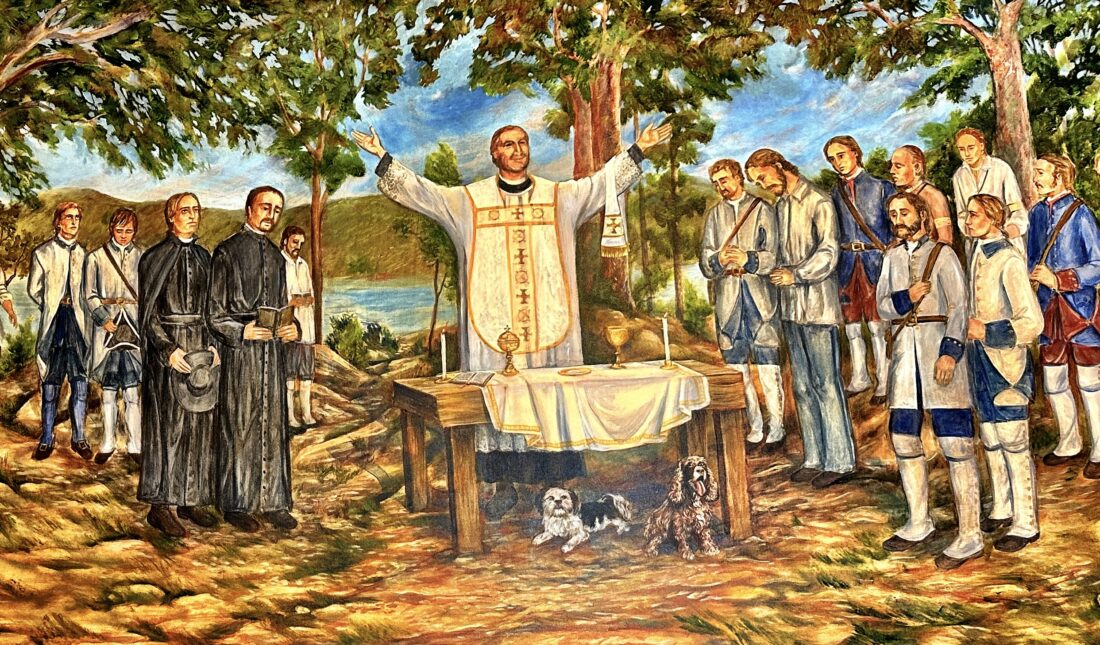
Mural from Basilica of St. Mary. (Photo by David B. Baker)

Want to know what happened to the lead plates and see images? Use the QR code.
Mural from Basilica of St. Mary. (Photo by David B. Baker)
Want to know what happened to the lead plates and see images? Use the QR code.
Trending
Perhaps you've heard of the so-called "Celoron Lead Plates." Or, maybe not. It's a fascinating, if not well known, story. Pierre Joseph Celoron De Blainville, a French military leader, led an expedition down the Ohio River Valley in 1749. They buried lead plates at major tributaries, including the Muskingum River, to establish French claim to land in the Ohio Valley. It was a curious way to claim land. Who would ever know that the plates existed, since they were, uh, underground? Never mind. The French were concerned about British inroads in the Ohio Valley and decided on this plan.
The expedition was an eclectic assembly. There were about 200 French soldiers and Canadian militia in their flamboyant uniforms, a few dozen Indians in native dress, and a catholic priest, along with numerous flags and banners. One historian said the group was reminiscent of a Hollywood movie scene, rather than a real-world expeditionary force.
A Jesuit priest, Father Joseph Pierre de Bonnecamps, was chaplain and navigator for the expedition. He was a trained scientist who used a sextant to log their position, drew maps, and made notes about the expedition.
Each plate burial was accompanied by a ceremony. Soldiers lined up in formation. King Louis XV of France was proclaimed lord of that region. There were songs, cheers, and musket volleys fired.
French Canadians at the time were predominately Roman Catholic, so there were masses (Catholic religious services) held as they travelled. Father Bonnecamps may have also preached to the Indians.
The expedition made an overnight stop at the Muskingum River on August 15, 1749. A lead plate was buried with the usual ceremony near where Harmar School is today. A hunting party was sent out to replenish their food supply. August 15 was also the date for the annual Catholic observance of Mary's death and ascension into heaven, referred to as The Assumption. A mass was held here on August 16, based on information provided to Father John Michael Campbell, Rector of the Basilica of St. Mary of the Assumption. This was the first Catholic mass in what became the Northwest Territory.
That event is depicted in a mural painted in 2013 at the north entrance to the church. The artist had some creative fun by drawing in Father Mike's two small dogs, Molly and Allie, (look carefully at the picture) who time- traveled back to 1749 for the event. Fortunately, they returned for their afternoon walk after the mass. The artist did not tell Father Mike about the dogs. He was delightfully surprised.
Catholic worship in Marietta began in the early 1800's with itinerant priests. A full time priest was assigned in 1838, and the first St. Mary Catholic church was built in the 100 block of Fourth Street in 1853. It was an elegant building, but it was in the flood plain.
After repeated flooding in the late 1800's, a new church was built on its current site at Fourth and Wooster Streets. The church was designated a minor basilica by Pope Francis on June 13, 2013.
The French expedition continued down the Ohio River to the Great Miami River, then returned to Montreal. The British and the Indians ignored French land claims.
Want to know what happened to the lead plates and see images? Use the QR code.