
Black History Month: The Freedom Train, Part 1
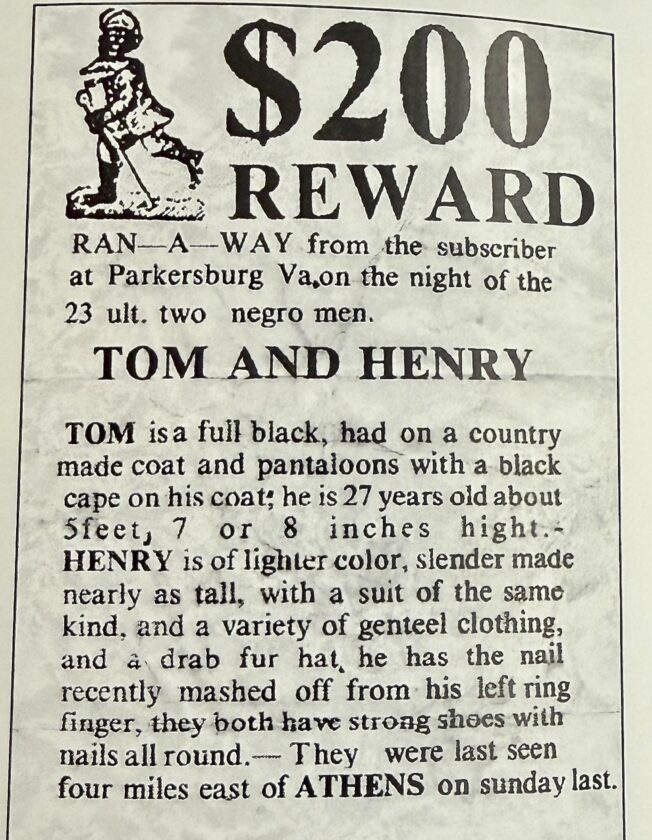
Copy of reward ad for runaway slave from Washington County Underground Railroad by Burke and Fogle. (Photo provided)

To learn more about David Putnam, Jr.’s Underground Railroad activity, scan the QR code.
Copy of reward ad for runaway slave from Washington County Underground Railroad by Burke and Fogle. (Photo provided)
To learn more about David Putnam, Jr.’s Underground Railroad activity, scan the QR code.
Trending
The ferry operator pulled his large flatboat to the edge of the Virginia shore of the Ohio River. He watched and listened carefully for signs of other activity. He waited for his passengers. A mist danced around in the slight breeze. It was past midnight in the 1830's. This was a special ferry operation – transporting escaping slaves to freedom in Ohio and points north. Soon ferryman Josephus, a slave himself working at great personal risk, rowed a small group of fugitives across to Buckley's Island, portaged across it on the freight haulers road to the other side, then floated down the Ohio River to Duck Creek. Other "conductors" on the Underground Railroad met the escapees to guide them north. Josephus made hundreds of such trips over many years.
The Underground Railroad was a network of secret routes and safe houses that helped slaves escape to freedom in the north. It became most active in the 1830-1850 period. "Conductors" and "station masters" were slavery sympathizers who led double lives – as ordinary citizens by day and clandestine operators at night. The Ohio River, called the River Jordan by slaves, was a major crossing point since states on the northern shore prohibited slavery.
There were dozens of stations and routes in Washington County. Important landing points near Marietta included Mile Run, Duck Creek, Little Muskingum, and Goose Run. The Marietta Station (stations were safe houses and transfer points) was the Harmar residence of David Putnam, Jr. Other stations in Washington County were kept by Ephraim Cutler at Constitution, Col. John Stone at Belpre, Horace Curtis at Little Hocking, James Smith at Cutler. There were many more.
This period was fraught with violence between slave owners and anti-slavery abolitionist groups. Tension was high with neighboring Wood County then in Virginia, a slave state. Plantations with names such as Henderson, Harwood, and Neale had slaves. They often fled into Washington County, Ohio.
One escape in the early hours of July 10, 1845 was foiled at Belpre. Six slaves from the Harwood Plantation including three children crossed the Ohio River. Five Underground Railroad members from Ohio met the slaves to guide them north. But an informant had alerted authorities about the planned escape. As the canoe landed, a group of heavily armed men from the Harwood Plantation sprang from hiding and confronted them. One adult slave and two of the Ohioans got away. The others were taken to Parkersburg. The slaves returned to the plantation where they are punished by whipping and facial branding. The Ohioans were jailed without bail. Wood County went on alert, expecting an attack by the Ohio Militia to free the men. The Virginia Appeals Court eventually heard the Ohioans case; there was no verdict. The men were released after six months and returned home.
James and Margaret Smith operated an Underground Railroad station at their and Cutler home. One day the sheriff of Wood County with several deputies arrived in a buggy. James was sitting alone on the front porch. The sheriff told James that he was under arrest for harboring slaves and violating the Fugitive Slave Act of 1793. James was indeed guilty. But he casually responded, "That may be well and good but before we depart, I suggest that you look up and see what's in my window." All five of Smith's sons stood in the windows, each with a rifle. There was no arrest that day; the sheriff left. A plaque near the Smith home, says: "James and Margaret Smith gave aid and comfort to more than 150 runaways."
To be continued next week: Find out how slaves evaded detection by pursuers and read about amazing escape stories.