
I-77 was a late addition to interstate plan
Trending
When I first arrived in Marietta, I came as most people do, by car along Interstate 77. In the early 1970s the highway had become the main north-south route between the south and the eastern half of Ohio, including the industrial cities up north. As we all know the highway skirts the eastern edge of Marietta, providing the residents of the city with an easy connection to the eastern, northern and southern parts of the country.
You can thank a Marietta man for making it all possible. S. Durward Hoag was the owner of the Lafayette Hotel. He understood a thing or two about America's love affair with cars. It's why the hotel has a large parking lot next to it today and it is also the reason you can drive to Cleveland in less than three hours.
Let's go back a few years, more like a few decades. Following World War II, the federal government decided to build the interstate highway system, or more precisely, the Dwight D. Eisenhower National System of Interstate and Defense Highways. Construction got started in 1956 and was finally "finished" in 1992. The original plan had no Interstate 77, and this greatly upset the owner of the Lafayette.
As a three-time president of the Marietta Chamber of Commerce, Hoag knew how to get things done. He found out that the mileage of the federal network of interstates was based on the mileage of the routes they replaced. The distances got shorter with the new roads because hills were flattened, and curves removed. The system would have a few miles left over, he rationalized, and those miles roughly equaled the distance between Cleveland and Charlotte, N.C.
Hoag gathered up a few friends and took a trip to Washington, D.C. C. William O'Neill, then governor of Ohio, and West Virginia Gov. Cecil Underwood paid a visit, along with Hoag, to the road planners with their findings. On Oct. 18, 1957 the highway was approved. "This will put us on the mainline," Hoag is reported to have said. "We are no longer on a siding."
Complete construction of the highway would take decades. The contract for the Washington County portion was awarded in 1964 and it opened a few years later. The West Virginia Turnpike required a massive amount of work to turn the three-lane highway that it was into the modern four-lane Interstate that it is today.
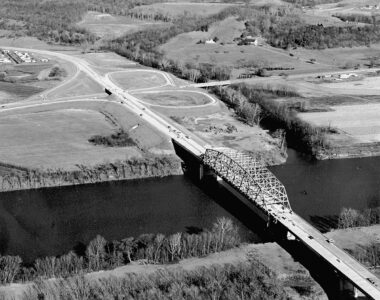
Hoag would be given the honor of becoming the first person to drive across the interstate bridge across the Ohio River when it opened On Dec. 15, 1967. The bridge opened a few days early after the Silver Bridge in Gallipolis fell into the Ohio River and an identical bridge in St. Marys was closed as a precaution.
Years ago, reporter Tom Hrach and I decided to experience travel to Cleveland without the aid of the interstate.
We traced the route of the old Route 21, that until I-77 was the only way north. It was horrible. It took eight hours to arrive in downtown Cleveland, we crossed I-77 dozens of times and must have gone around thousands of turns and up and down just as many hills.
The building of the interstate changed the whole dynamic of the eastern part of Marietta.
Three large shopping centers and a half dozen hotels now fill space that was once farmland, swamps, and woods.
None of the restaurants that feed hungry travelers and residents alike existed before the road was constructed. All the hotels near the interstate certainly had an impact on business at the Lafayette, something that Hoag most certainly knew would eventually happen.
The bridge across the Ohio River has been a valuable link for residents as well, giving us a quick connection to Williamstown, and for several years before the 1992 opening of the Williamstown Bridge, the only connection after the closure of the former structure.
Hoag literally put I-77 and Exit 1 on the map. Thank you S. Durward.
Art Smith is online manager of The Times, He can be reached at asmith@mariettatimes.com.