
Washington County’s first courthouse and jail
Trending
Marietta's first court was held just a few months after the pioneers arrived in April of 1788, establishing firmly that the rule of law would be followed, even on the frontier. Court convened on September 2 in the blockhouse at Campus Martius, at Colonel Battelle's house in the northwest corner of the fort. To mark this momentous event, a stately procession of settlers and soldiers, led by the first sheriff -- tall, imposing Ebeneezer Sproat, his sword drawn, and carrying the scepter of office -- walked the path that had been cleared from Picketed Point, where most of the settlers lived, to Campus Martius, about a mile.
Behind Sproat marched officers of the garrison at Fort Harmar; members of the bar; the new governor of the Northwest Territory, General Arthur St. Clair, and clergymen; and the newly appointed judges of the court, Generals Rufus Putnam and Benjamin Tupper. Other officers were: first attorney, Paul Fearing; foreman of the first grand jury, William Stacy; and first justice of the peace, Griffin Greene. To see an artist's depiction of this dignified procession, visit City Hall at 301 Putnam Street.
The first court was opened with a prayer by Dr. Manasseh Cutler, who "invoked blessing upon this, the foundation of all good government for the Northwest Territory." Colonel Sproat proclaimed with solemn "Oyez, Oyez, a court is opened for the administration of even-handed justice, to the poor and the sick, to the guilty and the innocent, without respect of person." The first meeting adjourned quickly since there was no business to address!
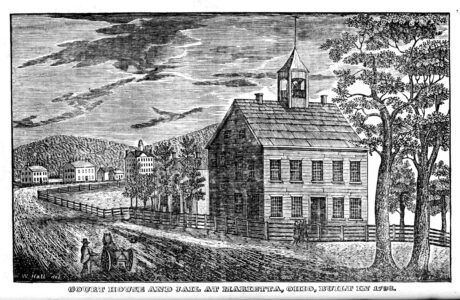
It would be eleven years later, in 1799, when the county's first court house and jail (as shown above) would be built. Griffin Greene was the architect, and together with Dudley Woodbridge, Marietta's first merchant, they served as the building committee. The two-story structure was erected on the corner of Putnam and Second Streets. Built substantially of double rows of poplar logs, it was about forty by forty-five feet, with walls three feet thick! The logs were neatly hewn and dovetailed at the corners of the building, and held together by heavy iron bolts. The lower story was divided into two rooms where the jailor and his family lived. A passage between the rooms led to the jail in the back of the building. Historian Dr. Samuel Hildreth in 1842 remembered it as one of the strongest prisons in the state, and "no prisoner had ever escaped from its cells, except from the carelessness of the jailor."
The upper story held the well-lit courtroom, with seven windows. It was warmed by two fireplaces. Two jury rooms were located over the jail. Adorning the very steep roof was a cupola in which hung a bell that was rung at nine o'clock morning and evening, and at noon, and it was also tolled on the death of any citizen.
Across from the jail stood the pillory, stocks, and whipping posts used for the punishment of criminals. It was said that curious crowds would gather around them while in use. Imagine walking down Putnam Street and seeing someone hanging in the stocks or being whipped in the center of town! Consider the poor unfortunate person who was on the receiving end of such discipline and public humiliation. By the time the new court house was built in 1823 at the same corner, on the northwest side, those old methods of punishment had ended.