
1924: Charles Dawes Elected V.P.
Trending
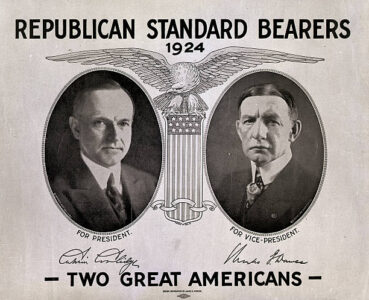
Turned off by the spiteful rhetoric in today's political discourse? Stressed by the twenty-four hour news cycle and social media rancor? Go back 100 years to the 1924 presidential campaign. A Marietta native, Charles Gates Dawes, was the running mate of Calvin Coolidge on the Republican ticket.
Dawes is the serious-looking one on the right in the photo. He grew up on Fourth St. in Marietta, the son of General Rufus Dawes and Mary Gates Dawes, and a descendent of William Dawes who rode with Paul Revere to warn colonists that "the British are coming."
1924: It was the roaring twenties. The economy was strong; there were no foreign policy crises. There were also no computers, cell phones, or television. Radio would soon become a boom industry. Locally, farming, brick making, furniture manufacturing, and the oil industry thrived. Trolleys and steamboats ran regular routes up and down the valleys. Shoppers packed the downtown area on weekends. Life was good; but it always seems that way when we look back in time.
Talk about qualifications for high public office: Charles G. Dawes was a graduate of Marietta College (what other qualification would you need?) and Cincinnati Law School, an executive with utility companies in Chicago, started a bank in Chicago, appointed Comptroller of the Currency, commissioned in the U. S. Army during World War I serving in leadership roles for logistics and attaining the rank of Brigadier General, and was budget director for President Warren G. Harding. All of this was intermingled with political activity, including an unsuccessful Senate run, mostly in campaign support for others. He was a co-recipient of the Nobel Peace Prize in 1925 for his role in helping plan the financing of Germany's World War I reparation debt.
Dawes and his wife endured the loss of their son Rufus at age 21 in a drowning accident. In his son's memory, Dawes built homeless shelters in Boston and Chicago and financed a dormitory building at his son's Alma mater Lawrenceville School in Lawrenceville, NJ.
The 1924 campaign had little of today's harsh rhetoric, though the Democratic Convention required over 100 ballots to finally select West Virginian John W. Davis for President and Charles W. Bryan for Vice President. Calvin Coolidge was a shoo-in for the Republicans, having been elevated to the Presidency in 1923 when Warren G. Harding died in office. The Coolidge-Dawes ticket won by a landslide.
Though Dawes was well qualified for office his actual performance in office was an embarrassment. He was bluntly outspoken on many issues, often inviting negative publicity – not the desired profile of a Vice President. One writer observed: "Dawes was criticized by many of Coolidge's opponents and was also resented by many of the President's allies." Once he allegedly overslept and missed a tie-breaking vote in the Senate, causing defeat of a Coolidge cabinet nominee. He was mocked and held in low regard by the press – despite his impressive public service record.
Dawes was predictably passed over as Herbert Hoover's running mate in 1928. Hoover appointed him as ambassador to Great Britain, a very prestigious assignment.
Charles G. Dawes was not only a successful businessman and dedicated public servant – he was also a talented musician. Dawes was a pianist, flutist, and composer. His composition Melody in A Major became well-known piano and violin piece in 1912. Later, lyrics were added, transforming it to the popular tune "It's All in the Game," which became a No. 1 Billboard hit.