
Trending
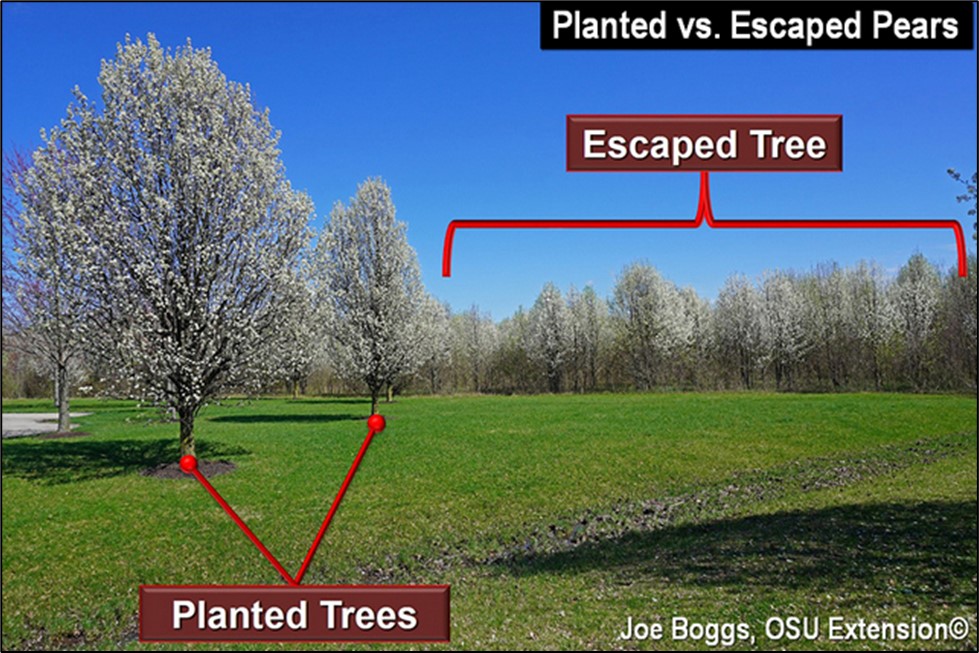
Uh, oh, something in our woodlot requires close inspection and perhaps corrective action. What are those trees displaying white blossoms so early in spring? My mind wanders to thoughts of the Callery pear, a tree and its cultivars illegal to sell, grow or plant in Ohio as of Jan. 1, 2023.
One of the first to identify the Callery pear as a truly invasive tree was University of Cincinnati professor Teresa Culley. Subsequently this tree spent five years on the state's invasive plants list until being declared illegal by Ohio, the first state to ban the tree. (For more information about the current list of invasive plants in Ohio, both the Ohio Department of Agriculture and the Ohio Department of Natural Resources websites provide such information.)
Like all invasive plants this tree negatively affects the ecosystem in a variety of ways. By competing with native plants, it destroys nutrient sources for other species such as songbirds because no caterpillars and nearly no other insects feed on Callery pears. This hardy tree can take over both forests and fields, often forming thickets. Its early flowering and leaf formation create shade leaving no understory and bare round thus choking out native plants like wildflowers.
The Callery pear, named after a missionary, is a native tree of China brought to North America in the early 1900's because of resistance to fire blight. Although described as sterile the tree began to cross pollinate and bear fruit. Additionally, cultivars – Bradford, Cleveland Select, Chanticleer, etc. – were planted widely from the 1960's to 1990's and favored by landscapers because of the tree's shape, flowering and fall color. Now this tree is found in vacant lots and other disturbed areas in large numbers because birds eat the fruit and disperse seeds. During spring the hills above Cincinnati reveal vast numbers of these trees in bloom and many Callery pears can be found throughout Washington County.
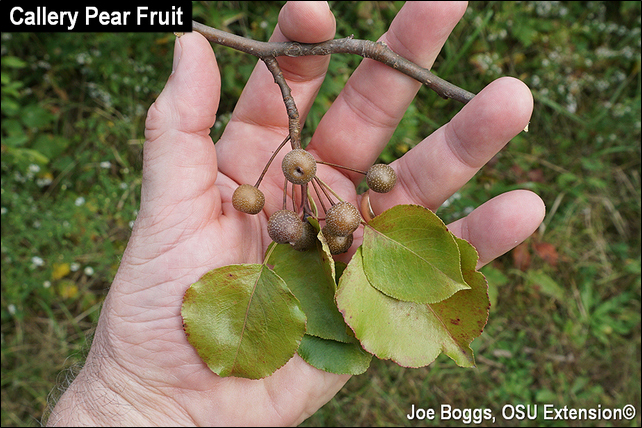
Features of the tree include alternately arranged thick and waxy leaves with toothed edges that display a bright red color during autumn. The tree has showy white flowers about ¾ inches across that grow in ball shaped clusters. However, the scent of the flowers is unpleasant and often compared to the smell of rotting fish. It bears small fruit. Young trees have smooth bark that matures to scaly ridges and shallow furrows. Sometimes trees have three-inch thorns.
Fortunately, there are many native trees to consider planting since this tree is no longer available. Some examples include serviceberry, Eastern redbud, flowering dogwood, and hawthorn among others as described in an OSU Extension article entitled "Alternatives to Callery Pear." Programs in some states like Missouri and North Carolina give landowners a free native tree after cutting down a Callery pear. Another OSU article entitled "Callery Pear: the Jekyll and Hide Tree" is both an educational and humorous source of information about this tree.
Though not required by the 2023 law, some landowners choose to destroy Callery pear trees; the ODNR recommends contacting a certified arborist about tree removal. Other management options may be found at the woodlandsteward.osu.edu website including:
*Controlling Undesirable Trees, Shrubs and Vines in Your Woodland (f-47-97 ID). This fact sheet describes woodland management techniques such as frilling, girdling, spaced cuts with tree injection, basal bark spraying and stump cutting.
*Herbicides Commonly Used for Controlling Undesirable Trees, Shrubs and Vines in Your Woodland. (f45_Supplemental-06). This fact sheet provides information about herbicides that can be used to destroy undesired trees, shrubs or plants including the Callery Pear.
About the Author:
Mary Marks became an OSU Extension Master Gardener shortly after moving to Marietta in 2010. Her gardening interests include planting native and perennial plants in her garden while reducing invasive plants from her property.