
Christmas Past
Trending
It's two weeks to Christmas. My wife's phone displays two notifications about gift orders from Amazon. It reminds me how different Christmas and gift giving is from decades past. Amazon, the second largest retailer in the world, is more well known than its namesake, the largest river in the world. Grandchildren's "Santa" lists, once scrawled on paper, are now text messages with direct on-line links to the items they want.
The settlers in Marietta's first years observed the holiday in low-key fashion – no Santa Claus, Christmas trees, gift giving, or excited children. Those customs were decades away. There were some church services and social events. Dr. Solomon Drown was in Marietta on December 25, 1788, and as noted in Hildreth's Pioneer History book, wrote: "It being Christmas, public worship was introduced by reading…in the Church Prayer Book. Gen'l Parsons read a sermon adapted to the occasion. Good singing." Dr. Drown also enjoyed a Christmas feast at Goodale's home: "A boiled dish, Turkey, beef and bacon, cabbage, turnips and potatoes, butter, etc…" Recreation activities like ball games, foot races, target shooting, hoop games, and dancing were popular. On December 15, 1788, there was a ball. It was the talk of the town. James Backus' journal: "…I went to the Ball….drank good wine & came home groggy." But for many people, Christmas was just another work day.
Fast forward a hundred or so years later. (Quotes are from Marietta newspapers at the historicalmarietta website.) Christmas was becoming more of a thing, thanks in part to awareness of English customs, and literature such as Dickens' "A Christmas Carol" and Clement Moore's popular "'Twas the Night Before Christmas" poem. December, 1893: Despite a severe nationwide depression, Marietta was largely spared. People were spending money on gifts: "Christmas spirit, (concern) for others, is manifest all about…shop windows and counters show the faith the merchants have in the Christmas time…"
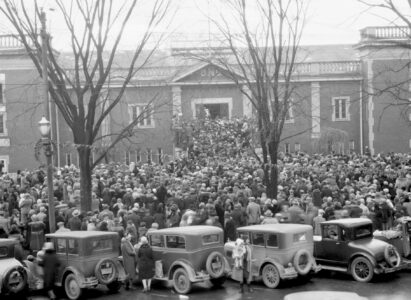
And there were big community events. On Christmas Day 1913, there was a "Christmas Sing" at the Court House. Despite "beastly" weather, 1,000 people attended. 1915: "Marietta will observe its third annual Municipal Christmas Tree Celebration,…hundreds of school children…have been practicing the songs for some time…" In 1916, there was another exciting community event: snow! Christmas Eve newspaper: "Remember the red sled that Santa Claus brought you years and years ago? Can't you just feel the thrill of it now? Today there is more than six inches of snow…and a genuine, old-fashioned white Christmas is assured." That same year, Christmas trees were said to be "plentiful" at prices around $.25; yes, that's 25 CENTS. Fresh cut trees this year cost $50-$100 or more.
At Christmas 1917, the United States entering World War I galvanized the nation – and Washington County. "Thousands of gifts have been sent to the men in General Pershing's Army" and at training bases. Gifts included "sweaters, warm flannels, military greatcoats, wrist watches, rubber boots, rubber ponchos, and fur-lined corduroy coats…and tobacco, candy, jams, jellies and marmalade and fruit cakes…" The Post Office that year reported record Christmas mailings: 50,000 cards and letters and 18,000 packages were sent out.
Christmas 1933: Local charities and the Salvation Army distributed 100 food baskets to needy families. There was greater need then during the Great Depression. Washington County Infirmary residents were served a "Belgian hare dinner... with all the trimmings." Belgian hare? It's a breed of domestic rabbit widely raised for show and for food from the late 1800s to 1930s. During the depression, such fare was a cheaper yet tasty option. Chat GBT says it was a "practical, affordable, and familiar food at the time" - so it must be true.
Merry Christmas!