
Explosion of ‘new and splendid’ steamboat kills 24
Trending
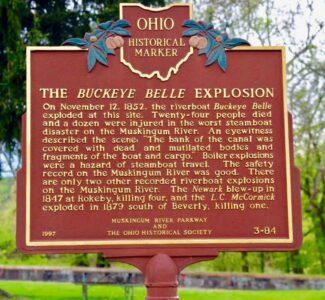
The steamboat BUCKEYE BELLE with about 40 passengers on board was torn apart in a spectacular boiler explosion on November 12, 1852, at Beverly, Ohio. Wreckage and human remains rained down on the surrounding area. It was a gruesome sight. 24 died; a dozen were injured. The BELLE was described as a "new and splendid sidewheeler" by the Pittsburgh Commercial Journal. She was launched from Knox Boatyard in Marietta in May 1952. The BELLE carried 8 passengers, mail, and freight between Marietta and Zanesville. I was fascinated by the varied aspects of the disaster.
The Devastation. Report excerpts from the Marietta Intelligencer provide chilling details: "…We do not suppose that in the whole history of steamboat explosions, record can be found of such utter destruction… as the Buckeye Belle. A piece of the boiler about five or six feet long was blown to the foot of the High Rock, on the hill. A man was thrown there also. Yesterday a tongue was found on the bank and elsewhere the head of a man…with a hat on it. A red-hot brick was thrown up the hill more than 300 feet and fired the leaves in the woods. A rabbit was killed by the fall of a brick, nearly 400 feet from the boat."
The Human Toll. An accident report stated that 24 died – 21 in the accident and three in the succeeding days. 12 were injured, some with permanent disabilities. Recovering human remains was traumatic for the many citizens who responded. Thirteen of the dead were unidentified. They were buried in the Beverly Cemetery. A plaque at the cemetery: "Here lie buried thirteen unknown persons killed by the bursting of the boilers of the Steamer Buckeye Belle on November 12, 1852."
Amazingly, there were survivors. Sixteen-year-old Pius Padgitt had just boarded when the explosion occurred. "I heard no sound, felt no shock, experienced no pain. When consciousness returned, I found myself (75 feet) forward on the bow of the boat…." He recalled hearing "…the most piercing, heart-rending cries and groans that ever fell upon mortal ear," sounds that haunted him years later. Women were spared serious injury; the cabin where they gathered had less damage. Charlotte Stone from McConnelsville calmed the ladies and kept them from jumping into the icy water. A wood stove started a fire; she calmly smothered it with a blanket.
News Coverage. News then was print media and personal correspondence only. Newspapers relied on eyewitnesses, such as reports from Beverly businessman Enoch McIntosh. Getting accurate information was difficult. Rumors and misinformation were rampant. On Nov. 13, the Intelligencer stated, "We have paid no attention (to) rumors but have given such facts as seemed to us ... well authenticated."
Accident Report. Coroner's Jury (convened when a cause of death was uncertain) served as the investigative body for the accident. Their report contains contradictions about the cause. It said that a specific cause could not be determined. Yet it stated there was "no doubt" that the second engineer was to blame by tampering with the safety valve to raise boiler pressure for more power and speed. Many steamboats were notorious for doing that, placing their vessel and passengers at risk, to gain more business.
More of the story. Surprisingly, the Buckeye Belle was rebuilt. It was again operating on the Ohio River in the spring of 1854. Another boiler explosion in 1857 ended its existence. A safe on board the BUCKEYE BELLE, rumored to contain a treasure trove of silver and gold, or cash, had disappeared. People searched for years. A fisherman found it 19 years later in 1871. It held nothing of value.