
Rosenthal captured the decisive moment of a generation
-
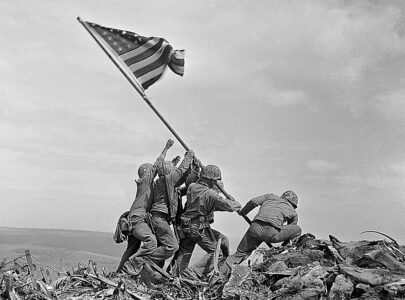
- (Photo provided) Joe Rosenthal’s Pulitzer-Prize winning photo of the flag raising on Iwo Jima was one of the most iconic photos from World War II.
-
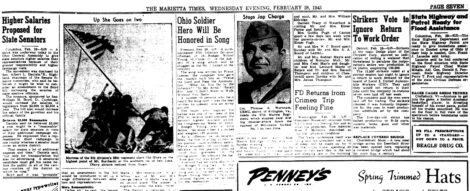
- (Photo provided) Joe Rosenthal’s photo as it appeared in The Marietta Times on Feb. 28, 1945.
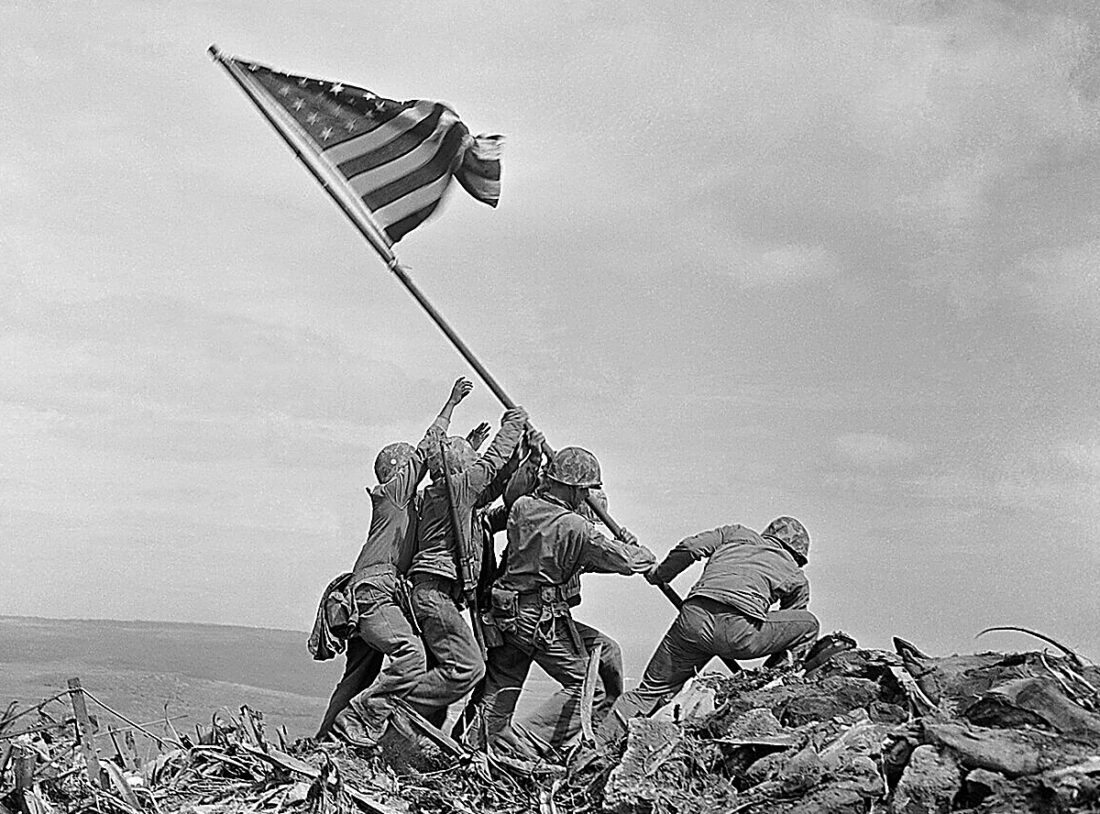
(Photo provided) Joe Rosenthal’s Pulitzer-Prize winning photo of the flag raising on Iwo Jima was one of the most iconic photos from World War II.
The Way I See It
By Art Smith
If you are a photographer, you always strive to capture the decisive moment. The one moment at an event that captures the essence of the story, wrapping up for all time that one sliver of time that tells the whole story. Still photography has a way of doing that.
Getting the decisive moment at a basketball game, a protest or a firework display is always the goal; it’s not always achieved. But when it is, it’s special.
Joe Rosenthal captured the decisive moment not only of an event, but for an entire war and for the generation that fought it.
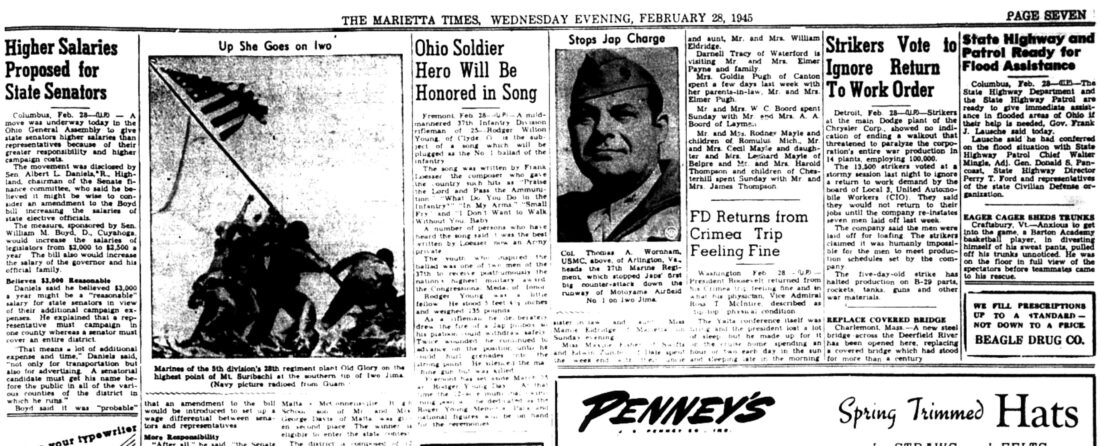
(Photo provided) Joe Rosenthal’s photo as it appeared in The Marietta Times on Feb. 28, 1945.
His photo of six Marines raising an American flag on top of Iwo Jima’s Mount Suribachi was taken following a successful invasion. How he got the photo, and how the photo quickly became a symbol of the war, is remarkable.
Rosenthal began working as a reporter-photographer in San Francisco in 1932. In 1944 he began working for the Associated Press following Army and Marine units as they made their way across the Pacific.
On Feb. 23, 1945, four days after the Marines had landed on Iwo Jima, he hitched a ride on a Marine landing craft to the island after he learned that a flag was being raised atop Mount Suribachi. With him he carried his Speed Graphic, a large press camera that was about the size of a large toaster. With lens, film and a tripod, it would have been a struggle to carry it up the mountain.
On the way up, he passed another photographer coming down the mountain who told him the flag was already up. Fortunately, he continued his climb because that was a smaller flag that was about to be replaced by a larger one.
Once on the summit, he started piling rocks to stand on. He was adjusting his camera settings (f/8-f/11,1/400th of a second) when out of the corner of his eye he saw six Marines start to raise the second flag. He got one frame off. The decisive moment.
He knew of course that he would never see the processed film, so he shot a few more frames to make sure he had something. One of those frames later caused confusion after he said he had the Marines posed for the photo. He meant the later one, not the iconic flag raising shot.
The photo soon took on a life of its own. The film was sent to Guam where it was printed and transmitted to New York where it was quickly sent out to newspapers all over the world. Just a few days after it was taken, it was on the pages of newspapers all over the country.
The Marietta Times ran the photo on page seven on Feb. 28. I personally would have run the photo on the front page. I’m sure the editor had a good reason not to run such an outstanding photo on the front page. For the life of me, I can’t figure out what that would be. The Parkersburg Sentinel ran the photo on the front page on the same day.
Sculptor Felix W. de Weldon was so moved by it that he quickly made a scale model that was the pattern used to make the large bronze statue that became the Marine Corps Monument in Arlington, Va.
The moment was also memorialized on war posters and stamps. The photo won the coveted Pulitzer Prize in 1945. The 2006 movie “Flags of Our Fathers” and 2000 book of the same name tell the story of the men that raised the flags.
Rosenthal would return to San Francisco and work as a photographer until 1981. When asked about the photo, Rosenthal would say “I took the picture; the Marines took Iwo Jima.”
Photographers strive to capture the decisive moment. Rosenthal captured a generation and then had it memorialized as one of the most recognized monuments in the world.
Art Smith is online manager of The Marietta Times and The Parkersburg News and Sentinel. He can be reached at asmith@newsandsentinel.com
Local Columns
Kidnapped!
God never intended for everyone to do what they see fit
By Mark Wilmoth Five hundred years before Christ, the city of Athens, Greece, birthed the world’s first known ...
Rosenthal captured the decisive moment of a generation
Get out of your comfort zone
Viewpoint Greg Kozera Friday evening in Istanbul, Turkey. The Shale Crescent USA Team was part of a U.S. ...
Each of us needs to be in the worship assembly
On September 7, 1995, Baltimore’s Cal Ripken broke Lou Gehrig’s previous Major League consecutive game record ...
Leaders change the world through action
When the Soviet Union overran and annexed Latvia back in 1940, the American Charge d’Affaires ad interim, John ...