Officials: Wood County Schools facing financial cliff
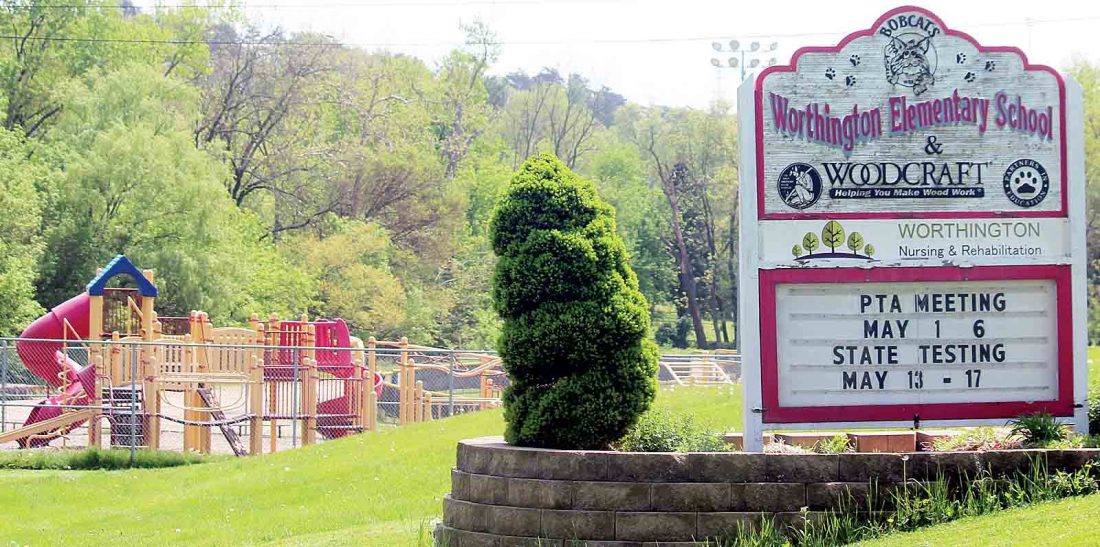
Worthington Elementary School, which was marked for closure and consolidation more than 10 years ago, will be among a handful of schools which the Wood County Board of Education will seek to close in the next year to avoid exhausting the district’s savings in mid 2020-21. (Photo by Michael Erb)
PARKERSBURG — Wood County Schools will exhaust its savings in less than two years if no changes are made to facilities and personnel, officials said Monday.
Administrators and board of education members say they plan to close and consolidate some of the district’s 27 schools within the next 14 months to avoid a financial disaster.
The announcement comes after a day-long budget work session Saturday in which the Wood County Board of Education looked at the effects of increasing costs and decreasing student enrollment.
Wood County Board of Education President Rick Olcott and Superintendent Will Hosaflook said the school system has seen its enrollment drop by 476 students since 2017 and has lost more than 1,300 students in the past seven years. The rate of student enrollment loss has increased every year since 2015.
With those students go state per-pupil funding. At the same time, the amount of staff has steadily increased each year, and the school system continues to operate 19 elementary schools, five middle schools and three high schools, in addition to numerous other facilities, each with their own administrators, teachers and service personnel.
Finance Director Whitni Kines said growth in the area’s tax base has allowed the levy to keep pace and cover some of the gap between state funding and the additional costs, and some one-time funding sources, such as grants or collection of back taxes, has allowed the district to keep its finances even for the current fiscal year.
However, that money will no longer be available, and Kines said recent across-the-board pay increases approved by or still being considered by the state Legislature have dramatically increased the cost of those days and positions not covered under the state aid formula.
Olcott said state funding also only applies to those contracts which are 200 days or less. About 420 of the school system’s 1,600 employees have contracts greater than 200 days or are not in positions reimbursed by the state. Those additional days and positions are paid for through local funds, either by the district’s excess levy or out of the school system’s general fund. In 2019, the cost of those positions jumped by nearly $2.4 million, due to state pay increases. A recent Reduction-in-Force, or RIF, is expected to save the district only about $300,000.
Kines said the school system has about $6 million in a carryover/contingency fund, but about half that amount will be used in operations during the 2019-20 school year. By the middle of the 2020-21 school year, that fund will be depleted, she said.
“It’s the perfect storm, and it has led us to this financial cliff,” Olcott said.
State law allows the district to operate at a deficit for one year provided the school system has been granted permission by the state ahead of time and has created a plan to get out of the deficit. If a school system fails to comply, it can have its spending frozen and be taken over by the state.
Hosaflook said consolidating schools and closing buildings is the only way to avoid that scenario. Officials hope to hold public hearings in September and have all decisions finalized and voted on by December.
“This is something we can do right now,” he said. “We can deal with this situation right now.”
Officials said while a consolidation plan will be announced at the board’s May 29 meeting, two schools already are on that list: Worthington Elementary and Waverly Elementary.
Olcott said Worthington has been slated for closure for more than 10 years now and that closure was part of the district’s most recent Comprehensive Education Facilities Plan, or CEFP. A new 10-year CEFP is being developed to begin in 2020 and also will include closing Worthington.
Waverly was part of a consolidation plan with Williamstown Elementary School, but was kept open after community and board members argued its closure was not spelled out in a bond call to build a new Williamstown-Waverly area elementary.
Olcott said because the school was named as part of the new school and because the new elementary was designed specifically to house the number of students from the combined Waverly and Williamstown schools, officials believe it was part of the bond call.
Board member Ron Tice opposed the closing and consolidation of Waverly Elementary in 2017, but at the time said it was an issue which would have to be addressed at some point. Tice said that time is now.
“Our finances right now are in bad shape,” he said Tuesday. “The reason is because we’re still operating with the same amount of faculty and staff and support services as if we still had the same amount of students. We’re going to have to downsize our system to match that need.”
Tice said the board cannot allow the school system to spend itself into a hole.
“You can’t operate a business on a zero or negative cash fund. If we don’t do something in the next couple years, we’re not going to be able to operate,” he said. “We’re going to have to make some really tough decisions to be able to survive.”
Board member Rick Tennant, who also voted against the closing of Waverly in 2017, said he has not yet made any decisions about any schools.
“I know we’ve got to right-size because of declining enrollment, and we do have some old buildings. I know sometime soon we’re going to have to talk about the CEFP,” he said Tuesday. “I think we need to take a look at the numbers. I want to get all of the information and go from there.”
Board member Justin Raber said in the past the school board has been too slow to adapt to the changing needs of the school system.
“We cannot operate in 2019 as if we still have the number of students we had in 2005,” he said.
Raber said part of that process will require some difficult decisions which have been put off in the past.
“In my opinion, we have not followed our current CEFP that has been in place the past decade,” he said. Worthington should have closed, and our bond call states that Waverly has to close, and I think we need to follow the will of our voters.
“We need to decide where can our financial resources best be deployed for all of our students. I truly believe we have the leadership within the BOE as well as the superintendent’s office to affect excellent change for our community.”
Board member Debbie Hendershot could not be reached for comment Tuesday.
Local News

Local donor makes $300K gift to Harmar Bridge project
Three candidates vie for two Williamstown council seats
WILLIAMSTOWN – With three candidates on the ballot for two seats, the race for Williamstown City Council will ...

Wood Commission and Union Williams PSD discuss their future
Wood County BOE candidates outline priorities ahead of election
PARKERSBURG – Voters in Wood County will choose from among nine candidates in this year’s Wood County Board of ...
Butler appointed to OhioSE Development Board of Directors
Ohio Southeast Economic Development (OhioSE) announces the appointment of Craig W. Butler to its Board of ...