
Marietta D-Day survivor was part of Ghost Army
Trending
A long-time Marietta resident had a special role in the events around the D-Day invasion of France on June 6, 1944.
Delbert Weber, who turned 99 on May 15 and now lives at Elmcroft of Marietta, was a staff sergeant in the Army as part of the 603rd Engineer Division, 23rd Headquarters Special Forces.
“We were known as the Ghost Army,” he explained. “Say the 82nd tank division was here, but we wanted the Germans to think they were over here. The tank division would pull out in the middle of the night and we pull in in the middle of the night. We’d set up dummy tanks, add flash powder, add noise and amplifier booms. We were top secret. We carried no ID.”
He said he didn’t sign up for the Ghost Army, as his division “first went in as the camouflage division. We set up camouflage artillery, but they didn’t need us for that,” he added.
He said the Ghost Army would go in and set up inflatable rubber tanks that looked realistic, with a big boom amplifier that made noise and flash powder.
“It was very real,” he said.
The Ghost Army was kept secret for more than 40 years and was finally declassified in 1996.
Weber clearly remembers D-Day from his division’s placement in France.
During what has become known as the largest amphibious military operation in history, D-Day, the Allies invaded beaches in northern France, with American forces at Utah and Omaha beaches, and British and Canadian forces at Juno, Sword and Gold beaches.
By the end of the day, more than 155,000 Allied troops had taken the beaches and could push inland. The northern part of France would be free within three months but more than 4,000 Allied soldiers died in the invasion.
“I remember seeing all the airplanes going over, making a circle, dropping bombs,” he said. “I saw the bombs come out from the bottom of the airplane, they wiggled and then all the sudden straightened out.”
He also remembers seeing the battleships shooting their guns.
“First you’d see the black smoke, then you’d hear the sound, then you’d see the ship move,” he recalled.
Although he didn’t have to hit the beach on D-Day, he was waiting offshore near Omaha Beach.
His time in the Army was up at the end of the war.
“I was one of the first ones home,” he said. “I was getting outfitted for Japan, but I had enough points to be discharged right away. I was discharged on Armistice Day, Nov. 11.”
His stint in the Army started when he was drafted at age “25 or 26” for boot camp at Fort Meade, Md. He then went to Tullahoma, Tenn., for more training.
“I was a supply sergeant for the headquarters company and the battalion,” he said.
Weber isn’t allowed to talk about most of what he did as part of the Ghost Army, but there was a story of a mission he has told to only a couple of people. He wasn’t even able to tell his wife of more than 74 years, Berneda Walters Weber.
“The captain was always sending me on missions,” he said. “So he said we were getting ready to go to Metz, Germany. The captain said, you take that truck there and go get some gasoline. Meet me in Metz at the railroad station.”
At the time, Weber was stationed in France, although he doesn’t remember the exact location.
He took off to get gasoline, not knowing that General George Patton had been in Metz and had to pull back because he ran out of gas.
“I’m getting my gasoline and pulled into an open field and they are landing on steel strips and unloading from an airplane into trucks,” he said.
The sergeant in charge told Weber he could have 200 gallons of gas and he had to go to the coast, which was about 200 miles away. Weber didn’t have maps of the area or food, only a canteen of water, rifle and helmet.
He knew he needed more gas than that, but he was refused.
“So I put another zero behind the two others, so now I had 2,000 gallons,” he said with a laugh.
He pulled up the airplane and they gave him 2,000 gallons of gas in 5-gallon cans.
He headed to Metz and saw two guys step out from the middle of the road. He was told Patton had pulled out from the town.
When he finally got to town and heard news of his division, he was told they had been diverted to Luxembourg. His was the last truck in the convoy from headquarters to pull into the Luxembourg area.
“My captain never expected to see me again,” Weber said.
Although many in the military brought home souvenirs from their time in the war, Weber brought home very little - only a battalion flag and a couple of small items.
Outside of his time in the Army, Weber and his wife, Berneda, had three sons, Charles, William and David, along with several grandchildren and great-grandchildren. Weber’s wife and son David are now deceased.
Along with being born and raised in Marietta, Weber is a 1938 graduate of Marietta High School. His twin brother, Albert, died about 10 years ago, but was also in the Army, serving in the South Pacific.
When Weber came home from the army, he got calls from Remington Rand every day to come to work there. He finally said yes and worked for the company, now known as Kardex, for 40 years.
He said there was an odd coincidence regarding his father’s time in the military.
“Something that I thought was very strange was that I was in the 603rd engineering division and my dad was in World War I in the 603rd engineers. The same outfit,” Weber said. “A lot he did, he never talked about. A lot he did, I do not know.”
Nowadays, Weber spends his days at Elmcroft, where he enjoys talking with other former members of the military.
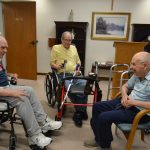
John James, 82, John Spear, 90, and Weber eat meals together every day. James spent seven years in the Army reserve, while Spear was in the U.S. Marine Corps during the Korean conflict.
“Mostly we just lie to each other,” said Spear about their mealtimes.
“We very seldom talk about the war,” Weber added.
Aubrey Henry, 20, a resident care assistant from Columbus, has known Weber for four years.
“He’s so honest and caring,” she said. “He cares so much about his friends. He’s hilarious. He’s a very funny guy.”
She said she’s impressed that Weber loves all the staff and takes the time to learn their names.
“He’s so independent for his age,” she added. “The only time he’ll call us is when he needs to turn off the light or open a pill bottle.”
D-Day at a glance:
• More than 4,000 Allied soldiers died in the June 6, 1944, invasion. Most of them were younger than 20 years old.
• D-Day is the day Allied forces launched the largest amphibious invasion in the history of warfare on the beaches of Normandy, France.
• The U.S. Department of Veterans Affairs estimated that fewer than 3 percent of the 16 million Americans who served during the war are still living.
• Following D-Day, the battles around Normandy continued for three months until Allied troops liberated Paris from Nazi control.
Source: Times research.