
No home, no easy answers
Homeless camps popping up in Marietta
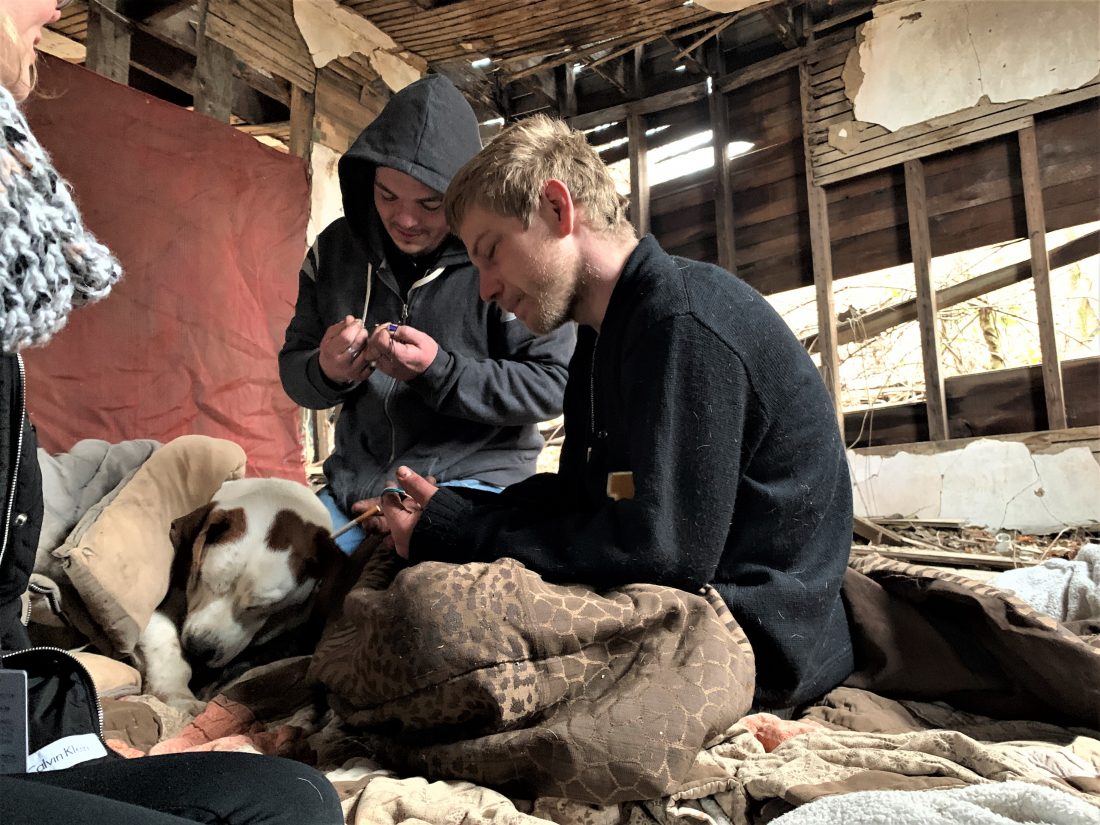
Photo by Janelle Patterson Jason Myers, left, and Dustin Myers, try to keep warm while living without full shelter in Marietta.
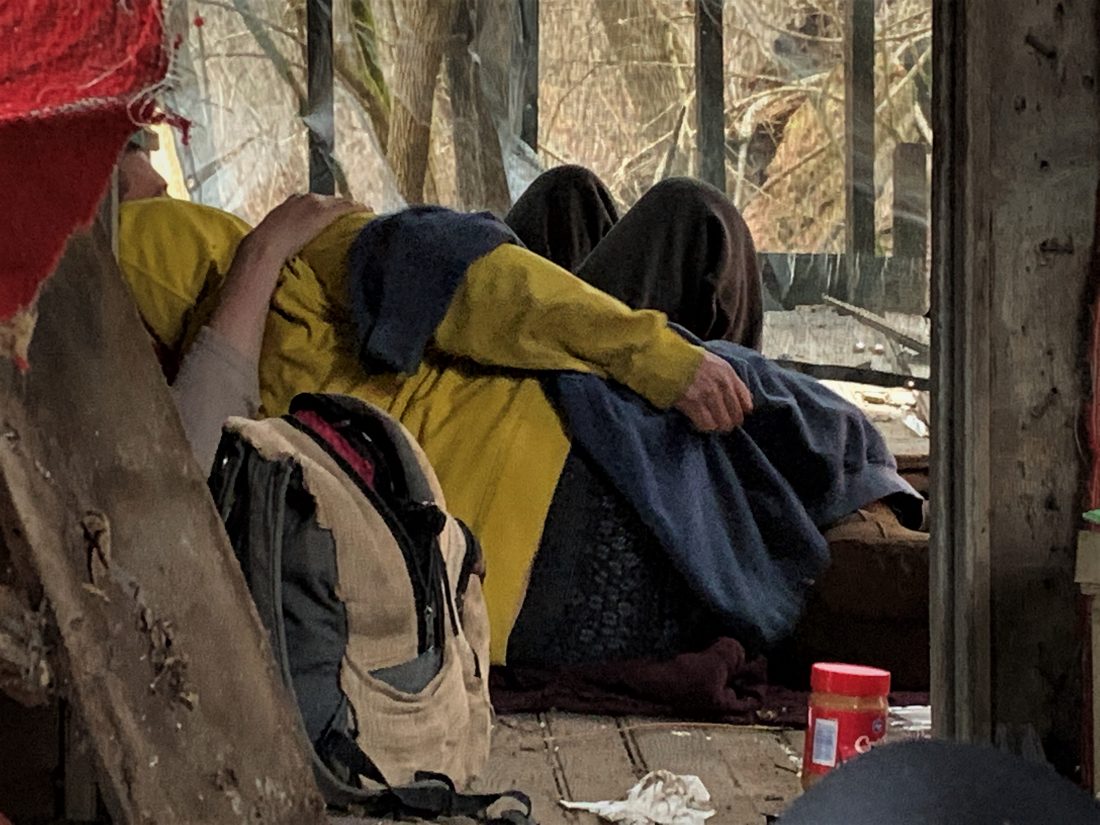
Photo by Janelle Patterson Iesha McFadden, front, and Victor Wittekind, try to stay warm Monday between broken walls in a forest in Marietta.
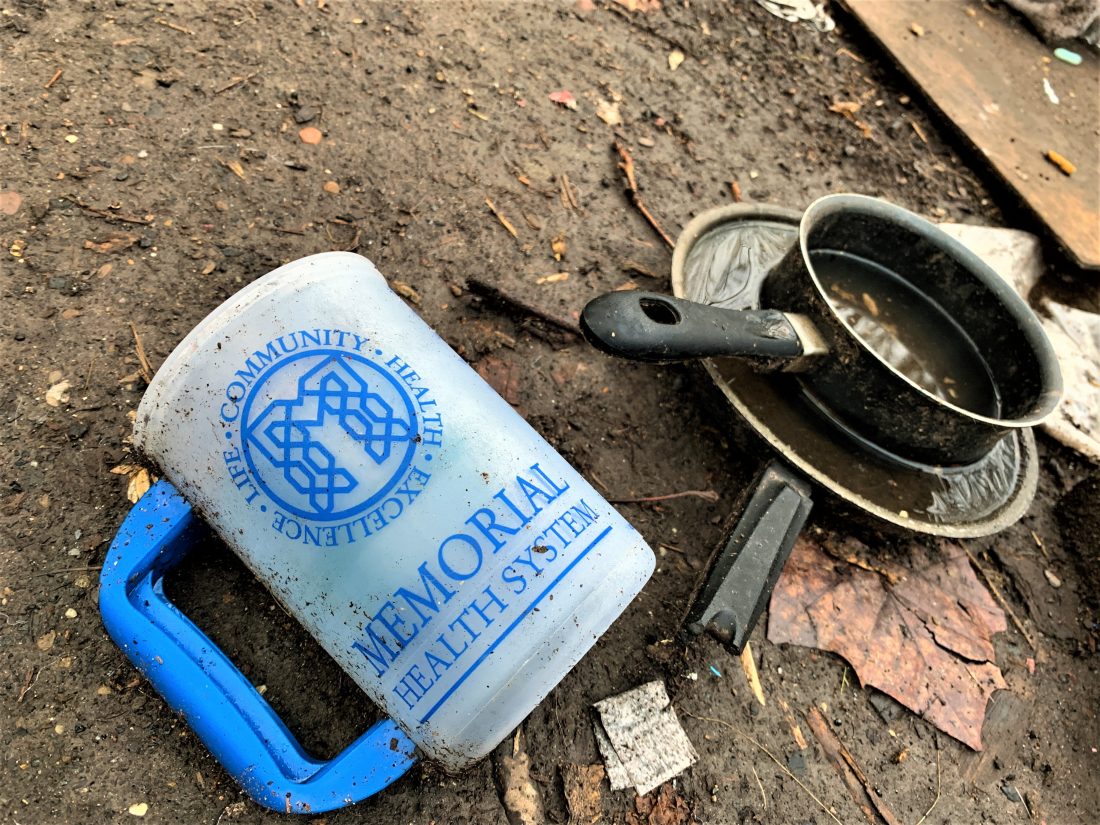
Photo by Janelle Patterson At an abandoned railroad track homeless camp, remnants of outdoor cooking rest in the mud this week in Marietta.
Photo by Janelle Patterson Jason Myers, left, and Dustin Myers, try to keep warm while living without full shelter in Marietta.
Photo by Janelle Patterson Iesha McFadden, front, and Victor Wittekind, try to stay warm Monday between broken walls in a forest in Marietta.
Photo by Janelle Patterson At an abandoned railroad track homeless camp, remnants of outdoor cooking rest in the mud this week in Marietta.
Trending
After a trip for a weekly hot meal at the Daily Bread Kitchen Wednesday, four adults returned “home” to the woods near a railroad in Marietta.
Home this week consists of broken lath, tarps and sagging floors collapsing under their own weight.
“This place is basically some plaster with the tree holding it up,” described Jason Myers, 35.
Their dog, Scooby-Doo, and their white cat snuggled between what blankets they’ve managed to keep dry from recent rains.
But there’s no address for their encampment on the west side.
The structure, according to tax records, should have been razed by 1997.
County tax maps show ownership is a gray area-- sandwiched between forfeited lands to the state and state right of way on a hillside.
It’s one of more than half a dozen such camps occupied by homeless in the city. They are attracting regular calls to law enforcement, with no easy answers on how to find shelter for those living there, and often the people are forced to move from one camping spot to another to another.
“Last night, I went back to get some more of our stuff from up by the tracks and over on the other hill where we were before,” said Dustin Myers, 27. “The Salvation Army said they can get us some transportation and a voucher to do some laundry, so I want to get all of our stuff really collected. I don’t expect anyone to do my laundry for me.”
On Wednesday, their new home was again visited by a familiar sight, a Marietta police officer.
The visit was prompted by another call from citizens who have concerns over squatting.
“We have had phone complaints with people asking if they can be one place or another,” explained Marietta Police Capt. Aaron Nedeff. “If we get a call, we go to see what’s going on.”
Without a direct complainant of trespass though, those visits are more of a wellness check, he said.
But when Marietta police visited one encampment next to CSX railroad tracks on Jan. 15, they were there following receipt of a formal letter from CSX asking for enforcement of trespass law.
“We gave them 24 hours to move on to another spot,” Nedeff described. “I went the second day and there were four or five people still there in the process of packing up.”
No arrests were made, Nedeff, Dustin and Jason all confirmed, but the group was told to move on.
After the Jan. 16 interaction, the next time Dustin and Jason talked with Marietta police was this past weekend.
“They didn’t say they were going to arrest us but that the property owner could call for trespass,” described Justin.
Nedeff said the call was logged on Saturday.
Then Wednesday, in a new location, Marietta Police were again dispatched and talked with Iesha McFadden, 23, and Victor Wittekind, on their way back from the bread kitchen held in the Knights of Columbus Hall on Franklin Street.
The group wasn’t asked to move on, given the gray area of ownership.
But city and county law enforcement aren’t the only ones paying attention to the consistent movement of local homeless residents in Washington County.
Washington-Morgan Community Action officials are planning a documentation run to eight separate camps throughout the city to try and account for which individuals are out in the cold.
Census committee members are talking in different public meetings about how to count those both on couches and in tents on April 1.
But Beth Casto, a public health nurse with the Marietta-Belpre Health Department, isn’t focused so much on the numbers, as the faces behind them.
“It’s in my heart, it’s right and that’s what I’m doing,” she said Wednesday.
Casto checked up on the group Monday after meeting them on Jan. 18 to administer Hepatitis A and B shots and the influenza vaccine at Flanders Field.
“That was the first time I had met them, we brought soup and bread, too,” she said.
Casto said she hopes to serve as a hand up to shelter, intending to connect a Washington-Morgan Community Action caseworker with those she serves.
But officials at Washington-Morgan Community Action Tuesday said “rapid” rehousing on average takes 60 to 90 days to move someone from a forest tent, shanty or tarp to a location with running water, a roof and heat.
“I think there’s a misconception where people think we just have units ready to receive someone,” said Jessica Stanley, quality control services specialist.
The best-case scenario depends on multiple appointments, scoring and availability of an apartment for placement.
“You absolutely score higher if you’re living in a tent, you’re literally homeless,” said Washington-Morgan Community Action Executive Director David Brightbill. “But that scoring is all regulated by the state and (federal government), not us.”
“If you’re a veteran, there are more resources in the interim to get you a hotel room or something here in the community,” added Carrie McNamee, director of senior and community services for Community Action.
For those living outside, 60 to 90 days is a daunting prospect, and requires help from people of authority, whom they’re not willing to trust outright.
“We would be willing (to meet a community action caseworker),” Jason reiterated Wednesday. “But what’s that going to do? We’ve applied for homeless prevention through them before and for rapid re-housing… How do we know they won’t just lose our application?”
The group has talked with Casto and with Councilman Geoff Schenkel, admitting that they actively struggle with drug addiction.
“I went down that path, I got addicted to heroin,” said Dustin Monday, when Casto visited. “But I did learn something in rehab last year, and this here, living here, is better than being inside another house that’s raided for drugs. I want to stay off it.”
“It’s not the first thing we think of in the morning,” added Jason on Wednesday. “Our first priorities are getting warm, getting water and figuring out if we can eat today.”
Marietta police said Wednesday said they’re not sure what more they can do, without a place to send homeless for the night in Washington County.
Schenkel wondered whether the neighborhood can instead partner with local church groups to set up temporary locations where those living without an address can be allowed to exist.
“I still see people who are trying to work towards some sort of resolution, I still see people trying to be decent,” he said. “What’s stopping us from setting up a campsite… maybe even just set up temporarily. Find a church to round up volunteers to help supervise overnight. Station a city cop, a deputy or a state highway patrolman each night (between) 9 p.m. and 6 a.m. with their overtime paid by a (charitable) contribution and have them present for safety and maintaining order.”
Schenkel said as chairman of Marietta City Council’s Planning, Zoning, Annexation and Housing Committee, provisions within residential zoning are where his next round of research lies.
“But that doesn’t bring you guys in from the cold tonight,” he told the group this week. “It hurts not to have that answer for you.”
Janelle Patterson can be reached at jpatterson@mariettatimes.com.
At a glance:
• The 2019 estimate of homeless residents in Washington County equaled 25 individuals.
• But this year, homeless residents of the west side of Marietta were not included in the geographic boundary counted by the Point-In-Time count on Jan. 21.
• Local agencies and private organizations are instead looking to how to both document and aid homeless residents in the unmet need of overnight shelter.
Source: Times research.