Local residents reflect on Kent State shootings 50 years later
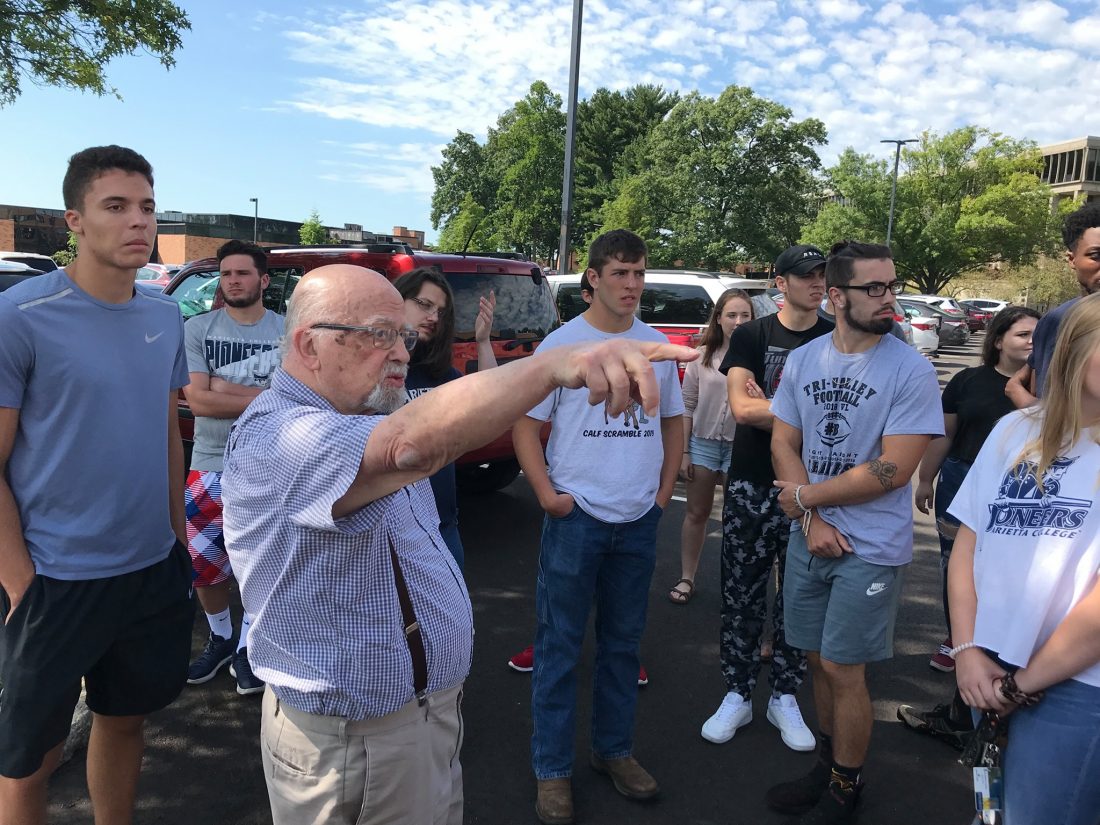
Photo courtesy of Matt Young Dr. Jerry Lewis, retired Kent State University professor, describes his experiences on May 4, 1970, to Marietta College students during a private tour in the fall of 2019. The students and professor stand in the parking lot on the Kent State campus where several students were killed or wounded. Lewis was one of the faculty members who played an instrumental role in convincing students that further demonstrations would only lead to more bloodshed.
This week marks the 50th anniversary of a defining moment for the state and the nation, but for one local resident, watching the virtual commemoration of that moment–during his graduating year– is too painful to complete.
“I’m also a Vietnam vet and have seen horrible stuff there, but this trauma of Kent State is a pretty emotional thing for me,” said Bill Reynolds, known locally as a historian for the Campus Martius Museum. “Emotions are something that humans have that you can’t deny or repress. You can’t deny that Kent State is a trauma that’s there.”
Monday marked the 50th anniversary of when four Kent State University students were fatally shot and nine injured by gunfire from members of the Ohio National Guard. The university posted a commemorative production online.
The powder keg in Portage County was primed for that fateful day by many contributing factors over the course of months and days leading up to the deaths of Jeffrey Miller, Allison Krause, William Schroeder and Sandra Scheur, explained Dr. Matthew Young, history professor at Marietta College.
“You look at what happened in Kent as kind of a perfect storm of one wrong thing after another,” said Young. “The decision to send the (National Guard) to campus was after guard presence in town with protests and bars closed and after the ROTC building on campus had been burned down over the weekend. But that decision wasn’t communicated clearly to campus leaders.”
And a second anti-war protest that had already been scheduled on campus began gathering students in the hour before its official start at noon on May 4, 1970.
“But students hadn’t been informed about the institution of martial law,” explained Young.
Reynolds said after the Friday protests turned violent downtown, he left campus.
“After the disturbance downtown on Friday evening we decided to go to New Jersey for the weekend,” described Reynolds. “While we were in Jersey Monday afternoon the newspaper caught up with us…I don’t know how they found us but they let us know what happened and asked us some questions.”
And returning to campus, he said, was surreal, including detention in Ravenna on the way home and the cancellation of most classwork for the remainder of the school year.
“What they teach you at Kent State nowadays is conflict resolution and how do you avoid situations like this. How do you speak out when you see something that’s completely and totally wrong,” said Reynolds. “How to be an active force in creating peace and justice is a particularly important lesson to me 50 years later considering the climate of our country right now. We are in a very important turning point in the way we govern ourselves, a turning point where we may lose our freedom of speech, our First Amendment rights, which is what happened at Kent State.”
Reynolds said reading news over the weekend of the protests outside of Ohio Department of Health Director Amy Acton’s house with armed individuals pacing was deeply disturbing.
“When the governor says we want you to wear a mask to we can get through this and people stand outside Amy Acton’s house with guns, for Pete’s sakes, you’ve got be kidding me,” said Reynolds. “Yes, it’s a First Amendment right to protest, but that crosses a line.”
Ohio Gov. Mike DeWine also criticized the actions during daily state COVID-19 press conference.
“I set the policy, so when you don’t like the policy you can demonstrate against me. That is certainly fair game,” said DeWine. “But to bother the family of Dr. Acton, I don’t think that’s fair game. I don’t think it’s right. I don’t think it’s necessary.”
In response to the protests outside of Acton’s central Ohio home Saturday, health care workers stood outside the capitol building in Columbus on Sunday in support of the safety measures instituted by the state.
“It’s critically important to try and avoid those same mistakes, as a historian for 46 years I can tell you that people don’t really learn much from the lessons of history,” said Reynolds. “But out of everything bad, good lessons can be learned.”
Both Reynolds and Young compared the rising tensions and feelings of unrest 50 years ago to those felt at present.
Both referred to the following days of protests across the nation on college campuses five decades ago.
“Are we next? That was a feeling students felt across the country,” said Reynolds. “As one of the stones says on campus, learn what happened, live what happened and teach so we can prevent it from happening again.”
Young noted that the Marietta College bookstore was burned down a few days later and students of the college from that time still remember the tension surrounding that event.
“One of the individuals who was a student here commented on my history department post on Facebook with a photo of that fire, like the burning of the ROTC building at Kent State,” said Young.
Young also took students to visit the university last fall with fellow professor David Torbett.
“Taking students there was a really great experience,” said Young. “They met one of the professors that had been there at the time of the shooting who agreed to give us a tour and who told us about his experience.”
Young said for younger generations it’s hard, especially for those who have grown up in a post-9/11 environment, to imagine such a divide against armed conflict.
“You see themes repeat themselves, there are similarities. It’s odd looking back on this 50 years later, but of course, there are significant differences, too,” Young reflected. “I do think we can look at events like Kent State and ask how can we do better, how can we not get to that point. Let’s realize this is what we are capable of, and not continue down that path.”
Janelle Patterson may be reached at jpatterson@mariettatimes.com.
Timeline:
– April 30, 1970: U.S. President Richard Nixon authorizes the invasion of the neutral nation of Cambodia, west of Vietnam.
– May 1, 1970: Protests begin at Kent State University against the war effort on campus and in downtown Kent.
– That night, violent clashes break out between students and law enforcement.
– May 2, 1970: Kent State University ROTC building burns.
– May 3, 1970: Martial law in effect, but the campus is quiet. National Guardsmen still present.
– May 4, 1970:
– Protest scheduled for noon begins gathering some 3,000 people at 11 a.m.
– After demonstrators refuse to disperse, 100 National Guardsmen begin marching across the college commons.
– Tear gas and rocks are exchanged through the air.
– Guardsmen retreat up Blanket Hill.
– At 12:24 p.m., just after reaching the top of the hill, the guardsmen turn back and fire.
– In 13 seconds, between 61 and 67 shots are sent from M1 rifles and pistols.
– Jeffrey Miller, Allison Krause, William Schroeder and Sandra Scheur are killed, and nine other students are injured.
– May 4, 2020: Marks the 50th anniversary of the shooting.
* View the university’s commemorative production online: https://youtu.be/njfZQG0g–jw
Source: Times research.
Local News
Rotating exhibit space aims to accelerate learning at Discovery World
Marietta Trolley returns May 2 for 2026 tour season
Mid-Ohio Valley Career Connect Job Fair set for April 8
Parkersburg mayor offers way for petitioners to remove signatures
PARKERSBURG — As a committee seeking to repeal or place on the ballot an ordinance authorizing a trash service ...

Backers urge Ohio lawmakers to require absentee voters to mail in copy of ID