
Attendees reflect on Marietta demonstration
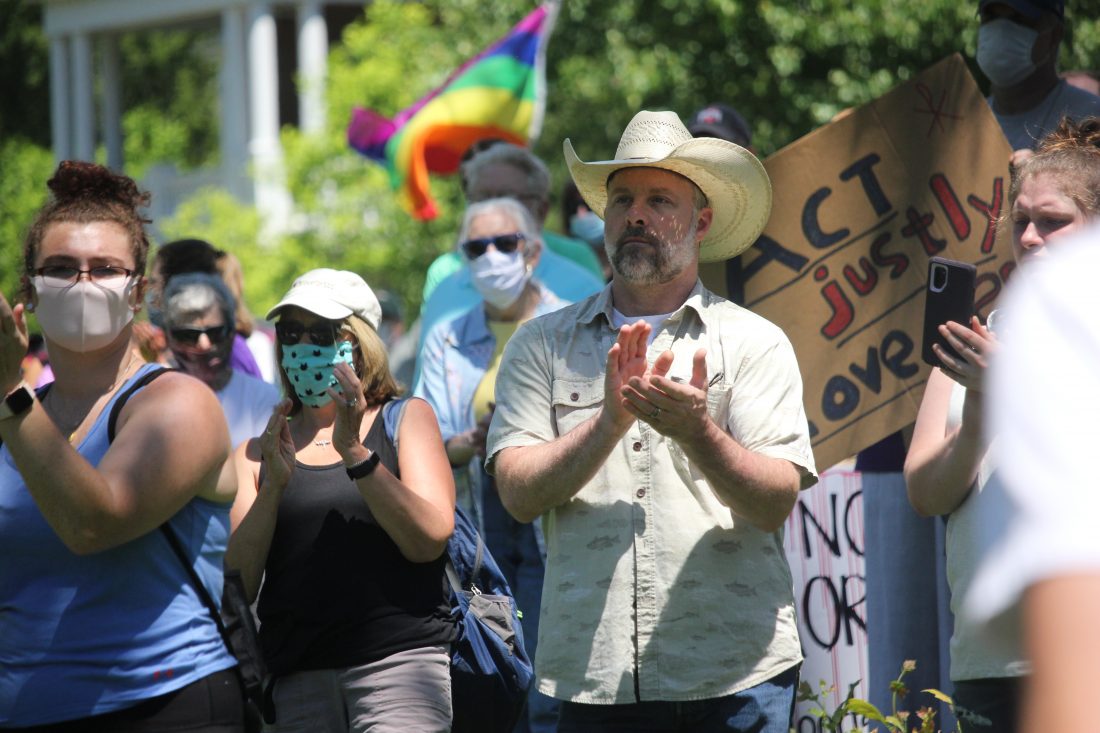
Photo by Janelle Patterson Bill Gossett claps during a speech on Sunday in East Muskingum Park calling out social injustice and racial profiling.
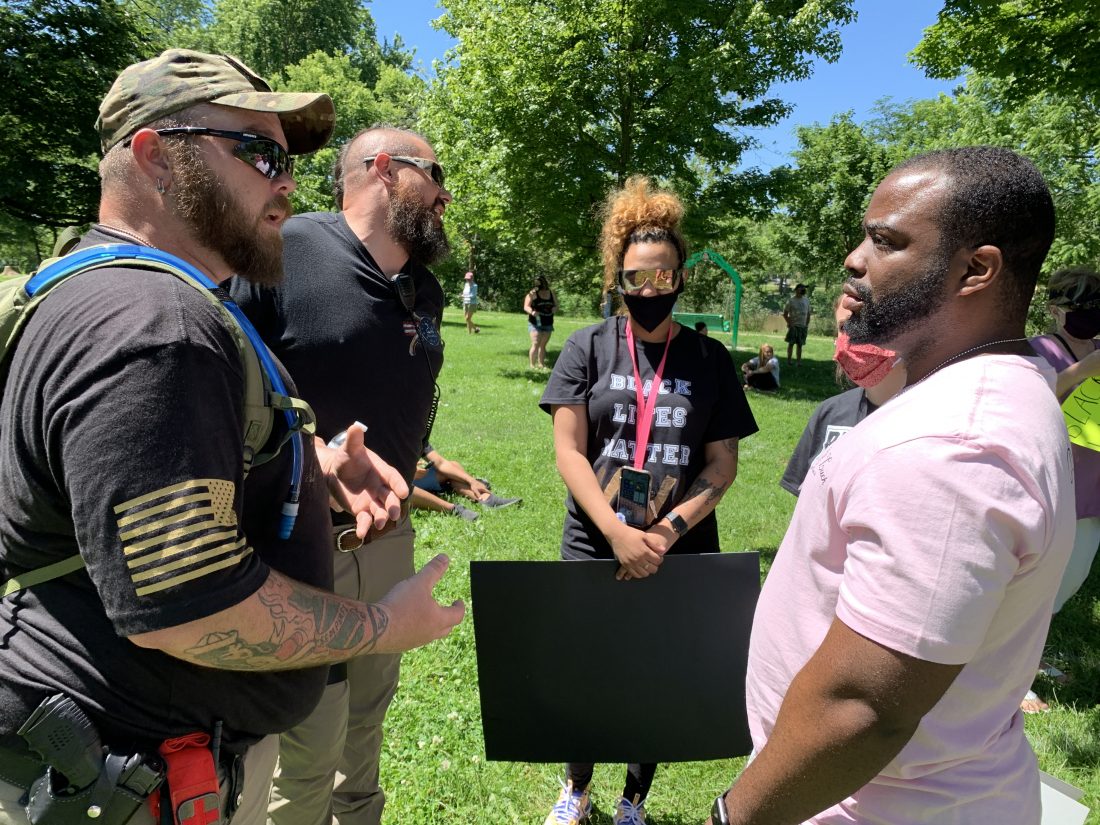
Photo by Janelle Patterson From left to right, Skylar Steward, of Marietta, and Robert Hal, of Athens, introduce themselves to Dante and Haylee Sherman, of Cleveland, before the opening of the peaceful demonstration against racism in East Muskingum Park Sunday.
Photo by Janelle Patterson Bill Gossett claps during a speech on Sunday in East Muskingum Park calling out social injustice and racial profiling.
Photo by Janelle Patterson From left to right, Skylar Steward, of Marietta, and Robert Hal, of Athens, introduce themselves to Dante and Haylee Sherman, of Cleveland, before the opening of the peaceful demonstration against racism in East Muskingum Park Sunday.
Trending
Conversations have continued over meals, social media and via phone calls this week following the peaceful demonstration offering people of color an opportunity to share their experiences with racism and mixed-race relations in Marietta Sunday.
Some took to Facebook to question why some arrived at the public park in Marietta with visible guns, while others have turned to literature and sermons to reflect on their own privilege and actions. Many say they hope the discussions continue after much of the United States and protestors in other countries have taken to the streets to call out excessive police force, racial profiling and social injustices since the death of George Floyd in Minneapolis.
Dante Sherman, 31, of Cleveland, was one of the speakers Sunday, who shared how his “white family” in Marietta have not only witnessed the effects of racism in his life when he attended Marietta College and as he’s visited after graduation, but also have taught him about goodness.
“For me, Sunday was beautiful optimism,” said Sherman. “But when I walked away from Sunday, I left feeling like I hadn’t done enough, that it took me too long to speak up. I’d challenge all of my black brothers and sisters that haven’t yet taken that scary step onto the front lines of fighting for social justice to look at what you can do on the large and small scales. I came back home and I know I can’t go back to life before Sunday.”
Sherman said impactful moments included approaching East Muskingum Park via the River Trail and initially feeling uneasy seeing members of the Three-Percent Ohio Patriots private militia armed and in the park.
There was a different kind of impact that came from holding hands in prayer in a sea of more than 1,000 people, the majority of whom were white..
“I owe it to all the people who came to hear and be vulnerable Sunday to not let up, to join us and keep educating yourself and asking questions, listening and reading and reflecting,” said Sherman. “It’s a crucial time in history to really look at how are we treating our fellow man.”
Bill Gossett, 50, a Marietta resident and city councilman, was one of the caucasian attendees Sunday, standing in the crowd in tears as he listened to the poetry and experiences shared and participated in Sabrina Wittekind’s exercise asking the crowd to put fingers down if they’d experienced specific instances of discrimination or injustice.
“I found myself on more than one occasion with tears streaming down my face,” said Gossett. “Most of the crowd were white people there and we were listening.”
Gossett owns Cobbler John’s in Marietta, and credits the namesake and his mentor with teaching him as a young adult about the injustices of racism, in a time when Gossett shared he was a ‘racist skinhead.’
“Over 30 years ago, I was, but when I started here Cobbler John taught me about how he was a part of the civil rights movement and I’m in here listening with him to blues and to civil rights’ musicians like Jimmy Collier & Rev. (Frederick Douglas) Kirkpatrick,” Gossett described.
Gossett said with the guidance and the music, his views and understanding changed.
“They absolutely changed me, I hadn’t been able to relate and hear before, not when I was 19 years old,” he said.
But learning to teach, listen and continually reflect is a goal of both Gossett and Sherman.
“Racism is never going to go away, not by legislators or government. Racism sadly is a heart condition, it’s the evil or hatred in the heart that comes out with ignorance,” said Gossett. “Those who are hate-filled and racist, if they never change, never learn, they’ll teach it to their children.”
Sherman called on black and white individuals alike to continue that learning and read, listen to sermons and watch videos and then reflect both alone, with family and with those of other races, ethnicities and nationalities.
“Every day that I step out of my house as a black man, I’m a black father, a black worker and I educate other people by my actions of what those labels mean,” said Sherman. “Our lived example of what those mean, and our patience to listen and answer respectful questions teach more to the hearts of others.”
Sherman’s own heart beat a little faster at first on Sunday as he stepped into East Muskingum Park and spotted members of the Three Percent Ohio Patriots militia present with sidearms visible.
He worried that white supremacists were present to intimidate the crowd and speakers.
But when introduced to Skylar Steward, 33, of Marietta, some of that trepidation began to dissipate, he said.
“For me, I appreciated them wanting to clarify who they are and that they stood with us,” said Sherman. “I think the way that they came to the demonstration, they left room for interpretation but the other part of me thinks it was courageous that they tried to talk and tell us they were there to support us.”
Steward shared Sunday in an interview with the Times and again this week that the goal was to stand in solidarity with the Black Lives Matter movement and to remind all present of their constitutional rights to bear arms and protect themselves against a militarized police force.
“People carrying weapons don’t normally get rubber bullets shot at them or maced,” explained Steward. “We showed up in less than full gear because we wanted to show that softer presence but also cause pause.”
Steward shared that his past life also has mistakes he wasn’t proud of, following time in the U.S. Marine Corps and falling into addiction and homelessness.
“But I’m doing the best I can to be a good father, a good Christian and a good countryman now and stand alongside my brothers in the militia who are Christian, atheist, black, white, gay or straight, the constitution in its entirety,” he said. “Yes, there are bad militias out there and a lot of social media groups have been labeling us as white supremacists, I wanted them to know that’s not who we are.”
Both Steward and Gossett noted that statistically in Southeast Ohio, with a gathering of more than 1,000 people, several in the crowd would have been legally concealing a loaded firearm.
“I was, but it’s an incredible responsibility I don’t take lightly either,” said Gossett. “For me, I carry for the protection of myself, my loved ones and the people I care about... If you’re not prepared to act in defense of yourself and others with deadly force, then don’t do it.”
All three said they hope conversations and visual barriers between parties attending the weekend demonstration continue throughout the coming days.
Janelle Patterson may be reached at jpatterson@mariettatimes.com.
Continuing discussions through literature, music and the spoken word:
Read:
– White Fragility by Robin DiAngelo.
– "A Gathering of Old Men" by Ernest J. Gaines.
– "When they call you a terrorist" by Patrisse Khan-Cullors and Asha Bandela.
– "Stamped; Racism, Antiracism and You" by Jason Reynolds and Ibram Kendi.
– "The Price of the Ticket" by James Baldwin.
– "Letters to a Birmingham Jail" by Bryan Loritts.
– "The Other Wes Moore," by Wes Moore.
– "Black Label, White Wealth," by Claud Anderson.
Listen:
– "The Death of Jazz," "Premature Autopsies," and "Oh, But on the Third Day," by Stanley Crouch, Rev. Jeremiah Wright, Jr. and Wynton Marsalis.
Watch:
– "Classic Malcolm X interview at UC Berkeley" on Youtube.
Sources: Recommendations by Dante Sherman and Geoff Schenkel.