
Empowering older adults; Regional council presents elder abuse information
Trending
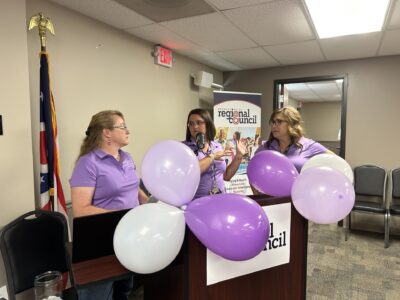
Buckeye Hills Regional Council had a room full of people Thursday who were used to being called a lot of names. Senior citizen. Elderly. Aged. Mature. Older adult. Over 60. Over 70. Really old. But it didn't seem to cramp their style.
They were attending an Elder Abuse Awareness Month activity hosted by the Area Agency on Aging, and they were paying attention to the folks from local groups and resources who were there for them.
The "Empowering Older Adults" program included lunch, goodie bags and prizes along with presenters and representatives from Washington County's Adult Protective Services, Job and Family Services, Community Action and OSU Extension, along with AmeriCorps Seniors – RSVP, the Marietta/Belpre Health Department and Parents and Friends of the Hearing Impaired.
In one part of the program, written information on elder abuse was presented on several large screens around the room. It was reinforced and explained by Deanna Green, supervisor of Adult Protective Services, and Lori Hart, one of the social services workers in that department. The term "elder abuse" involves three types of behaviors, Green told the group Thursday. The first, sexual/physical/emotional abuse, might be revealed in untreated injuries and changes in behavior. The second, neglect, could be indicated in such things as hazardous or unclean living conditions, dehydration, malnutrition or bed sores. A related category, self-neglect, could be a possible situation when someone is not taking medications as prescribed or not showering.
The third type of elder abuse, exploitation, was the one that many in the room could relate to, and the one Green zeroed in on.
"Exploitation," she said, "is using another person's resources for your own benefit. That includes theft, deception, and threat intimidation. It includes scams, which are so prevalent." The elderly are the biggest victims of scams, Green explained, but it's not automatically because the elderly lack mental capacity. Anyone, any age, can get scammed.
But the elderly are the biggest targets because they have more money saved up than young people do.
"When the elderly lose in a scam, they lose big," she said. "I want to educate you guys so that you know the red flags, and you know when to stop."
On any kind of phone scam, don't rely on the Caller ID information to tell you who is calling. It can be faked easily. A call from anywhere can be made to look "local." If you answer and still don't know who it is once the caller tells you, don't talk to them. Hang up.
Your voice can be recorded, rearranged, and used to imply that you have approved their half of a dialogue that is composed without your knowledge.
Among the scams described were:
¯ The Tech Support Scam: These phone calls can be very dramatic warnings that there is likely something dangerous going on in your computer and the caller will help you fix it.
If this is someone you don't know and you didn't call first, hang up. Shut down your computer.
If you have given this caller any kind of financial information or money, call your bank. Report it to the local police and FBI. It's likely you may not get your money back if you have already taken that step, but let them know what's going on.
The tech support scam's dire warnings about computer problems can also come from pop-up messages on your computer screen.
Never click on them. They can contain viruses that will infect your computer and/or compromise the information you store on it.
¯ The Romance Scam: Online dating has its dangers and this type of scam is on the rise, Green said. The elderly victim can experience heartbreak as well as financial disaster. She listed some red flags you may be able to identify.
The scammer may ask you to use another messaging platform than the one you're using now. (The scammer wants one where the sender can't be verified.) They express strong feelings in an extremely short span of time. In maybe a month or six weeks, the scammer is suggesting a big vacation, buying a house together or a wedding.
They ask for a large amount of money to help them out of a situation that is not their fault.
They ask you to deliver or mail or a package for them. (Realize that this could be drugs or money laundering.)
They are in the military and far away. Or on an oil rig or ship, and far away.
Green showed a film clip of a widow who scraped together $125,000 to send to her "beloved." The woman in the film says she was indeed heartbroken as well as financially injured.
"It's a little bit humiliating to admit, but I want this guy caught," she said.
¯ The Prize Money or IRS Scam: "Send money to pay the taxes on this big prize you won somehow, and we'll send it right along."
"You didn't know it until now, but you owe money. Please pay in gift cards, crypto currency, a payment app on your cell phone, a wire transfer or a prepaid debit card."
Green had a special paper handout to give people Thursday, a "quiz" about the IRS. The lesson learned here was that the IRS will never call to demand immediate payment by gift card or wire transfer.
The IRS will not bring in law enforcement to threaten, arrest or deport you.
The IRS will not demand payment without giving you the opportunity to question or appeal the amount they say you owe. The IRS will not use email, text messages or social media to discuss your financial situation.
¯ The Grandparent Must Send Bail Money to an Arrested Grandson Scam: This can sound like an authentic emergency if the scammer has been able to get personal details about you and your family on FaceBook or other social media.
Scammer tricks go on in endless variation. But Green says there are ways to beat this by being an empowered older adult.
First, don't beat yourself up thinking this happened because you're old and helpless.
That's not it at all. It happens to people of all ages. Second, Don't be so embarrassed that you keep it a secret.
"The scammer wants you to keep secrets," she said. "Talk to your spouse or trusted friends. Listen to each other without judging." Finally, call Washington County Adult Protective Services about any kind of elder abuse that is concerning you or that you suspect, on your own behalf or for others you care about. Talk it over with someone else.
"We'll be glad to help you with the Ohio Attorney General, the FBI, the Washington County Sheriff, the Marietta Police," Green said.
Washington County's Adult Protective Services number is 740-434-0531.
Green didn't suggest it, but if you're going to keep being an empowered older adult you might want to tape that number in a handy place.
Nancy Taylor can be reached at ntaylor@newsandsentinel.com
There were a total of 250 reports involving 100 males and 150 females. (Some individuals may have had more than one report. COVID impacted reporting numbers in 2022.)
Classifications of abuse:
Exploitation, 48 cases
Physical abuse, 5 cases
Emotional abuse, 29 cases
Sexual abuse, 0
Neglect by others, 25 cases
Self-neglect, 160 cases
Age ranges:
Under 60, 2 cases
60-69, 84 cases
70-79, 88 cases
70-89, 52 cases
90 and up, 24 cases
Completed elder abuse investigations by Adult Protective Services in Washington County in 2021:
There were a total of 222 reports involving 95 males and 127 females. (Some individuals may have had more than one report. COVID impacted reporting numbers in 2021.)
Classifications of abuse:
Exploitation, 43 cases
Physical abuse, 9
Emotional abuse, 26
Sexual abuse, 0
Neglect by others, 20
Self-neglect, 150
Age ranges:
Under 60, 0
60-69, 81 cases
70-79, 74 cases
70-89, 55 cases
90 and up, 12 cases