
WWII Veteran, Ray H. Brown still flying high at 100 years old
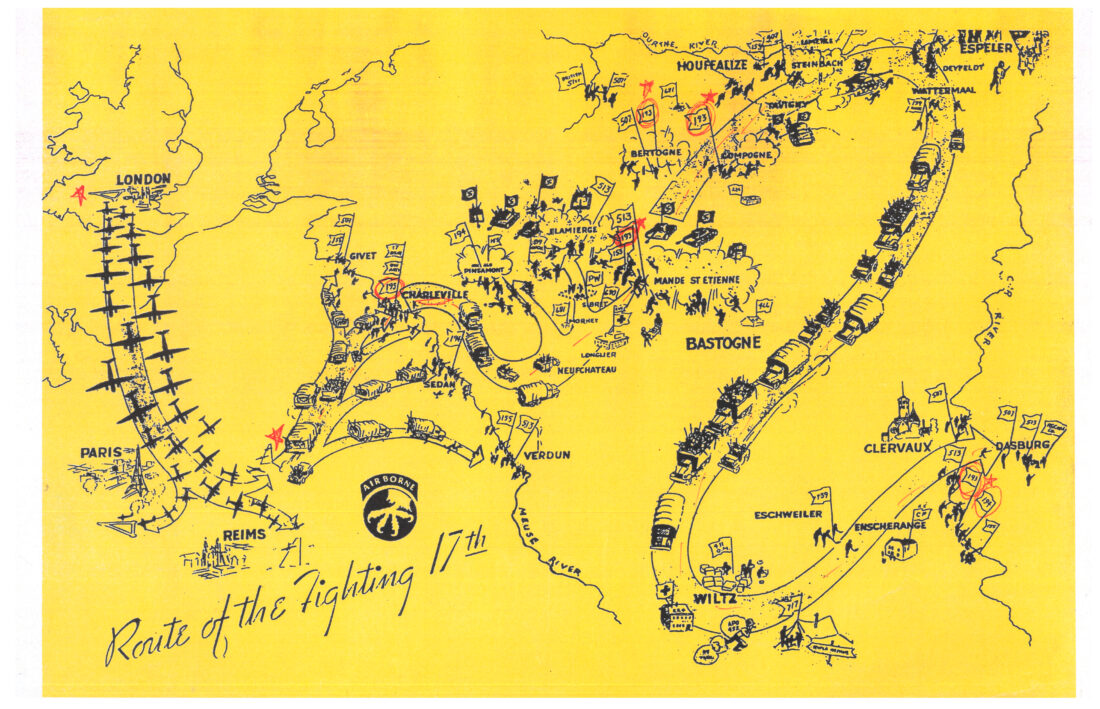
(Photos Provide) The Route of the Fighting 17th in the Battle of the Bulge in 1944.

Ray H. Brown, World War II veteran and grand marshal of the Veterans Day Parade in Parkersburg.

Cpl. Ray H. Brown in World War II.
(Photos Provide) The Route of the Fighting 17th in the Battle of the Bulge in 1944.
Ray H. Brown, World War II veteran and grand marshal of the Veterans Day Parade in Parkersburg.
Cpl. Ray H. Brown in World War II.
Trending
WWII veteran Ray H. Brown of Parkersburg turned 100 in July. He was a corporal in the 17th Airborne, 193rd Glider infantry, 1st Batt, Company A in the U.S. Army from 1943-1945.
He fought in two of the biggest battles on the European front, the Battle of the Bulge and Operation Varsity.
He recalls being dropped off in Charleville, France, in December 1944 and then moving through the Ardennes to Bastogne Belgium in knee-deep snow to help the 101st Airborne that was surrounded by the Germans. Gen. Patton's 3rd Army was supposed to be there, but they were bogged down in the snow and couldn't get the tanks through, so the 17th Airborne was sent to help the 101st.
On Jan. 7, 1945, Brown's first day in the Battle of the Bulge, the 17th was ordered to 'take the hill.' He recalls as Company A started up the hill it was under intense German machine gun fire and artillery. It was a very bloody battle as Brown describes. "It was the coldest day, the hottest day, the shortest day, the longest day," of his life. This battle later became known as "Dead Man's Ridge."
He remembers Lt. Fitz was captured, Lt. Donaland was wounded and Lt. Davison in the 2nd platoon was killed. Of his entire company, only 40-50 men made it back down that hill after they got the order to fall back that night.
Later that night, the soldiers found coverage in an old farmhouse. Just as Brown was going to get some shut eye, Capt. Voss yelled his name. Brown responded. Voss had received word seven to eight men from Company A were in an old building about a quarter to a half mile down the road trying to find their unit.
Voss told Brown to go find them and bring them back. So Brown did. As Brown was going out the door about 8 p.m., a fellow soldier in the farmhouse yelled, " Brown when you get to the creek, pause and run like hell because the Germans are zeroed in right there." Brown nodded and in the cold dark night he went searching for his comrades. When he got to the creek he did just as the soldier told him. He paused then ran like hell across it.
Upon approaching the buildings where the soldiers might be, he quietly called out "Company A." Finally, he heard a response and the men came out of the building. Brown recalls one soldier was badly wounded and couldn't walk. Fortunately, an Army Jeep came by, Brown flagged it down and asked if they could take the wounded soldier to the first aid station. They did. Brown told the other soldiers to follow him back to the farmhouse when surprisingly one soldier said he wasn't going. Brown said, ''you have to!" The soldier replied, "No!" Brown told him '"if you don't go back you will be an AWOL deserter." Brown said, "You will be court martialed or shot." So, the soldier decided to make the journey with the others and followed Brown. When the group approached the creek, Brown gave his comrades the same instructions he had received about crossing the creek. Brown got all of his comrades back safely to the farmhouse.
As the battle continued under constant pressure from the 17th Airborne the Germans were only able to hold their line for a short period before beginning to withdraw. Due to weeks in knee high snow and temperatures in the 20's, Brown was hospitalized with frozen feet and legs. After 54 days in the hospital Brown went back to his company. The 193rd had been basically wiped out in the Bulge, so he was assigned to the 194th glider infantry, Company B, just in time for the jump across the Rhine. It was Operation Varsity. On March 24, 1945, they took to the air in two gliders being pulled behind a C-47. This was the largest airborne operation in U.S. history and more than 21,000 glider infantry and paratroopers landed on the German side of the Rhine River. On May 8, 1945, Germany surrendered and the war was over.
When the war ended, Brown pulled guard duty until he left Germany. Then he went to France and around June 1 he was on a ship headed to the USA. He remembered being in a whale of a storm at sea and getting sea sick. A merchant marine came by and asked if he was sick. Brown said, "I'd have to die to be any sicker." The marine told him to suck all the juice out of this lemon and then eat the rind. He did. Believe it or not, it worked! While they were out to sea they got word that Japan had surrendered. They were headed home! A very memorable day, as he recalls! Brown returned to the states and received an honorable discharge on Nov. 11, 1945. If you take a minute and think about this story you can't help but say "Wow!" Brown continues to remain in good health and is quite active at 100 years of age. He loves to travel, attends church and the 17th Airborne Scion gatherings and still talks about the Dream Flight he took two years ago in a restored WWII bi-plane as the first West Virginia WWII veteran to take the Dream Flight.
Brown loves his God, Country and family.
A true American who fought for our freedom and is truly the "Greatest Generation!"
Respectfully submitted,
Diane Brown Balderson and Roger Brown