
Schenkel gives council $9.4 million waterfront plan update
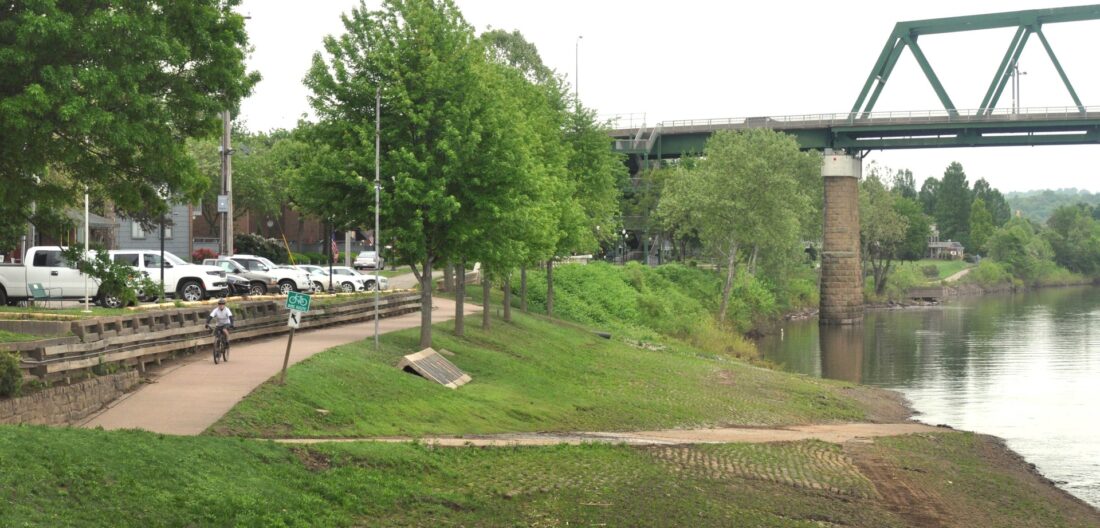
A cyclist uses the bike and walking path at Ohio Riverfront Park in Marietta in May. City Development Director Geoff Schenkel shared information Thursday evening about the planning process for $9.4 million the city received from the state for projects to improve the area of the park that runs from the Lafayette Hotel to the Levee House Bistro. (File photo by Art Smith)
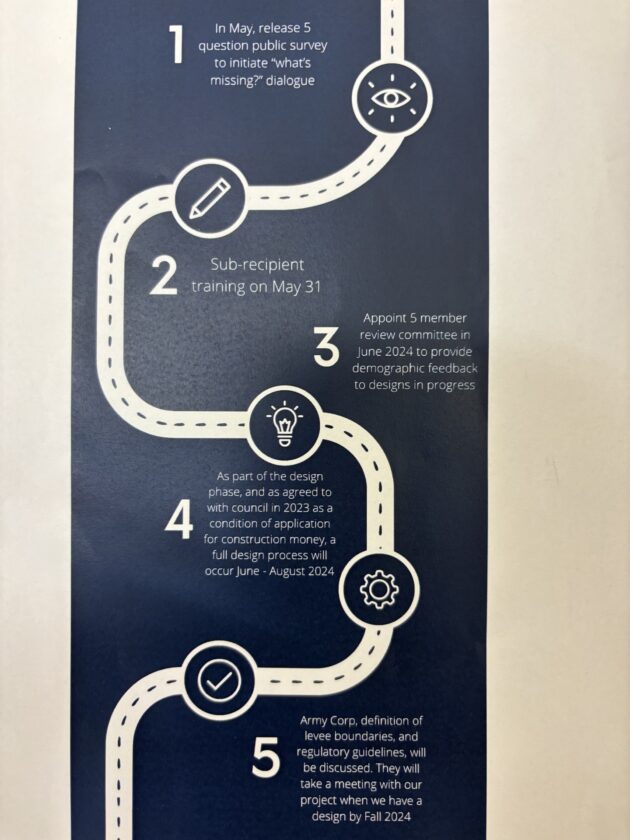
Pictured is a timeline for how the city of Marietta will handle the planning and design processes for projects to improve the area of Ohio Riverfront Park that runs from the Lafayette Hotel to the Levee House Bistro with $9.4 million it received from the state. (Photo by Michelle Dillon)
A cyclist uses the bike and walking path at Ohio Riverfront Park in Marietta in May. City Development Director Geoff Schenkel shared information Thursday evening about the planning process for $9.4 million the city received from the state for projects to improve the area of the park that runs from the Lafayette Hotel to the Levee House Bistro. (File photo by Art Smith)
Pictured is a timeline for how the city of Marietta will handle the planning and design processes for projects to improve the area of Ohio Riverfront Park that runs from the Lafayette Hotel to the Levee House Bistro with $9.4 million it received from the state. (Photo by Michelle Dillon)
Trending
Marietta City Council discussed a timeline and some beginning ideas for a $9.4 million Ohio River waterfront improvement plan Thursday night.
During a joint Public Buildings and Lands and Property, Housing, Annexation and Zoning Committees meeting, City Development Director Geoff Schenkel presented council with a timeline for the project and discussed some of the parameters for the project plan.
The city was awarded $9.4 million in Appalachian Community Grant Program funds by Gov. Mike DeWine on May 6 to redevelop Ohio Riverfront Park as part of the state's new Ohio's Wonderful Waterways Initiative.
"I came here to talk about kind of the timeline and how this relationship is structured between us, the state and the other parties involved with the use of the Appalachian Community Grant money," Schenkel told council Thursday night.
Schenkel shared with council a document titled "riverfront redevelopment timeline" that laid out the steps involved to get the city through the planning and design process for the project.
According to the document, the first step of the process will take place this month and is a five-question public survey that will be released to initiate a dialogue about what is missing in the waterfront.
Schenkel said the survey will be finalized at a meeting this coming week with the Ironton-Lawrence Community Action Organization (ILCAO), which is the recipient of the grant, and Buckeye Hills Regional Council, who is a partner in the grant program. He said the survey will be released next week and remain open until June 10.
Ward Four Councilwoman Erin O'Neill asked Schenkel how the survey will be distributed. He said it will be put out electronically and the city could also use printed copies of the survey. He said the survey details will be worked out during the meeting with the IALCO.
O'Neill also asked if the survey is in place of having public meetings about the project. because she had received requests from the public for there to be public meetings.
"I’m not really thinking about town hall-style meetings for something like this," Schenkel answered.
According to the document, the second step of the process is the city receiving sub-recipient training. Schenkel said the city will receive the training on May 31 because ILCAO is the recipient of the grant and the city of Marietta is a subrecipient of the grant.
"The money flows through them to us and they are kind of supervising things with us...They are handling the administrative capacity so the money is spent properly, contractors are lined up according to the deadlines established by the state," Schenkel said about ILCAO's role.
He also said the $9.4 million in grant money will not sit in the city's general fund, but that IACO will administer the money.
The third step listed in the document is that the city will appoint a five-member review committee in June to provide feedback for project designs.Schenkel said the committee will do some of the legwork to get things back to council for review and that he has already put forward some names for committee members that Mayor Joshua Schlicher is comfortable with too. He said he is also willing to take recommendations from council.
The fourth step listed in the document is that the full design process will occur June to August. Schenkel said the design process needs to take place during this time so the city has some preliminary things ready to share with the Army Corps of Engineers by the fall because the Corps can't work with the city until it has something to present.
The fifth step listed in the document is the city meeting with the Corps to define levee boundaries and regulatory guidelines. It states the meeting will happen by this fall. According to the Ohio Department of Development's website, which is the agency handling the grant program, all Appalachian Community Grant Program funds must be obligated by October 2024 and spent by October 2026.
After presenting the timeline, Schenkel shared the information he has about guidelines for the project.
'I've inquired on the types of things this money can be spent on and it's perfectly within the realm of appropriate use to deconstruct Ohio Street, re-lay a proper sub-bed with an aggregate of limestone and proper compaction and get good life out of these things we say we're committed to and that we want to preserve," Schenkel said. "We could rebuild Ohio Street as part of improving the levee area."
Schenkel said some of the things that the city could think about could be reworking spatial issues like limestone steps that are unsafe that people use to get to the Sternwheel Festival, the small space available in the Lafayette parking lot from which people watch fireworks and other issues to make the space more user-friendly, have better use of space for events and better curb appeal.
Public Lands and Buildings Committee Chair and At-Large Councilman Harley Noland asked Schenkel if the project area has been defined. Schenkel said they will be asking the Corps what extent they consider the levee area to be. He said he could ask if the scope of the project extends to the area on the west-side of the city near the Celeron Monument, which he called the French Monument and that the Governor's Office of Appalachia will have a role in making the decision of the scope of the levee area.
PZAH Committee Chair and Ward 2 Councilman Bret Allphin pointed out an issue he has noticed with the public's understanding of the grant. He said that he has had people ask him how to apply to get some of the grant money.
"This isn’t that kind of project," Allphin said. "This is not money we are re-granting."
Schenkel asked council to take a first pass at coming up with project ideas before he and Schlicher have their next meeting with the IALCO.
O'Neill asked Schenkel for more information about the scope of the project and Schenkel said council should think about the area around the levee geographically starting from the intersection of Greene and Front streets and going toward to the Ohio River and then going down to the confluence of the Ohio and Muskimgum rivers and perhaps going up to the west-side to near the French Monument and going up Ohio Street and what they want or don't want in that area. Schenkel did not guarantee that all of that area would end up as the scope of the project, but asked council to think of ideas for that area.
O’Neill asked if the funds could be spent on things like related to historic, ADA accessibility and flood mitigation mattiers. Schenekl said he didn't know if it would be but council could try coming up with ideas related to that.
"Think big, think practical, " Schenkel said about future proposed project plans from council.