
Marietta City Council: City discusses tax budget, getting rid of longevity pay for future new employees
Trending
Marietta City Council members discussed the 2025 tax budget and getting rid of longevity pay for future new nonunion employees Thursday night.
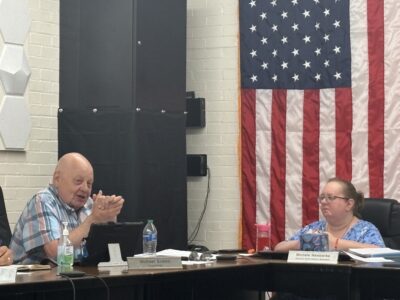
During a Finance Committee meeting, Ward 1 Councilman and Finance Committee Chair Michael Scales discussed the 2025 tax budget with council members who were in attendance.
According to City Law Director Paul Bertram, the tax budget is required by Ohio law in order for the city of Marietta to receive certain county funds.
"It is an estimate of what the city of Marietta anticipates," Bertram said after the meeting. "It could go up, it could go down."
According to Bertram, the 2025 tax budget must be adopted by council by July 15 and must be turned into the Washington County Auditor by July 20.
While the tax budget is preliminary, according to Bertram the actual 2025 budget must be done by Dec. 31 and the city has already started working on it.
According to Scales, council will start discussing the 2025 budget in public meetings in November and they "like to have the budget ... wrapped up the first week of December."
During the meeting, Scales said the tax budget will be talked about "again on Monday."
He said City Auditor Sherri Hess and City Director of Budget and Purchasing Mitch Dimmerling will be at the meeting to discuss the tax budget for 2025. During the meeting they will "have a talk about the tax budget, where it's going," Scales said.
As of Thursday evening, there were no council meetings or committee meetings regarding the 2025 tax budget listed on the city calendar on the city's website.
"The bottom line is, for the first time in a while our revenues and expenditures estimated for 2025 are in the black for the first time," Scales told council members about the tax budget.
A copy of the 2025 tax budget was provided to The Times and it shows the total estimated expenditures for 2025 are $13,482,786 and the total estimated revenues are $13,585,209. That is $102,423 more in estimated revenues than expenditures.
In comparison, in 2023 the actual total expenditures were $13,292,135 and the actual total revenue was $12,721,921, which shows the city spent more than $500,000 more than what it brought in for 2023.
To be exact, that is $570,214 more spent than brough in.
The 2025 tax budget shows for the current year, 2024, the current total estimated expenditures are $14,077,137 and the total estimated revenue is $13,266,083, which would be the city spending $811, 054 more than it expects to bring in this year.
For 2022 the difference between actual total revenues and expenditures was $278,606 more in expenditures than the city brought in. This shows a trend from 2022 to the end of this year of the city spending ever increasing amounts more than what it brings in. If the 2025 expenditures and revenues play out as shown in the 2025 tax budget, then it would be the first time in a while that the city did not spend more than it brought in.
The difference between the total estimated expenditures for 2025 versus the total estimated expenditures for 2024 is more than half a million dollars, $594,371, to be precise. No mention was made during the meeting of what changes will be made in city spending in 2025 to garner the difference.
During an employee relations meeting Thursday night, At-Large Councilwoman and Employee Relations Committe Chair Cassidi Shoaf presented council members with proposed new amounts for future new nonunion employee longevity pay.
According to the information Shoaf provided to council, the proposed amounts are based on an average of what Dover, Mansfield, Troy, Medina and Canton give their employees for longevity payments though the suggested amounts are not exactly the same as the averages.
Shoaf suggested that employees who have worked five to nine years would get $300, 10 to 14 years get $600, 15 to 19 years would get $900 and 20 years or more would get $1,200.
Right now the city's longevity pay is based on a percentage of an employee's gross salary and includes overtime.
While council was discussing these suggested amounts, Scales stated he wanted to keep this all simple, because the more complicated it gets the more "litigious it can become."
"No longevity's pretty simple," Shoaf said in reply to Scales.
Scales said he thinks for new employees the city should start there, at no longevity pay.
Bertram said he would work on an ordinance to get rid of longevity pay for future new nonunion employees.
Scales asked Shoaf when she wanted to have an ordinance ready to be considered at a council meeting and she answered she was hoping by "next Thursday," June 20.
Shoaf confirmed after the meeting the ordinance is regarding future new non-union employees.
The next council meeting is June 20 at 6 p.m. in Room 10 of the Marietta Armory.