Period of intentional transformation: Marietta College’s President Dougherty presents updates
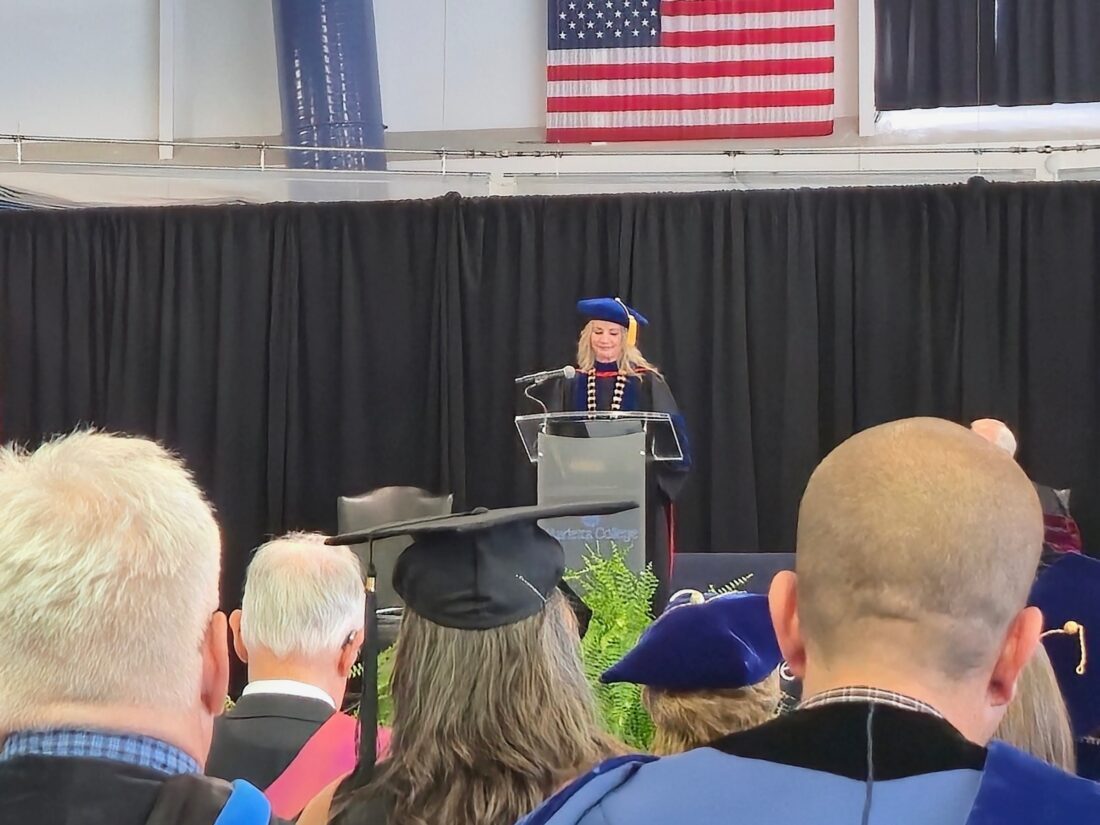
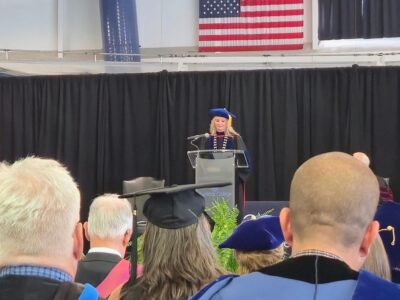
Kathleen Poorman Dougherty gives an inaugural speech as she accepts the role of president for Marietta College at the Dyson-Baudo Recreation Center in October. (File photo)
Marietta College is entering what recently-appointed President Kathleen Poorman Dougherty describes as a period of intentional transformation, one shaped by deeper community partnerships, strengthened experiential learning and expanded pathways that make a private education more accessible.
Dougherty, who became the college’s 21st president in October after serving as interim president, said the institution’s new strategic plan provides the framework for MC’s next era. While the plan acknowledges rising challenges across higher education, its focus is on “innovation over inertia,” she said, and on building a future that preserves the college’s long-standing tradition of mentorship and purpose-driven learning.
At the center of that work is the newly developing Center for Appalachian Innovation, which Dougherty said reflects the plan’s commitment to cultivating partnerships and conducting research that benefits the region.
“We are really excited about this center because we think it has tremendous possibility for benefiting both our region and our region’s economic development, but also the academic and intellectual development of our students,” Dougherty said.
The center is structured around mentored student research tied to issues that shape the Mid-Ohio Valley. In the spring, a data analysis class will begin examining opportunity zones, with the work continuing into the summer through faculty-student collaborations in political science and communication. The college plans to host annual symposiums to share findings with local partners.
The Appalachian Center will also expand on Nonprofits LEAD, the college’s longtime program supporting nonprofit capacity-building. Future efforts will extend that support to small governments and small businesses.
“Because when governments can serve their constituents better, our region does better,” Dougherty said.
The strategic plan outlines broader academic initiatives the college expects to pursue, including developing new undergraduate and graduate programs in high-need fields such as health care and education, expanding offerings for pre-college and adult learners, and exploring new delivery formats that widen access while maintaining Marietta’s relationship-centered identity.
Dougherty said that a personalized approach remains a defining attribute of the college.
“This is a place built on relationships,” she said. “We’re going to know so much more than your name. We know your hopes, your dreams, your talents, your challenges, and our goal is to help you meet those dreams.”
The college’s signature experiential model — where students engage in mentored research, hands-on projects, creative work, internships and leadership development — will continue to expand through the “Landmark Experience,” another initiative embedded in the strategic plan. Dougherty said those experiences, which occur both in and outside classrooms, shape the outcomes that matter most for graduates.
The plan also calls for strengthening student support structures. The Milone Center for Academic and Career Success, located in the library, consolidates academic assistance, advising, professional development and internship support into one collaborative space.
“That center is meant to ensure that our students really have the full picture of support during their time here, so that they get intentional pathways from academic success to career success,” Dougherty said.
Campus life is another focal point of the plan, with efforts to expand programming, enhance signature events, strengthen peer connections through themed housing and learning communities, and support student-led initiatives that build community traditions.
In the realm of regional engagement, the strategic plan includes the launch of a Center for Earth, Energy and the Environment. The center will integrate the college’s established petroleum engineering program with study of alternative energy systems, earth resources and environmental solutions. It will complement Marietta’s ongoing commitment to serving as a cultural hub, offering community programs in the fine and performing arts.
Dougherty said the college is also keeping affordability at the forefront. MC recently announced a tuition, fee and housing freeze for the 2026-27 academic year, along with the introduction of the Marietta Promise Award, which covers remaining tuition and mandatory fees for Pell-eligible students after grants and scholarships are applied.
“By keeping the cost of tuition and housing flat for the upcoming year we help to ensure students can move forward with confidence, building their futures without incurring unexpected financial burdens,” she said.
Meal plans will increase 3% due to rising food costs.
The strategic plan also outlines long-term financial priorities, including brand investment, updated admissions approaches, strengthened donor engagement, and a campus-wide focus on aligning expenses with strategic goals. It encourages development of new revenue-generating programs and calls for a long-term campus plan to support future growth.
Dougherty said the momentum of her first year has reinforced her optimism about the college’s trajectory.
“It has been a fantastic first year,” she said. “It feels like we’ve accomplished a lot, and we are seeing what’s possible for this campus and this community. We’re excited to be in partnership together.”
Local News
Individual involved in Monday shooting succumbs to injuries
PARKERSBURG — One of two people shot Monday in south Parkersburg died Thursday, Parkersburg Police ...

Local law enforcement still following leads three years since Gretchen Fleming disappearance

Sisters Health Foundation celebrates nonprofits
Chamber reviews year, graduates first leadership cohort and presents annual awards

Commissioners meet: OhioMeansJobs receives over $19,000 for veteran services