Husted took thousands from company that paid Ohio $88M to settle Medicaid fraud allegations
-
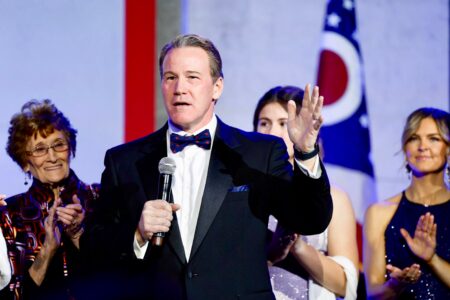
- (Ohio Capital Journal Photo) Ohio Lt. Governor Jon Husted and his family at the Governor’s Inaugural Gala, January 7, 2023, in the Atrium at the Statehouse in Columbus, Ohio.
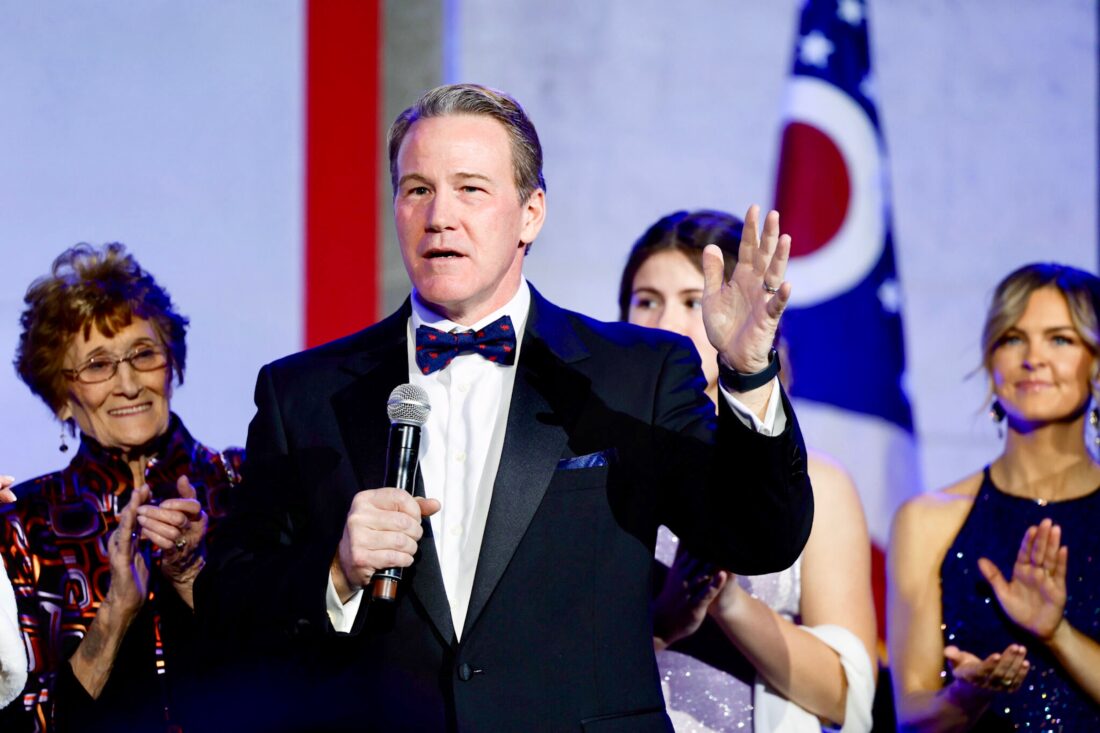
(Ohio Capital Journal Photo) Ohio Lt. Governor Jon Husted and his family at the Governor’s Inaugural Gala, January 7, 2023, in the Atrium at the Statehouse in Columbus, Ohio.
Company hired DeWine friend to lobby, and administration restarted its Medicaid contract
Ohio Republican U.S. Sen. Jon Husted has taken at least $75,000 in campaign contributions from Centene, the largest Medicaid managed-care provider in the United States. Of that, more than $29,000 came after the company paid $88.3 million to settle allegations that it had fraudulently extracted tens of millions from Ohio Medicaid.
Meanwhile, Husted has repeatedly voted against extending subsidies for 600,000 Ohioans who are now seeing their health insurance skyrocket. One of the reasons he has cited is fraudulent activity in the program during the coronavirus pandemic.
When Centene paid the settlement, then-Lt. Gov. Husted was part of the administration that was in charge of the program that had allegedly been defrauded.
The administration of Husted and Gov. Mike DeWine suspended contract negotiations with Centene for a few months in 2021. But taxpayer dollars flowed again after Centene hired an old friend of DeWine’s to lobby the officials on its behalf.
Husted’s office didn’t respond to questions for this story — including whether he thinks it’s important to fight fraud.
DeWine appointed Husted to the U.S. Senate at the beginning of 2025 after he spent six years in an administration marked by one of the biggest corruption scandals in Ohio history.
Catherine Turcer, executive director of the watchdog group Common Cause Ohio, said it’s disconcerting that Husted took big donations from a company that had paid millions to settle allegations of massive fraud against Ohio taxpayers.
“We expect our elected officials to turn their backs on donors who have committed fraud,” she said. “We expect them to step away and repudiate that. One way they can do that is by refusing campaign contributions.”
Tax cuts for the rich, but no health subsidies for the modest
Husted voted last summer for President Donald Trump’s “One Big Beautiful Bill Act,” which cuts more than $1 trillion over 10 years from Medicaid and federal food assistance to the poor. At the same time, it extended Trump’s 2017 tax cuts, providing a $1 trillion windfall to the richest 1% of Americans, and adding $4.1 trillion to the national debt.
But while Husted voted to extend tax cuts heavily tilted toward the wealthy, he repeatedly voted against extending 2021 subsidies for 600,000 moderate-income Ohioans to buy health insurance in a marketplace created by the Affordable Care Act. About 70% of the people using the ACA exchanges make 250% or less of federal poverty guidelines. For a family of four, that’s $80,375 a year.
Before the subsidies expired at the end of 2025, experts predicted that expiration would cause premiums to more than double, on average.
Now that they have expired, that appears to be the case. The New York Times reported on Tuesday that nationally, enrollment has already dropped by 1.4 million.
That’s about 6% of the 24.2 million Americans who get insurance from the program. Experts told the paper that if the subsidies aren’t reimplemented, that number likely will rise, and many who stop using the ACA marketplace will no longer be insured.
After a 43-day government shutdown in a fight over the subsidies, Husted took to the Senate floor in November to propose freezing the amount spent on the subsidies, adding further restrictions, and extending them, but just for two years.
He also proposed requiring everybody to pay something, no matter how poor they were. He said that would stop a problem with fraud that the Commonwealth Fund said already had been largely fixed, while proposing further steps that didn’t involve making the poorest pay.
Fraud in Ohio Medicaid
Concerns about fraud were addressed in 2021 when the administration to which Husted belonged decided to resume business with Centene. The company owns Buckeye Community Health Plan, one of the Medicaid managed-care providers that administered much of the $28 billion the department spent that year.
Managed-care providers act in many respects like insurers — with the major difference being that taxpayers pick up the tab. They sign up clients, create provider networks and they pay claims.
They also work with pharmacy middlemen known as pharmacy benefit managers, or PBMs. Those companies decide which drugs are covered, negotiate non-transparent rebates with drugmakers, and they decide how much to reimburse pharmacies that purchase and dispense them.
In 2017, while DeWine was still Ohio attorney general and Husted was secretary of state, two PBMs charged taxpayers far, far more for drugs than they were reimbursing pharmacists.
A 2018 audit of the opaque system showed the PBMs — part health conglomerates CVS Health and UnitedHealth — charged the state $224 million more for drugs in 2017 than they paid Ohio pharmacists, who even then were closing their doors at an alarming rate.
Centene-owned Buckeye Community Health Plan added its own PBM to transactions that were already running through the CVS PBM. Centene charged taxpayers an additional $20 million in 2017.
Centene denied that it was double-dipping — even though it and CVS were unable to point to any unique services the Centene PBM provided.
Despite its denials, incoming Attorney General Dave Yost in 2019 launched an investigation and filed a lawsuit in 2021.
Just three months later, Centene settled with the state for $88.3 million. It didn’t admit wrongdoing, but it also announced that it was setting aside more than $1 billion to settle similar claims with more than 20 other states that hadn’t even sued it.
“Centene used sophisticated moves to bill unearned dollars — moves known only at the top levels of health care companies,” Yost said in a written statement announcing the settlement. “It has taken a huge effort by my team to untangle this scheme — and now that we know how it works, the alarm bells should be ringing for anyone using similar tactics.”
Big contributions
Husted is a long-standing opponent of the 2010 Affordable Care Act, former President Barack Obama’s signature law.
“I wasn’t in Congress when Democrats created the broken ACA system or the Biden (health care) subsidies… ,” he said last month.
Despite Husted’s criticism, his supporter Centene owes its massive size and much of its current identity to the ACA.
Its annual revenue was just $4.45 billion in 2010. That figure mushroomed to $163 billion in 2024, largely by providing Medicaid managed care.
Through it all, it has supported Husted’s political career with donations, giving his campaigns $75,000 over the past two decades.
Turcer of Common Cause said people and companies don’t make donations of that size for the mere sake of good government.
“When you look at why someone gives $50 to a candidate, it’s probably because they really like that candidate,” she said. “But when you start getting into thousands of dollars, those folks want something. They want a policy, they want to develop a relationship so that they can get their phone calls returned quickly. They are making those larger contributions as a way to grease the wheels.”
At the beginning of 2021, as Yost was investigating Centene’s dealings with Ohio Medicaid, the company hired Michael Kiggin, DeWine’s law school classmate and close associate. Kiggin signed on to to lobby DeWine, Yost, Husted, and the Medicaid department on “decisions regarding Medicaid managed care” on Centene’s behalf.
During the fraud investigation, the Medicaid department suspended negotiations over a managed-care contract for 2022. But two months after a settlement was announced, the Medicaid department announced it was resuming business with the company — without mentioning the fraud allegations.
And while Husted continues to have problems with the Affordable Care Act and fraud in its subsidy program, he has not voiced any problem with Centene — a company that has benefitted greatly from the ACA and was credibly accused of defrauding millions from Ohio Medicaid.
A year ago, DeWine appointed Husted to fill the U.S. Senate seat that was vacated by JD Vance when the latter was elevated to the vice presidency.
Since June, Centene executives have contributed $29,000 to Husted’s effort to be elected in his own right next year, according to records at the Federal Election Commission.
Meanwhile, company executives appear not to have contributed anything during this cycle to Husted’s likely Democratic challenger, former U.S. Sen. Sherrod Brown.
Turcer said elected officials shouldn’t take political contributions from companies that are credibly accused of ripping off taxpayers.
“If our elected officials don’t turn their back on those who are engaged in shenanigans and focus on protecting Ohioans and our pocketbooks, we’re all going to be taken advantage of,” she said.
Original story can be found at https://ohiocapitaljournal.com
Local News

Vintage view: Frozen Ohio River

Marietta Tree Commission plants memorial oak in honor of local educator

Business development: Wood County receives three site readiness grants
Husted took thousands from company that paid Ohio $88M to settle Medicaid fraud allegations
Capito says market not yet ready for Northern Panhandle hydrogen hub