
Marietta City Council approves street safety planning, infrastructure fund
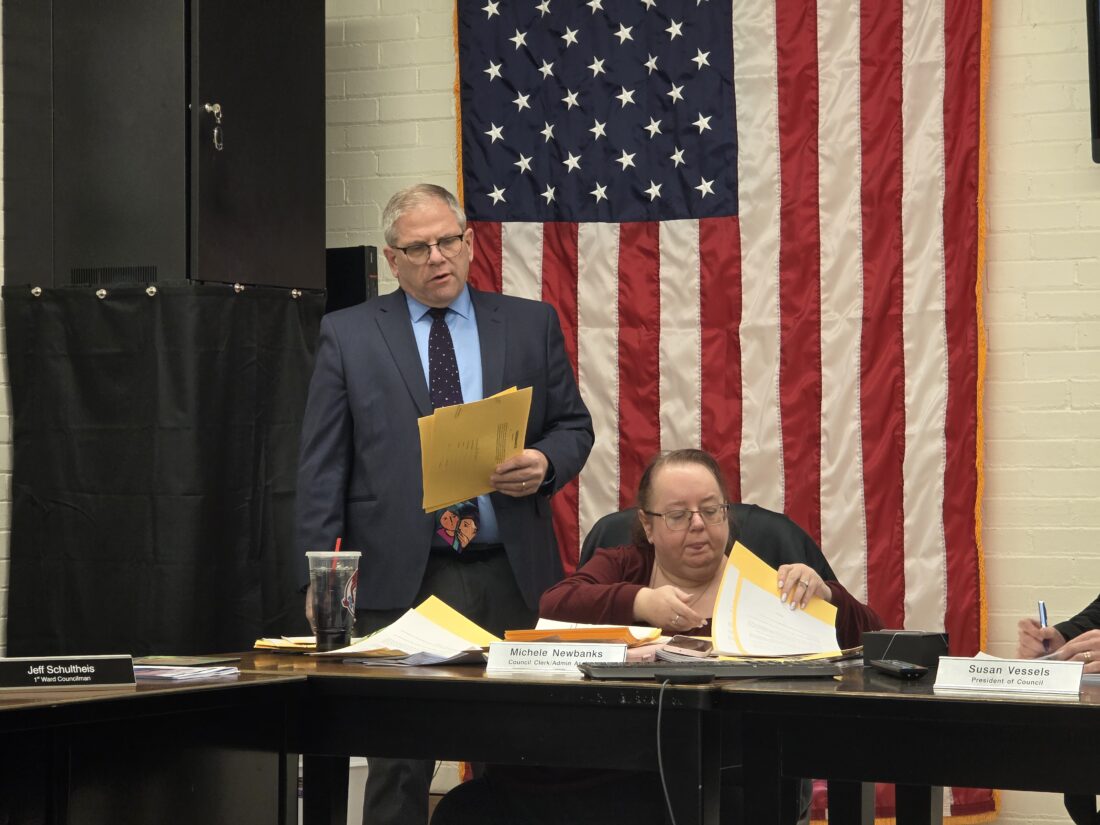
From left, Councilman Jon Grimm reviews the legislation for Thursday evening’s Marietta City Council meeting alongside Council Clerk Michele Newbanks. (Photo by Gwen Sour)
Marietta City Council moved quickly through a lengthy agenda Thursday night, suspending rules to fast-track more than two dozen ordinances and resolutions, including a $149,790 contract to begin a citywide safe streets planning effort and the creation of a new infrastructure fund intended to receive adult-use cannabis tax revenue.
Council unanimously adopted Ordinance 3 (26-27), authorizing the director of public safety and service to contract with American Structurepoint Inc. of Columbus to begin planning and research for the Safe Streets and Roads for All Comprehensive Action Plan. The ordinance was passed with an emergency clause after council suspended the third reading.
Council also unanimously approved Ordinance 5 (26-27) after suspending the second and third readings, allocating $30,000 to the Southeastern Ohio Port Authority to assist the city’s economic development and revitalization efforts.
“They’ve already started consulting and working with the city on this,” Councilman Jon Grimm said.
Several other measures were fast-tracked and adopted unanimously, including authorization to advertise for bids and purchase up to 2,500 tons of rock salt for the street department, along with ordinances approving bids for gasoline and diesel fuel for city vehicles. Emergency clauses were added to the fuel ordinances before final passage.
Mayor Josh Schlicher said winter conditions have strained city crews and supplies.
“The last two weeks have been pretty challenging,” he said. “We’ve had a lot of long hours. We’ve had injuries, we’ve had property damage — you name it.”
Safety-Service Director Steve Wetz said the city shifted to salt-only applications during recent storms and is closely watching inventory.
“We’ve been using a lot of salt, and we are running low, but we have been able to maintain adequate levels at this point,” he said, adding that the Ohio Department of Transportation loaned the city 200 tons of salt.
A series of bookkeeping and budget measures tied to indirect cost allocation between city funds and the general fund also were approved after council suspended readings. Those included an ordinance establishing a plan for allocating indirect costs through Dec. 31, 2026, and separate ordinances authorizing transfers from the sewer, fire levy, streets, water and capital improvement funds to reimburse the general fund. Grimm described the measures as routine financial housekeeping.
“This is all just to clean up the books from the previous year,” he said.
Council also advanced several updates to the city’s table of organization and job classifications, including abolishing a records specialist position at the water treatment plant and creating an office manager position, creating a development specialist position in the community development department, and updating the job description and pay scale of the wastewater collections foreman to reflect Ohio EPA requirements. Two temporary, full-time tax specialist intern positions in the income tax department also were created. Two ordinances creating seasonal laborer positions in public works for cemeteries and the harbor received first readings but no further action Thursday.
Council unanimously approved a $737,628.81 agreement for a Vac Jet Unit sewer cleaning combo truck under Ohio’s cooperative purchasing law after amending the ordinance to clarify the equipment would be used by the public utilities department. After passage, council recessed briefly to discuss concerns about how the legislation described the transaction. Council members questioned whether the language clearly reflected a lease-purchase arrangement over seven years rather than an immediate purchase.
Grimm also questioned whether council had clearly authorized borrowing as part of the arrangement. City officials responded that the agreement functions as a rent-to-own arrangement, with annual payments budgeted over seven years and ownership transferring to the city at the end of the term.
Council created a new Public Infrastructure Improvement Fund through Resolution 2 (26-27), which members said is intended to receive proceeds from adult-use cannabis tax revenue and be used to leverage grants and support long-deferred infrastructure projects. Grimm said he changed the language to make the intent clear.
“I’m changing the word ‘may’ to ‘shall,’ because I want all the monies to go into this infrastructure fund,” he said. “I don’t want to leave a question as to where that money goes.”
Assistant Law Director David Silwani cautioned council about how marijuana-related revenue is handled.
“When it comes to marijuana money … my suggestion would be to not mess with this and to come to us first,” Silwani said. “Whatever goes in here from marijuana should stay for what it is.”
Council also fast-tracked and approved resolutions authorizing the mayor to apply for 2026 grant funding through the Ohio Department of Natural Resources NatureWorks program, the Appalachian Regional Commission, the Clean Ohio Trails Fund and the Ohio Department of Transportation’s Safe Routes to School program. A resolution supporting the Start Westward Memorial Society’s effort to list the Start Westward Memorial on the National Register of Historic Places received no further action.
The meeting opened with condolences for former Mayor Joe Matthews, who died Sunday. Council members and residents later shared memories of Matthews’ service to the city.
The Harmar School development project was mentioned during public comment.
Tension surfaced during closing remarks when resident Jeff Schultheis offered condolences to Matthews’ family but criticized city staffing levels and asked about progress on putting council meetings online. Wetz responded sharply, accusing Schultheis of approaching city employees with claims he disputed.
“I’m going to ask that you stop going to our superintendent from the water treatment plant … telling him not to trust our public utilities director,” Wetz said. “Bring those concerns to us.”
Council members also marked Councilman Ben Rutherford’s final regular meeting. Rutherford announced his resignation to focus on his duties as head of Veritas Classical Academy.
Rutherford thanked colleagues and residents for their support and reflected on the challenges of the term.
“Our first cycle was difficult. We had budget concerns,” Rutherford said. “We also found ways to save money, to put money aside for budget stabilization and capital improvements. The lines underneath our feet have been in disrepair for many years, and it’s time that that sees attention.”
Gwen Sour can be reached at gsour@newsandsentinel.com.
Local News
Multiple rape charges among Washington County Grand Jury indictments
Twelve people were indicted by the Washington County Grand Jury this week, including a Marietta man charged with ...
Honoring Matthews

11th annual Fridays in the Garden workshops scheduled for February
Blennerhassett Winter Lecture Series begins Sunday
PARKERSBURG — The Blennerhassett Historical Foundation Inc. will be kicking off its 2026 Winter Lecture Series on ...
Belpre Elementary reopens after one-day closure due to leaks
Artsbridge schedule of events
PARKERSBURG — Artsbridge released the following schedule for this weekend’s events: TOday ¯ Art Exhibit by ...