Sanitation request denied: WV Public Service Commission to not investigate contract efforts
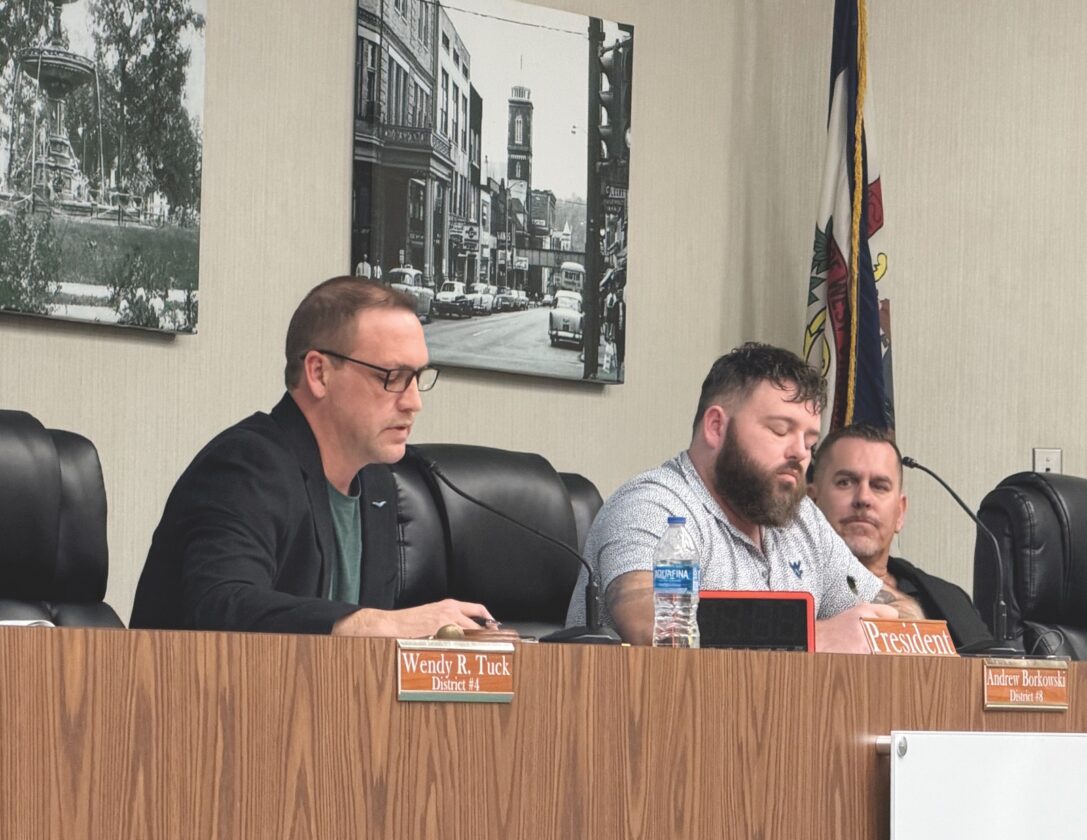
Parkersburg City Council President Andrew Borkowski, left, speaks during Tuesday’s council meeting as Councilmen Zak Huffman, center, and Mike Reynolds listen. Council voted 7-2 to approve the first reading of an ordinance authorizing a contract with Rumpke of Ohio for a subscription-based, curbside recycling program. (Photo by Amber Phipps)
PARKERSBURG — The West Virginia Public Service Commission will not investigate Parkersburg’s efforts to contract out its sanitation and recycling services, citing a lack of jurisdiction.
The commission issued an order during its meeting Tuesday in response to a petition from Carole Hanlon, a property owner in the city who requested in December that the agency investigate the city’s proposal and conduct a public hearing on the matter.
“The Legislature has granted broad power to municipalities and limited jurisdiction to the Commission with respect to municipal solid waste services,” the order says. “The Commission’s jurisdiction does not extend over this matter, as the City has authority to enact an ordinance to regulate its service. Petitioner’s request for investigation and a public hearing should be denied.”
Parkersburg Mayor Tom Joyce said he was pleased but “not at all surprised” by the ruling.
“The city’s authority and ability to enter into contracts (and) appropriate funds for such services is well within our rights and duties,” he said.
Hanlon on Tuesday described the commission’s decision as “a clarification of the legal boundaries and not a validation of the city’s policy.”
She said oversight now rests with the residents of Parkersburg and referred to efforts to collect signatures for a referendum petition to force council to reconsider the contract ordinance.
Petitioners must submit more than 2,700 signatures of registered voters by today.
Should enough signatures be collected, forcing council to reconsider the ordinance, and if it is not repealed, the measure would be placed on the ballot for a public vote.
Last month, council approved the ordinance authorizing the contract with Waste Management in a pair of 6-3 votes.
The commission order says Waste Management has authority to provide solid waste services in the city because it is certified as a common carrier for the transportation of solid waste, hazardous waste and other discarded items in Wood County. Because the company is entering into a contract with the city, rather than serving individual customers upon request, the service would fall under the special contract provisions of the commission’s tariff rules.
“Because Waste Management is the certificated utility subject to our rules, it is premature for the Commission to consider the contract until it is properly filed by Waste Management,” the order says.
Waste Management must file a copy of the contract with the commission, “as any negotiated rate between Waste Management and the City is subject to Commission review and possible repricing in future rate cases,” the order says.
The city has cited staffing issues and excessive call-offs in sanitation challenges that led to the suspension of curbside recycling service in May.
“This whole process and situation is very simple in my view. My only motivation all along has been to get our waste collected in a manner that is reliable and consistent,” Joyce said. “This Waste Management contract does that, and I am hopeful to get our dedicated public works personnel refocused to our streets, parks and floodwall duties as soon as logistically possible.”
Joyce has said there are just five employees left in the Sanitation Department, so personnel from other departments have been working in sanitation along with temporary workers from an employment agency and the Parkersburg Correctional Center helping to cover those duties.
Residents opposed to the Waste Management contract – and a separate, subscription-based curbside recycling contract with Rumpke that council approved 7-2 on first reading Tuesday – have said city officials did not offer high enough wages to keep the jobs filled. Joyce has responded by outlining pay increases and incentives the city offered.
Hanlon’s filings cited city officials’ statement that the municipal recycling facility off 24th Street saw a nearly $3.8 million deficit in fiscal years 2019 to 2025. That’s a factor they’ve cited in plans to close the recycling center if the recycling contract with Rumpke is approved, although some in the community are hopeful the facility would remain open.
Hanlon sought a review of the city accepting recyclable materials from commercial haulers for decades at no charge, a practice that was ended in December. City officials have said the facility does not have the scales needed to charge for such materials by weight.
Finance Director Eric Jiles said the MRF operated at a deficit but the sanitation fund as a whole still paid for itself.
Hanlon has also sought a forensic audit of the city’s finances related to sanitation. Joyce has said the city’s annual state-required audits have included unmodified or clean opinions for multiple years.
A response filed by City Attorney Blaine Myers said the city did not object to the commission’s review of the contract but said the broader investigation was unmerited.
It also questioned whether Hanlon’s filings were generated by an AI program, citing Wood County Circuit Judge J.D. Beane’s order denying Hanlon’s request for a temporary restraining order on enacting the contract. Beane said case law citations were incorrect or non-existent and appeared to be AI hallucinations, though he noted there was no finding Hanlon was intentionally deceptive.
Hanlon said in a response to the city’s filing that the city responded to her “legitimate inquiry into a $3.8 million fiscal crisis with a strategy of deflection, disparagement and deception.” She also challenged the city’s claim that public hearings had been provided since a special meeting to discuss the issue did not fit the legal definition of a public hearing and was scheduled 90 minutes before the start of a meeting during which there was a vote on the first reading of the Waste Management contract.
Local News
Sanitation request denied: WV Public Service Commission to not investigate contract efforts
Pickering Grant supports WSCO veteran students for second year
Fatal crash in Pomeroy being investigated by Ohio State Highway Patrol
POMEROY — The Ohio State Highway Patrol is investigating a one-vehicle crash into the Ohio River that was ...

Area Scouting volunteers celebrated
Wood BOE holds bond budget work session Tuesday