Ohio lawmakers queue up data center study commission
-
- Meta’s Stanton Springs Data Center is seen Tuesday, Jan. 13, 2026, in Newton County, East of Atlanta. (AP Photo/Mike Stewart)
-

- Photo Illustration
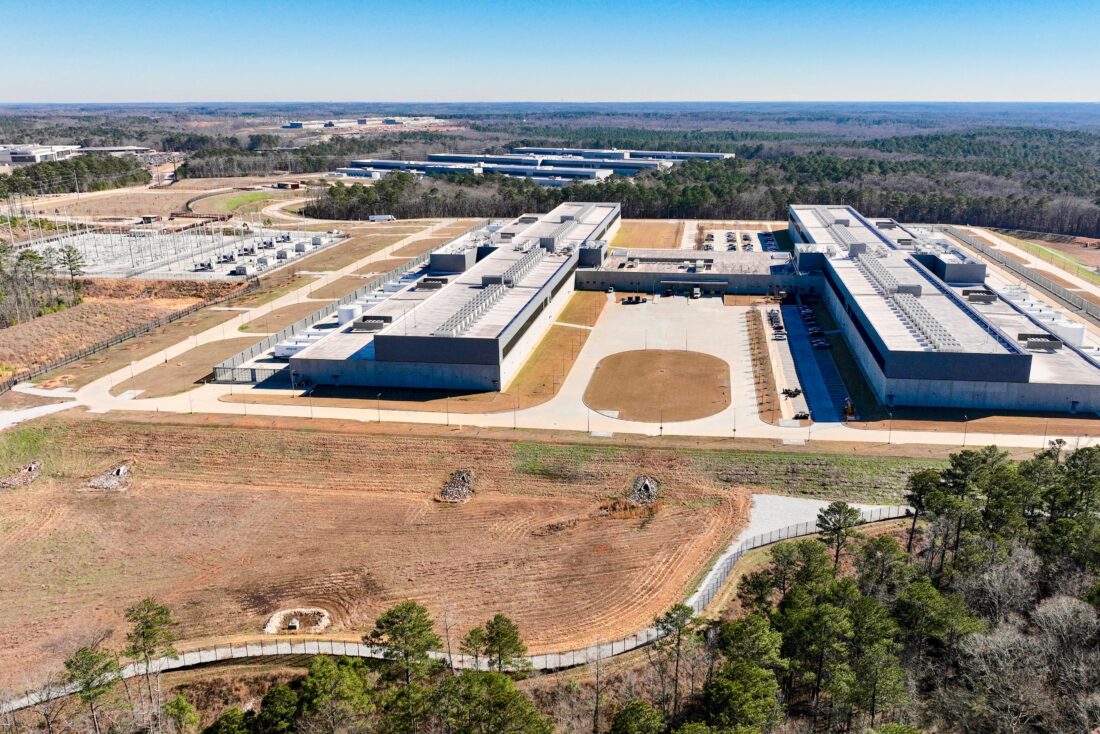
Meta's Stanton Springs Data Center is seen Tuesday, Jan. 13, 2026, in Newton County, East of Atlanta. (AP Photo/Mike Stewart)
By Nick Evans
Special to The Times
Ohio lawmakers appear ready to set up a new commission studying data centers. Business groups believe it can vindicate the industry, while ordinary Ohioans worry time is short to rein in the already out-of-control growth of data centers.
And if there were any doubt that data centers will be a potent campaign issue in this year’s elections, a pair of political candidates recently took the opportunity to criticize lawmakers for not doing more.
After a House Committee voted to advance the proposal Tuesday, the bill seems likely to go before the full chamber Wednesday.

Photo Illustration
What the study looks like
Ohio state Rep. Gary Click, R-Vickery, said the motive behind forming a study commission is the opposite of the one driving most legislation.
“Typically, when we have legislation, we’re starting with an answer,” Click said. “It’s like, we know this is the answer to this problem, but a commission starts with the questions — what are the issues that we face? So, let’s take in all of the data, and then we’ll write something afterwards.”
Click is co-sponsoring Ohio House Bill 646 with Ohio state Rep. Kellie Deeter, R-Norwalk.
Their proposal would set up a 13-member study commission made up primarily of state representatives and senators. A last-minute amendment rejiggered the commission membership. The changes mandate a majority of members have specific subject matter expertise, instead of filling each seat with lawmakers. Gov. Mike Dewine gets to appoint three members. The House Speaker and Senate President get five appointees each, including two lawmakers from their chamber representing majority and minority parties.
Subject matter experts include people familiar with data center operations, local governments, public utilities and tax incentive policy among others. Under the original proposal, minority leaders each got to appoint two out of those five members from their respective chambers. Now the measure only requires one member come from the minority party.
A handful of Democratic members voted against advancing the bill out of committee. After the hearing Rep. Ismail Mohamed, D-Columbus, explained they were frustrated with a slower, deliberative response when their constituents see an immediate problem.
“Commissions are things that we would typically vote yes on, because we have no issue with commissions,” he said. “But the issue is, right now, when it comes to data centers, a lot of them have been popping up, and they are having a severe impact on localities. They’re moving really fast.”
The bill requires at least four public hearings. Two of them must include expert testimony and two more open the floor for public input.
The commission’s task is enumerated in statute. The members must consider economic, environmental, agricultural, and utility impacts. They also have to look at potential pollution, including from wastewater, noise, and light.
Other priorities are more diffuse: How do data centers and their underlying technologies relate to national security? Are foreign actors spreading propaganda meant to foster opposition to data centers?
And the Data Center Study Commission will be working on a tight timeline. If it passes, the first hearing must be held within 45 days of the law taking effect, and commissioners must submit a report within six months of the effective date.
What Ohioans had to say
Kara Hetrick lives on 15 wooded acres outside Gibsonburg in Northwest Ohio. She’s frustrated that a proposed data center could go up less than a mile from her home.
“What happens in 10 to 15 years when the data center leaves the area?” she asked during a hearing last week.
Hetrick thinks the constant hum and bright lights will scare off local wildlife, and she worries the water used to cool the facility will get contaminated and eventually wind up in a nearby lake.
But she was particularly perturbed about the commission studying whether foreign propaganda is fueling data center opposition.
“Now we’re going to have more wasteful tax dollars to study a so-called foreign propaganda,” she said, “when really all it is, (is) we the people voicing our concerns with opposition.”
Nikki Gerber runs a canoe rental company in Manchester, Ohio and described her Adams County home in glowing terms.
“Magic comes to mind,” she said.
Gerber hopes the commission can provide guardrails to protect the area’s natural resources.
“Because the way they have been operating is stripping us of everything those before us learned from living through the industrial development of the past,” she said.
Perhaps hinting at data centers’ political salience on the campaign trail, a pair of politicians made sure to offer their two cents as well.
Eric Watson is challenging Rep. Click in this year’s Republican primary.
Watson insisted he came not as a candidate but as a concerned citizen.
He opposed the measure and criticized lawmakers for not including outside experts on the commission. He warned electromagnetic radiation could harm pollinators like honeybees, and that local governments are getting sued into submission by tech companies.
Kim Georgeton, who’s running for lieutenant governor alongside Republican Casey Putsch, argued that studying the issue doesn’t go nearly far enough.
“I’m asking you to adopt an immediate moratorium for a minimum of 36 months on data centers, server farms, and related AI infrastructure statewide,” she told the committee.
She insisted she’s not anti-tech — data centers just haven’t proven to be a good deal yet. They get big tax breaks, push power costs higher, and offer very few permanent jobs in return, she said.
“A moratorium on data centers is not a no, it’s just a not yet,” Georgeton said.
The business view
Meanwhile, the Ohio Chamber of Commerce sees a booming industry bringing jobs and tax revenue to the state.
Chamber Senior Vice President Rick Carfagna told lawmakers data centers were responsible for more than 95,000 jobs in 2024 and $26.4 billion in economic output, according to Chamber research.
Notably, that figure includes temporary jobs related to construction.
While some Ohioans are mounting a campaign to abolish property taxes, Carfagna added, “data centers represent a significant source of local government revenue that does not come from constituent wallets.”
He noted that’s about $1billion in state and local taxes that support schools, libraries, and local governments “without asking more from homeowners and small businesses.”
Greg Lawson from the free market think tank The Buckeye Institute, framed his argument in national security terms.
He argued that the country is engaged in a kind of “tech Cold War” with China, and the artificial intelligence tools involved in that stand-off rely on data centers.
But The Ohio Farm Bureau sounded a more skeptical tone.
The group’s Director of State Policy Evan Callicoat explained that his members are torn: Modern agricultural technology is crucial to their success, but the scope of land getting committed to data centers is troubling.
“Once farmland is lost, it’s likely gone forever,” Callicoat explained, and many of his members aren’t sure the benefits data centers promise outweigh the costs.
“Establishing a study commission enables an in-depth cost benefit analysis to ensure we do what is best for our state in the long term before we reach a breaking point,” he said.
Follow Ohio Capital Journal Reporter Nick Evans on X or on Bluesky.
Original story can be found at https://ohiocapitaljournal.com
Local News
Water boards, local officials call for moratorium on injection wells ahead of trip to Columbus
Representatives from several Washington County water systems, local governments and citizen advocacy groups met ...
Ohio lawmakers queue up data center study commission

Ohio EPA reviewing draft permit to authorize limited increase in data center wastewater discharge

Holistic: ‘Dirk Gently’ opens Friday at Mid-Ohio Valley Players

Surrounded by cones