Backers urge Ohio lawmakers to require absentee voters to mail in copy of ID
-
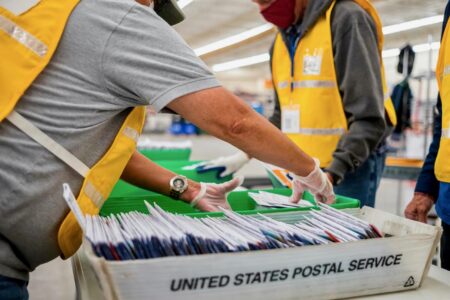
- Election workers process ballots at the Arapahoe County Elections Facility in Littleton, Colorado. (Carl Payne, for Colorado Newsline)
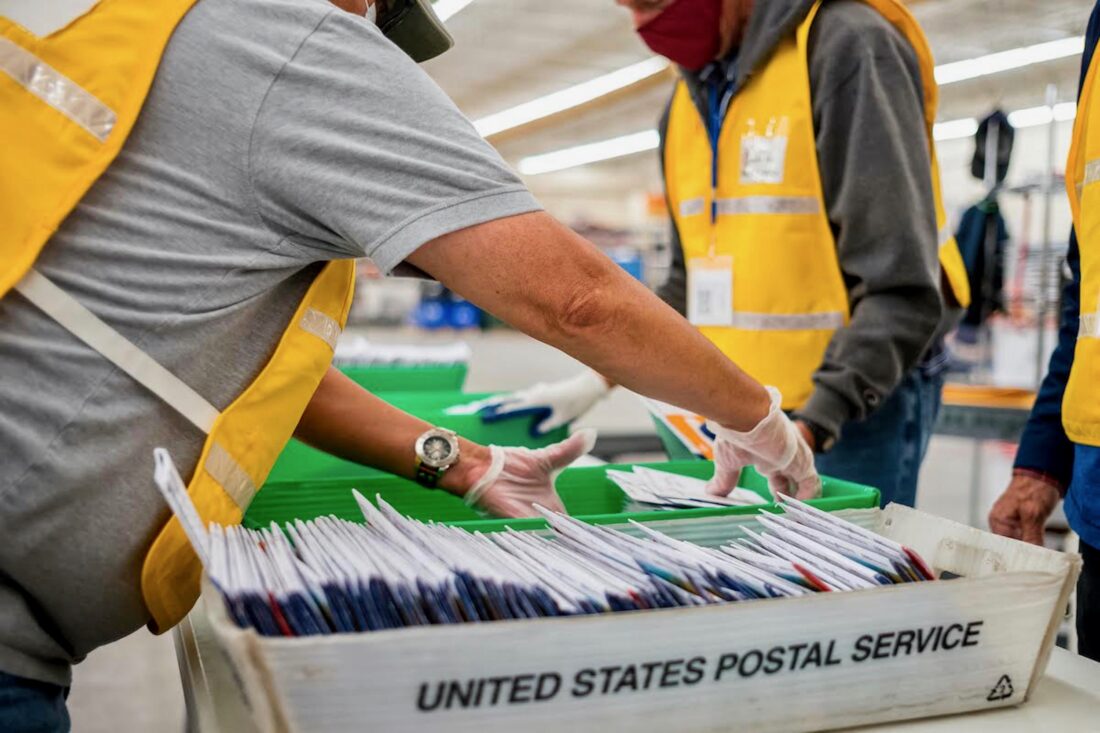
Election workers process ballots at the Arapahoe County Elections Facility in Littleton, Colorado. (Carl Payne, for Colorado Newsline)
By Nick Evans
Special to The Times
A Republican Ohio lawmaker wants absentee voters to include a copy of their photo ID with their ballot. Last week the idea’s supporters got a chance to weigh in.
They insisted Ohio House Bill 577 would enhance security and promote voter confidence. The new requirement isn’t too much to ask, they said — it would simply create consistency between in-person and absentee voting.
But lawmakers from both sides of the aisle appeared skeptical. They didn’t see tracking down photocopies as a minor inconvenience. And if changes are needed, one asked, why aren’t Ohio’s elections professionals the ones asking for them?
Perhaps most pointedly, lawmakers questioned backers’ security rationale.
What is gained by including a photocopy of an ID if voters already fill out identifying information on the absentee ballot envelope? They noted election officials won’t have the voter standing in front of them to compare to the picture.
“Comparable safeguards”
Several of H.B. 577’s supporters are connected with the Ohio chapter of the Election Integrity Network. The organization has spread false claims about noncitizen voting and was founded by Cleta Mitchell, who played an active role in the legal effort to overturn the 2020 election.
The group’s elections bill of rights goes even further than H.B. 577, calling for all votes to require photo ID confirming “identity, residency, and US citizenship.”
What that would look like in Ohio is unclear — a driver’s license doesn’t necessarily establish citizenship, and a U.S. Passport doesn’t indicate residency.
Eileen Watts, described on the Ohio Election Integrity Network website as a founder and board member, said requiring photo ID for absentee ballots would align the process with in-person voting.
“The current disparity where mail voters provide only an ID number undermines uniformity and trust,” Watts claimed. “By closing this gap, H.B. 577 ensures every ballot receives comparable safeguards.”
But Watts wandered into the same logical cul-de-sac as many other supporters, trying to equate two kinds of voting that, by necessity, rely on different methods for verification.
“We believe that we need equal treatment under the law,” she said. “That if someone needs to show a government-issued photo ID to vote in person so that we can see what, you know, obviously they look like, that the same should be required if they vote via absentee ballot.”
As Watts said, presenting a photo ID to vote in-person means poll workers can compare the person to the ID.
There’s no way to do that with an absentee ballot. As the name suggests, the voter isn’t there.
Bad actors and identity theft
Marcell Strbich, a Republican running for secretary of state, made a case rooted in identity theft. The former Air Force intelligence officer told the committee Ohioans’ identifying information is available online for a price.
“It’s straightforward for cyber criminals to breach computer systems,” he said, “and then use the stolen or purchased information with the voter’s name and address to register them to vote and request in Ohio a no-excuse, mail-in ballot in their name unknowingly.”
Strbich said he’s heard anecdotal reports on the campaign trail from constituents who have had ballots requested in their name. Under those circumstances, the board counts the first ballot received.
Requiring voters include a photocopy of their ID would “not only correct a matter of fairness,” he claimed, but it would make it harder to impersonate eligible voters.
“We deter — we deter — bad actors from exploiting our most vulnerable voters and stealing their votes and voices for them,” Strbich said.
But while Strbich warned that cyber criminals or identity thieves could use stolen information to get absentee ballots, H.B. 577 does nothing to change the process for requesting ballots.
Bad actors intent on using stolen information to request an absentee ballot in another person’s name could still do so — risking felony voter fraud charges each time.
Committee chair, state Rep. Sharon Ray, R-Wadsworth, pressed Strbich on that point.
If everyone’s information is really available online, she asked, what purpose does the photocopied ID serve?
“Because if you got somebody’s driver’s license, you could request the absentee ballot,” she said. “They’re never going to see you anyway. What difference does a photo ID make?”
Strbich didn’t answer directly. Instead, he asked, “What’s wrong with creating a process by which the board of elections has access to that information so that they can make sure that it’s not a third-party group impersonating somebody?”
But H.B. 577 doesn’t do that either. Election workers won’t be pulling up an image of a voter’s ID on their computer to compare it with the copy. Instead, the bill simply punishes those who don’t include a photocopied ID.
Under the bill, a ballot is considered incomplete and thus invalid if there’s no copy, just as if the voter didn’t fill out their address or date of birth. But ballot verification still comes down to matching the signature and other ballot information against records the board has on file.
As Strbich himself noted, county boards don’t have the means to directly verify driver’s licenses and state IDs.
Strbich is locked in an increasingly bitter primary race where the state Ohio Republican Party chose to endorse current Ohio Treasurer Robert Sprague to be Secretary of State over Strbich.
Ray at one point had to remind him that his testimony was not an opportunity to campaign, and some GOP members on the panel pressed him on his prior voting record.
He acknowledged pulling Democratic ballots in 2005 and 2009 “for the purposes of local issues that affected my family” when no Republicans appeared on the ballot. Strbich said he’s voted Republican in every other election since 2000.
Follow Ohio Capital Journal Reporter Nick Evans on X or on Bluesky.
Original story can be found at https://ohiocapitaljournal.com
Local News

Rotating exhibit space aims to accelerate learning at Discovery World

Marietta Trolley returns May 2 for 2026 tour season

Mid-Ohio Valley Career Connect Job Fair set for April 8
Parkersburg mayor offers way for petitioners to remove signatures
PARKERSBURG — As a committee seeking to repeal or place on the ballot an ordinance authorizing a trash service ...
Backers urge Ohio lawmakers to require absentee voters to mail in copy of ID