
Lawsuit filed after Wayne National Forest well explosion
Trending
MARIETTA -- A Monroe County man who suffered catastrophic burns in a 2025 orphan well explosion in Wayne National Forest is suing the drilling and cementing companies involved, alleging their safety failures caused the blast.
Chazz Bates filed the civil complaint Aug. 21 in Washington County Common Pleas Court against Monroe Drilling Operations LLC and Formation Cementing Inc. The complaint also names 10 unidentified defendants.
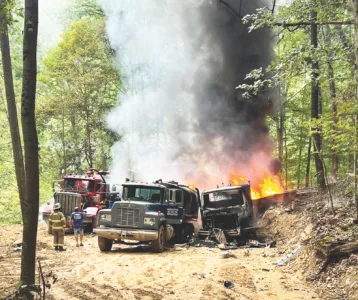
Bates, who was 20 at the time, worked as a rig hand for Monroe Drilling. Five workers suffered catastrophic burns when the Farnsworth No. 4 orphan well exploded Aug. 25, 2025, in Independence Township. Two of the workers later died.
The well was part of an Ohio Department of Natural Resources state-funded program to plug abandoned oil and gas wells.
"This explosion was entirely preventable," said Spencer Hattemer, one of Bates' attorneys with Cooper Elliott. "ODNR has safety rules that the companies hired for this job didn't follow. The companies didn't establish basic well control and didn't have appropriate equipment in place to prevent a blowout."
Bates spent months in the hospital and underwent numerous surgeries and skin grafts, according to the complaint. He has permanent scarring and limited mobility, had to relearn how to walk through physical therapy and cannot get on the ground to play with his 2-year-old child, the lawsuit states.
Bates was not available for an interview.
Monroe Drilling had received an ODNR contract to plug 16 orphan wells in Wayne National Forest as part of the Washington No. 16 Project. The company hired Formation Cementing to provide cement-mixing and pumping services.
The suit states on the morning of the explosion, three Monroe Drilling employees, two Formation Cementing employees and an ODNR inspector were at the Farnsworth well site.
According to the lawsuit, Formation Cementing pumped only enough water into the well to clear the tubing of obstructions before pumping bentonite clay gel and cement. The complaint alleges the work proceeded without first circulating fluid through the well or achieving static conditions, meaning the well's pressure had not been stabilized.
State regulations prohibit cement from being pumped into a well before static conditions are established, according to the complaint.
As water was pumped behind the cement to move the plug into position, a "kick" consisting of natural gas, crude oil and oil mist rushed to the surface, the complaint states.
The mixture escaped through a flexible hose that Monroe Drilling had chained over the top of a discharge tank. The hose came loose and began spraying gas and oil across the site while the wellhead also leaked, according to the lawsuit.
The complaint alleges diesel engines on the drilling rig and trucks began revving after drawing in the flammable mixture. None of the engines had automatic air-intake shutoff devices, and the lawsuit alleges the engines ignited the gas and oil mist.
An ODNR investigation report attached to the complaint determined the explosion was caused by Monroe Drilling's improper implementation of primary and secondary well-control barriers.
The report found the company did not load the well with fluid, establish circulation or achieve static conditions before cementing. It also found the wellhead's discharge line lacked valves and a dedicated line through which workers could have pumped fluid to regain control.
Other contributing factors identified by ODNR included the absence of a mud pump, insufficient water, an improperly secured discharge hose, a lack of gas monitors and air movers, crowded equipment, limited escape routes and multiple potential ignition sources near the well.
The complaint alleges Monroe Drilling had a four-gas monitor but did not use it at the Farnsworth site. ODNR's report states no monitor was present at the well when the explosion occurred.
The lawsuit also alleges an ODNR inspector warned Monroe Drilling owner Kerry Brown about two months before the explosion that a smaller wellhead fabricated by the company was leaking, inadequate and needed to be replaced.
Monroe Drilling continued using the wellhead, including at the Farnsworth No. 4 site, the complaint alleges.
"ODNR knew about these problems but didn't enforce its own rules," Hattemer said. "Oil and gas work is dangerous enough when done the right way. When companies cut corners and sacrifice safety, they're putting workers' lives on the line. We've filed a civil complaint to ensure that there's accountability for the failures that caused this tragedy."
The lawsuit accuses Formation Cementing of negligence or recklessness because its employees pumped cement despite not knowing the well's fluid level or confirming that static conditions had been reached. It also accuses the company of negligence per se, alleging it violated state well-plugging regulations.
The complaint brings an employer intentional-tort claim against Monroe Drilling. It alleges the company deliberately stopped using or failed to provide safety features including a properly sealed wellhead, two steel discharge lines, a secure tank connection, an air mover, a mud pump and automatic air-intake shutoff devices.
Bates is seeking more than $25,000 in compensatory damages, along with an unspecified amount of punitive damages, attorney fees and court costs. He has requested a jury trial.
The complaint was filed by Columbus attorneys Rex Elliott, Hattemer and Sara Schiavone of Cooper Elliott.
Monroe Drilling and ODNR declined to comment, citing pending litigation. Formation Cementing was not immediately available for comment.