
Trending
At a glance:
¯ Marietta City Council's Streets Committee reviewed a 2020 traffic signal removal study of three Marietta intersections on Thursday:
¯ The Franklin and Market streets' intersection in the Fourth Ward.
¯ The Second and Scammel streets' intersection in the Second Ward.
¯ The Acme and Phillips streets' intersection in the First Ward.
¯ Marietta City Council is not expected to advance legislation on the signal removals on Feb. 4 at 7:30 p.m. but may advance legislation for removal of the red-yellow-green traffic signal in the Fourth Ward by mid-March.
Engineering conclusions of a 2020 traffic signal removal study resulted in a call for further discussion about resident and local business impacts Thursday in Marietta City Council.
The legislators were briefed on the latest installment of a multi-year fiberoptic network project to upgrade some of the city's traffic signals.
That most recent step before contractors move forward on installation of the federally-funded and Ohio Department of Transportation-managed upgrades called for reviewing which traffic signals do not meet federal eligibility for upgrade and therefore determine if they should be removed.
Considered for removal through a study last year and before council Thursday were three intersections:
¯ Franklin Street at Market Street.
¯ Second Street at Scammel Street.
Acme Street at Phillips Street.
According to the study, none of the three intersections meet traffic warrants necessitating a traffic signal.
According to the National Cooperative Highway Research Program, a warrant is a condition that an intersection must meet to justify having a traffic light.
The Manual on Uniform Traffic Control Devices specifies eight "traffic control signal needs studies," known as warrants. However, "The satisfaction of a traffic signal warrant or warrants shall not in itself require the installation of a traffic control signal."
While council is not expected to advance legislation on the signal removals on Feb. 4 at 7:30 p.m. it may advance legislation for removal of the red-yellow-green traffic signal in the Fourth Ward by mid-March.
"I'm not (going to) propose anything at this point, I think probably at some additional conversation is warranted before we make a decision," summarized Chairwoman of the committee Susan Boyer.
SIGNALS REVIEWED
Fourth Ward
¯ The Franklin and Market Street intersection is located in the Fourth Ward represented by Councilman Geoff Schenkel.
"Franklin and Market Street, as I read the report, the most recent traffic study indicated actually I think that there was 70 percent of the required traffic flow. And so that intersection did meet warrants as a continuation basis, is that correct?" asked Boyer.
"The volume has gone up at that intersection and the most recent count, which was done (in 2020)," explained Ed Engle, the traffic engineer representing TEC Engineering which completed the traffic study. "It does rise the level of needing a 70 percent warrant. That is an allowable warrant for existing location."
Boyer referenced her last interaction with residents specifically addressing the intersection at a Marietta Traffic Commission discussion last fall.
"In talking to people from the West Side … there was an indication that people deliberately don't, that pedestrians don't cross the street because of the high level of danger perceived in crossing that street," she summarized. "My question is, how do we address the pedestrian issues at that intersection?"
The intersection was recommended for removal by TEC Engineering and Marietta City Engineer Joe Tucker.
They recommended in the red-yellow-green light's place to instead install an all-red flashing stop in all four directions at the intersection but did not recommend a pedestrian-led ability to stop traffic via the overhead flashing lights.
"Knowing that we have the long-standing history of residents who are unable to figure out a way to teach their kids a safe way to cross the street for the length of the Franklin Street corridor," Schenkel said. "I would want to know what we can do to address that before moving on to a decision on removing or changing things at Market and Franklin."
Fantasy Green, who lives on the side of the neighborhood cut off by Franklin, has also shared with the Times and Schenkel in multiple interviews that she will not let her children or others she cares for cross Franklin because of the inattentiveness of drivers through the thoroughfare.
Her concerns shared in interviews since 2018 were echoed in public records of input on the study provided to the Times by Safety-Service Director Steve Wetz.
¯ "I had an accident there a few years ago," noted Virginia Graves, of Marietta, in an emailed public input submission to the study.
¯ "No one coming off from the Ohio 7 (bypass) actually stops long enough at the stop sign to give anyone trying to pull out of their street or their driveway long enough to actually accomplish their goal," wrote Bethany Gomez, a legal assistant for a downtown law firm and a lower west side resident. "There are too many kids in the neighborhood to even consider truly removing the lights without other safety precautions for pedestrians."
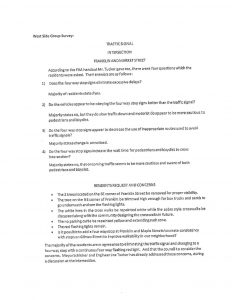
¯ 34 private residents and members of the lower west side neighborhood group, named Main Street West said in a joint submission to the study that they would accept removal only if:
¯ The two trees located on the southeast corner of Franklin Street are removed for proper visibility.
¯ The tree on the northeast corner of Franklin can be trimmed high enough for box trucks and semi-trailers to go beneath and see the flashing lights.
¯ The white lines in the crosswalks are repainted initially in the "zebra style" with community designs between the stop bars agreed to for future planning.
¯ The curbs are repainted yellow to indicate parking prohibition and that the zones for no parking be extended.
¯ The red flashing lights remain in place.
¯ The addition of a four-way stop at Franklin and Maple streets "to create consistency with stops on Gilman Street to improve walkability in (the) neighborhood."
Jackson Patterson, chairman of Main Street West, and CJ Smith, the pedestrian and safety head of the same neighborhood group, attended the committee meeting with Schenkel.
Patterson, Schenkel and Smith reported following the committee that they will seek to have the requested improvements included in any legislation blessing the removal of the current traffic light.
"Without those in the legislation, I won't be able to support it," said Schenkel.
Second Ward
¯ The Second and Scammel Street intersection is located in the Second Ward represented by Councilman Mike McCauley.
Police Chief Rodney Hupp also weighed in Thursday, calling the intersection "the most dangerous intersection in town." He also critiqued the use of the stop bar on Scammel in place of the traffic light, because effective use "makes you blind" to oncoming traffic as a driver.
City Law Director Paul Bertram also attested to the lack of sight view at the intersection.
Second and Scammel was recommended for removal by TEC Engineering and Tucker, with the proposal of putting in the light's place a two-way stop for Scammel Street traffic crossing Second Street.
The recommendation saw no support from council members.
First Ward
¯ The Acme and Phillips Street intersection is located in the First Ward represented by Councilman Mike Scales.
Scales was not present for the committee discussion Thursday.
Acme and Phillips Street was not recommended for removal due to lines of sight at the intersection.
Public Input
Of the three intersections studied, only two received notes of public input via email or phone according to Appendix D of the study.
Notes concerning the Second Ward recommendation also included impacts on local businesses which administrative staff noted had not been approached formally concerning the removal of the traffic light at Second and Scammel; namely Whit's Frozen Custard and McCarthy Dentistry, while both the city law director and chief of police confirmed that Sterling Service Center's parking of vehicles in the apron and lines of sight still fall within the businesses' property rights.
WHAT'S NEXT
If council would choose to bless any of the study's recommended replacements at the listed intersections, Tucker asked that those changes be decided by mid-March at the latest to give the Ohio Department of Transportation's contractors time to implement the changes into the fiberoptic project's construction plan.
Boyer noted a need for additional committee discussion, but did not schedule a follow-up meeting date Thursday.
Other business
The legislators also met for a brief Water and Sewer Committee meeting Thursday to discuss a change order related to the upgrade of the aeration system at the city's sewer plant. Council unanimously approved of advancing legislation for formal consideration on Feb. 4.
Council next meets Monday between two committees to discuss:
¯ Administration-requested financial transfers and appropriations.
¯ A proposal for a "Marietta Visioning Workshop."
¯ A park donation offer for East Muskingum Park.
Janelle Patterson may be reached at jpatterson@mariettatimes.com.