
Wrongful death lawsuit continues
Trending
The AEP service worker on duty the night of the house fire that took Elsa Thompson's life testified Friday in the jury trial against AEP.
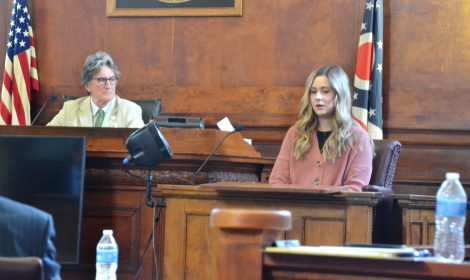
Josh Vandergrift, of Fleming, was one of six who testified for the plaintiff in the Laura Thompson vs. AEP case.
On May 25, 2019, Vandergrift, an AEP service worker, was working a 24-hour shift when Elsa Thompson's Warren Street home caught fire. It is alleged that the fire was started by downed power lines which AEP workers did not repair in a timely manner.
Vandergrift testified he started working at AEP in 2006 and has only worked at that electric company.
One of the contentions in the case is that Vandergrift went to lesser priority calls instead of the priority 2 call at Elsa Thompson's house.
As he was being questioned by Attorney John Power, Vandergrift admitted he had not seen any documents that provided a list of materials that were hazards. He also admitted he had never seen any documents pertaining to the priorities or the priority system, including in what order calls were supposed to be handled.
Power read part of his deposition where Vandergrift said he thought the only priority calls were 911 calls from the police and fire departments. The lineman then said in regard to outages, he was taught to go to the call with the greatest number of outages first, in most circumstances.
Power took Vandergrift through the report he would see on the screen in his work truck that tracked the work that needed done during the shift.
Vandergrift said he was never told of any words to look for in prioritizing the calls. Dispatch would contact him about 911 calls or if he had another ticket, but they wouldn't inform him of priority calls.
The screen shows the calls that have come in and those that are marked with a red box should be done first, as earlier testimony showed.
Vandergrift said he believed the red box showed the call was a hazard. He said it was never explained during training or field training that calls with red boxes should be done first. He said he believed he had discretion in completing the calls in any order.
Earlier testimony was made that linemen were on call, but that they didn't show when called on the night of the fire.
"Everyone is on call, but nobody is required to respond," Vandergrift said.
Michael Bissell, trial representative for AEP, returned to the stand Friday morning to finish his testimony.
Power questioned Bissell about texts between him and Vandergrift on May 25. There was a text around 7:40 p.m. He didn't communicate again with Vandergrift until 12:44 a.m. the next day. Those were their only documented communications.
Bissell testified that priority calls are never communicated to line services, who weren't taught about the priority system. He was asked if he told line workers, even indirectly, to skip documented hazards to do the greater number of houses first, but he said no.
Power said there was a four hour time set for hazard calls. He asked Bissell if he would expect to be done within four hours if it was the only priority call, to which Bissell said yes.
From the initial call about the downed line to Elsa Thompson's next call at 4:52 p.m. is three hours, Power said. There was no documented communication between dispatch and Vandergrift during that time.
Elsa was told by dispatch someone would be there by 6 p.m., which is four hours after the initial call. Call logs showed there was a shift change and the four-hour alarm was acknowledged by the new shift worker. The next documentation on the call is seven hours later. It shows the service drop was removed at 1:57 a.m., two hours after the fire started, the call logs showed.
In cross-examination defense attorney Liz Moyo questioned that Bissell had pulled records of outages and responses of the server for May 25 to make sure the actions were in line. He said he determined Vandergrift responded in correct action.
He then said he tried to call in more workers as he didn't want Vandergrift to work all night.
In re-direct, Power asked Bissell if his answers on Thursday were truthful, to which Bissell admitted he "misspoke" about some things.
"Did you misspeak yesterday when you said you didn't have enough people because they didn't show up?" Power asked.
Bissell said he had thought through Thursday's answers and realized he misspoke. He was questioned whether he had looked at any AEP documents or if he had talked to anyone that might have changed his mind about his testimony.
He said other than talking to his attorney, he didn't speak to anyone about it.
Power asked him when he was nervous, did he lie? Bissell said no.
"Did you tell the truth to the best of your ability yesterday?" Power asked. Bissell said yes.
Power asked if Elsa Thompson would still be alive if Vandergrift had gone to Marietta to cut the lines instead of going to Newport. He said going to Newport lost 4 1/2 hours and reminded Bissell that customer service said Elsa didn't have to wait up for the lineman and she could go to sleep.
Power asked were "all out" calls without hazards a priority 3? If so, did Vandergrift violate the AEP policy? Bissell said that was correct.
Power asked based on policy, were priority 2 calls to be completed before priority 3? Bissell said yes.
Power then asked that even though Vandergrift violated AEP policy, Bissell still supported his decisions? He said yes.
Two of Elsa Thompson's grandchildren took the stand Friday. First was Jake Rudie, the son of Laura Thompson.
He said Elsa Thompson had played a great role in his life. She taught him values and was a huge influence on him.
He said he saw Elsa Thompson about a month before her death, when she came to Miami of Ohio University to see him. He said the university ran in his family and she always wanted him to go there.
"I miss having someone I knew was always rooting for me," he said. "She was always in my court."
Her granddaughter, Annalea Thompson, daughter of Jade Thompson and the late Andrew Thompson, spoke to the jury next.
She told the story of how her grandparents met at Marietta College and that she and her grandmother would talk on the phone and correspond by writing letters to each other.
"I considered her my best friend," she said. "She shaped who I am."
She said after her grandmother's funeral, she went over to Elsa Thompson's house to see what could be salvaged.
"I kinda got tunnel vision. I think I was in shock," she said.
There were letters in her grandmother's bedroom she had hoped had survived the fire. The first was a letter from her grandfather to her grandmother when they were first dating. One was a letter from Elsa's father to Elsa, and the third was a card from her grandparents' 10th anniversary.
She said when she went into the bedroom, she had to break the dresser to get into the drawer, but when she finally broke through, there were the letters.
"They were there for me to find," she said.
Dr. Michael Gelbort of Joliet, Ill., a clinical psychologist took the stand next, as he has treated burn victims and people who have suffered from smoke inhalation.
He had reviewed Elsa Thompson's records, death certificate and coroner's report.
"In general terms, smoke inhalation and asphyxia," he said of the cause of death. "There was a description of her being half-in, half-out of her bedroom."
As he started describing in detail some of the effects Elsa Thompson could have gone through in her final minutes of life, it became too much for her daughter, Laura, who had to leave the courtroom.
In cross-examination, attorney Jason Gerken asked Gelbort if those were opinions based on what survivors of fires have told him. It was agreed each story isn't exactly the same and no one knows what she experienced that night.
Forensic engineer Edward Brill of Fort Lauderdale, Fla., also testified.
He said as a forensic engineer, he is called on to investigate fires. He told the jury about how other power companies in other states handle incoming calls and that they all have certain hazards they prioritize higher, with fire and police calls at the top of the list.
Brill said the call at Elsa Thompson's house was tagged as a priority 2 as there was a line down between the electric pole and the house.
"First, the line was low, and the second problem was the power was still on," he said.
He said the linemen had received improper training as they didn't know about the priority system.
Attorney Jacob Liebovitz, who was questioning Brill, said Brill had not investigated the fire and had not visited the scene.
Vandergrift's testimony will continue Monday morning at 9 a.m.
Michele Newbanks can be reached at mnewbanks@mariettatimes.com.