
WVU students to study methane leaks from storage tanks
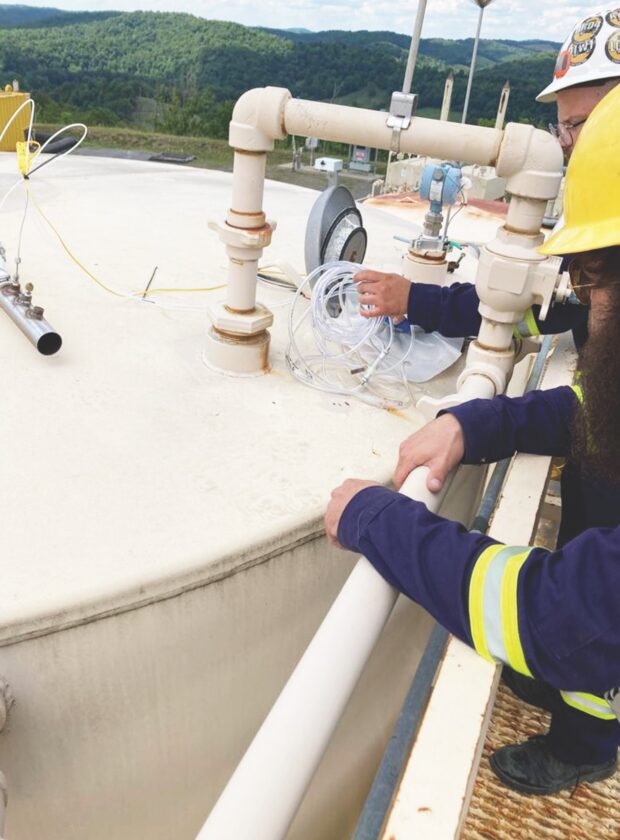
WVU students study methane leaks by taking a sample of vent emissions from a shale gas liquid storage tank to test it with a gas chromatograph. (Photo Provided)
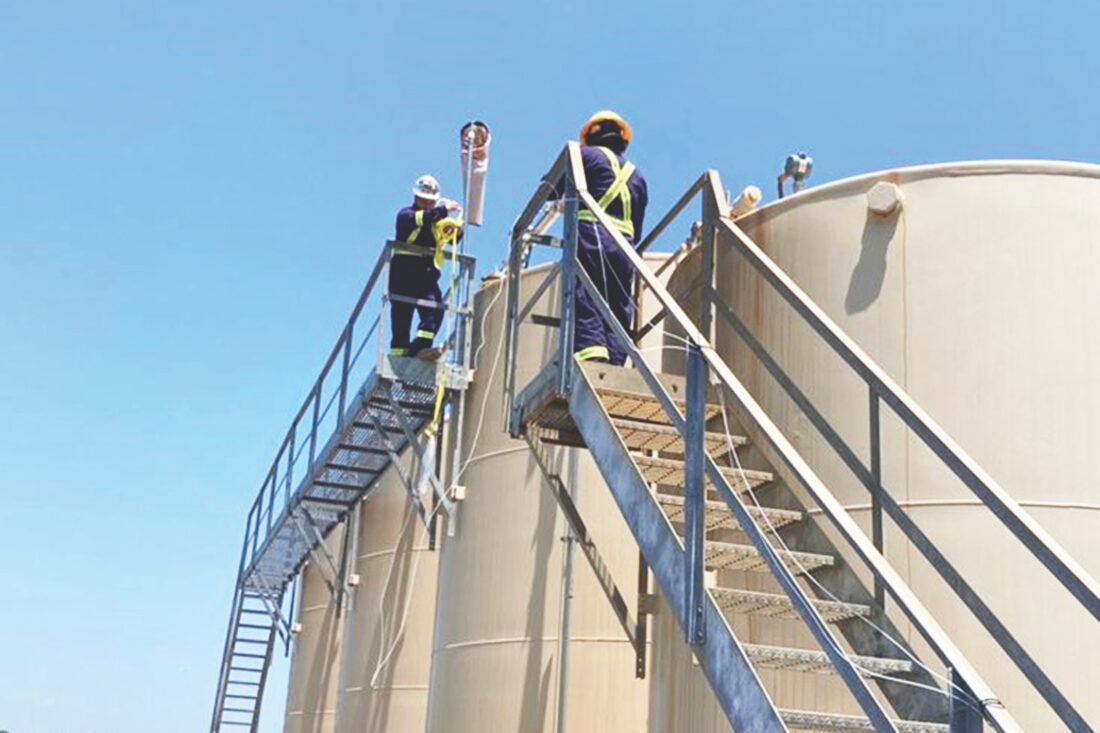
To record emissions flow and activity, West Virginia University student researchers attach instruments to water storage tanks at a natural gas production site. Funding from the U.S. Department of Energy will support methane emissions monitoring at sites in West Virginia, Ohio and Pennsylvania over the next three years, a project from the WVU Center for Alternative Fuels, Engines and Emissions. (Photo Provided)
WVU students study methane leaks by taking a sample of vent emissions from a shale gas liquid storage tank to test it with a gas chromatograph. (Photo Provided)
To record emissions flow and activity, West Virginia University student researchers attach instruments to water storage tanks at a natural gas production site. Funding from the U.S. Department of Energy will support methane emissions monitoring at sites in West Virginia, Ohio and Pennsylvania over the next three years, a project from the WVU Center for Alternative Fuels, Engines and Emissions. (Photo Provided)
Trending
MORGANTOWN -- West Virginia University will study methane leaks from storage tanks in West Virginia, Ohio and Pennsylvania to determine why they happen and their environmental impacts.
Over the next three years, the WVU Center for Alternative Fuels, Engines and Emissions will examine where and why leaks of methane and other gasses happen and their effects on local air quality and global climate.
The project will be funded by $5.5 million from the U.S. Department of Energy and will be led by Derek Johnson, associate professor at the Benjamin M. Statler College of Engineering and Mineral Resources.
The project, Storage Tank Emissions Assessments in the Marcellus to Acquire New Knowledge with Science, dubbed S.T.E.A.M. T.A.N.K.S., will measure methane and other volatile organic compounds and hazardous air pollutants emitted from liquid storage tanks located upstream at extraction sites and midstream at sites along the routes that oil and gas take to refining and processing facilities.
Methane is a planet-warming greenhouse gas.
"Methane is the second most emitted greenhouse gas in the U.S. after carbon dioxide," Johnson said.
Methane also is 28 times more potent than carbon dioxide at trapping heat in the atmosphere. Atmospheric methane concentrations have more than doubled over the last 200 years, with gas and petroleum systems constituting the second largest source of U.S. methane emissions after the agriculture sector.
Natural gas is made primarily of methane and when both gas and crude oil are produced, processed, transported and stored, methane emissions may leak into the air, offsetting some of the lower carbon benefits of natural gas.
Liquid storage tanks are "complex systems," Johnson said.
Tanks may be vented to the atmosphere or to emissions control devices. They may lose gasses when they are drained or filled and when they simply "breathe" day in and day out, due to natural changes over time in tank temperature and pressure, he said.