
Community backs vets in fight against PTSD, suicide
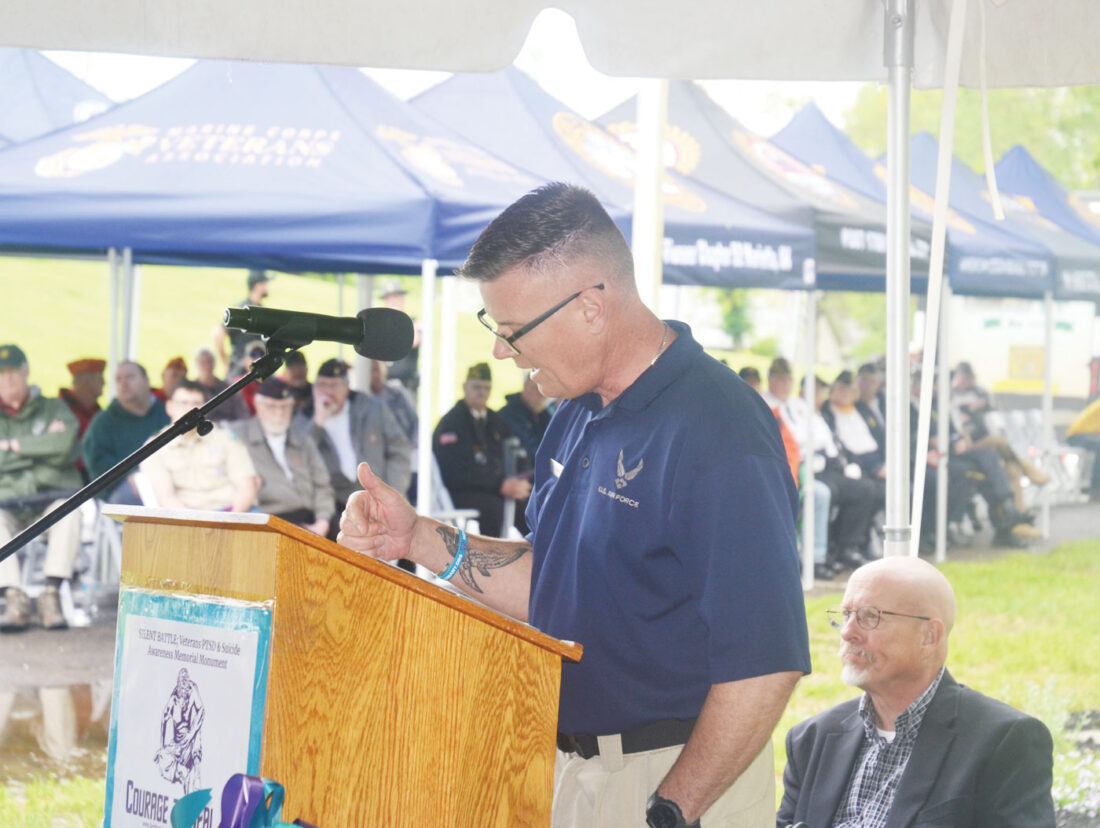
Chaplain Thomas H. Whiteman, United States Air Force, was one of the speakers at Sunday’s ceremony. He spoke about his own PTSD and suicidal ideation journey and how those who suffer with that are not alone. (Photo by Clara Noelle)
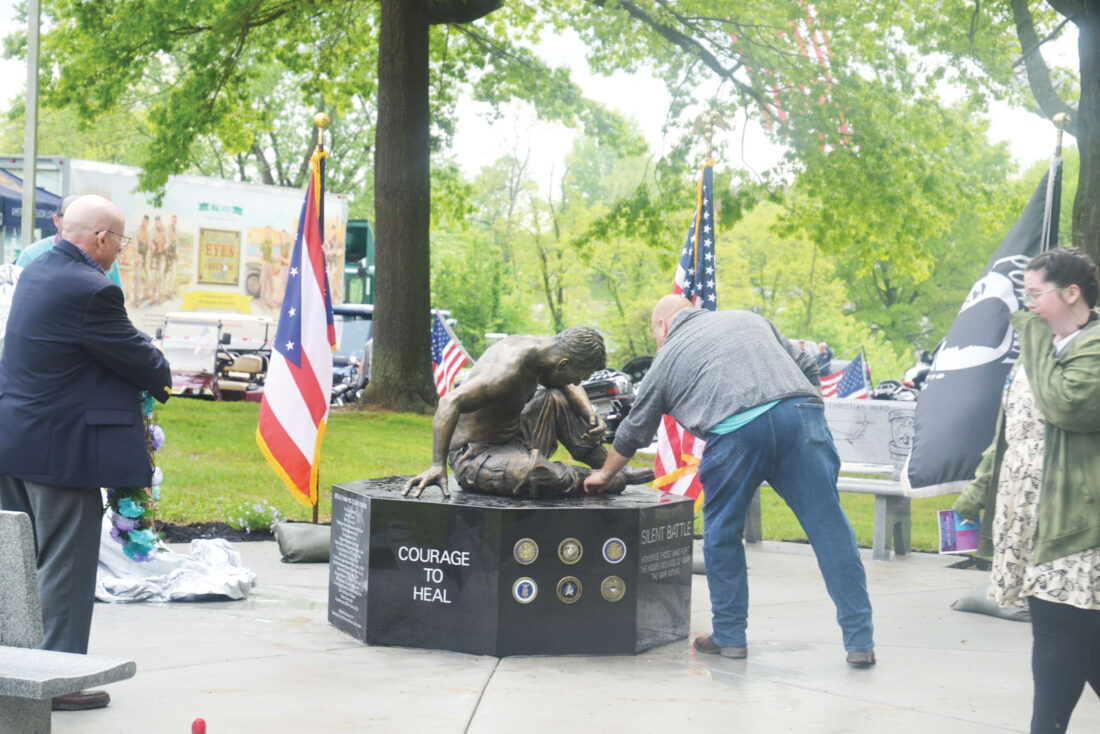
Gary Ward touches the Silent Battle soldier in memory of his late son, Christopher Ward, who died in a military accident. Ward and his wife, Karla, are members of the Silent Battle Committee. They have given a bench dedicated to him, which sits on the platform surrounding the statue. “He was terrified of spiders, so I had a spider carved on the back of the bench leg for him,” Ward said. (Photo by Clara Noelle)

Those who were at the unveiling had the opportunity to write phrases or names of loved ones to be remembered, then place them on the Silent Battle monument. A living soldier taking care of the tags of a fallen soldier is a familiar symbol of brotherhood. (Photo by Clara Noelle)
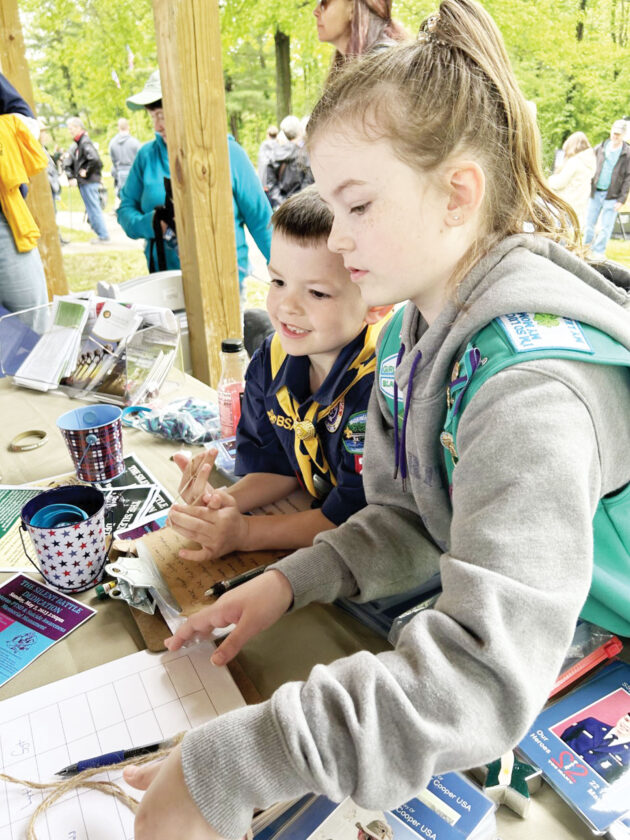
Gunner Smith 6, left, and his sister, Liberty, 10, both helped with Sunday’s activities. Gunner led the Pledge of Allegiance and Liberty is shown taking information for the City of Marietta’s planned Tree of Honor. Both are children of Silent Battle Committee founder Jared Smith and his wife Alison. (Photo by Nancy Taylor)

Will Yannitell, an Eagle Scout and member of the Silent Battle Committee, talks with some of the crowd Sunday at the Battlefield Cross Memorial Monument he was responsible for bringing to Gold Star Park. At the far right is Kim Wightman, stepmother of William “Brett” Wightman, one of the soldiers pictured in a painting in the “Eyes of Freedom” series done by artist Anita Miller. Brett Wightman’s image is displayed in a replica of the painting behind Yannitell. His family traveled from Washington Court House, Ohio to attend the ceremony and see the painting again. (Photo by Nancy Taylor)
Chaplain Thomas H. Whiteman, United States Air Force, was one of the speakers at Sunday’s ceremony. He spoke about his own PTSD and suicidal ideation journey and how those who suffer with that are not alone. (Photo by Clara Noelle)
Gary Ward touches the Silent Battle soldier in memory of his late son, Christopher Ward, who died in a military accident. Ward and his wife, Karla, are members of the Silent Battle Committee. They have given a bench dedicated to him, which sits on the platform surrounding the statue. “He was terrified of spiders, so I had a spider carved on the back of the bench leg for him,” Ward said. (Photo by Clara Noelle)
Those who were at the unveiling had the opportunity to write phrases or names of loved ones to be remembered, then place them on the Silent Battle monument. A living soldier taking care of the tags of a fallen soldier is a familiar symbol of brotherhood. (Photo by Clara Noelle)
Gunner Smith 6, left, and his sister, Liberty, 10, both helped with Sunday’s activities. Gunner led the Pledge of Allegiance and Liberty is shown taking information for the City of Marietta’s planned Tree of Honor. Both are children of Silent Battle Committee founder Jared Smith and his wife Alison. (Photo by Nancy Taylor)
Will Yannitell, an Eagle Scout and member of the Silent Battle Committee, talks with some of the crowd Sunday at the Battlefield Cross Memorial Monument he was responsible for bringing to Gold Star Park. At the far right is Kim Wightman, stepmother of William “Brett” Wightman, one of the soldiers pictured in a painting in the “Eyes of Freedom” series done by artist Anita Miller. Brett Wightman’s image is displayed in a replica of the painting behind Yannitell. His family traveled from Washington Court House, Ohio to attend the ceremony and see the painting again. (Photo by Nancy Taylor)
Trending
It was both a party and a grieving ground.
It was the military at its dressed-up ceremonial best, telling its stripped-down truths about the mind, heart and soul.
Unveiling and dedicating the Silent Battle statue at Gold Star Park Sunday afternoon was not a quick and simple ceremony. It took some reflection, some crying, some quiet reverence. And for some, it took even more to make it through the personal memories of PTSD and Suicide Awareness one more time.
Immediately after the statue was unveiled, Michelle White of the Silent Battle Committee asked those to come forward who were surviving family members of military fallen. They formed a large circle around the statue, hanging onto loved ones and participating in laying a memorial wreath.
Later, many others took up the suggestion to write their loved ones' names on dog tags that were supplied and place them on the statue. For others, it was enough just to touch the Silent Battle figure.
"Touch him," urged Anita Miller, who created the Silent Battle work of art. "Fill him with every part of your love. Charge him up like a battery, if you have that to give. Or take what you need from him. This is a meeting place of souls."
Chaplain Thomas W. Whiteman, United State Air Force, was one of the speakers who shared his story of a depression that built and built, and eventually shattered him. He was going to serve in Eastern Africa, and he felt that he was really ready for it physically, spiritually and emotionally, and was sure his resilience was strong.
A set of circumstances related to work made him feel isolated and unanchored. His tent was a "cave" that he went to when it got dark at night. Part of his recovery began when he was asked to develop a suicide prevention program, and he found himself angrily ignoring the feedback questions his colleague had developed. Eventually he began to admit to the colleague that he was struggling with his mental health. Long-distance, his wife urged him to share the truth with a close colleague there. And when he did, another soldier there with his colleague said two words that he will remember forever: "Me too."
From his experience and long road to recovery, Whiteman said he had four truths to share with the group:
¯ PTSD and suicidal ideation are not always combat-related. "I have never been in combat. But that does not diminish the impact PTSD can have on spirit, soul and psyche. Being rejected, then not being connected to a support community shattered me."
¯ PTSD and suicidal thoughts can happen to anyone. "I've always had people who tell me what a chaplain should and shouldn't do or feel," he said with a laugh. "You're a chaplain, you shouldn't feel that way." I repeat it can happen to anyone. Even a chaplain."
¯ Even if you're doing all the right things and you think you're prepared, these things can still happen.
¯ PTSD and suicidal ideation are shareable. "In the military in the past, you were always taught that talking about these kinds of wounds and hurts are shameful and shouldn't be shared. That is a baldfaced lie."
"My prayer," Whiteman said, "is that all who see this will know the end of the Silent Battle doesn't have to be the end of your life. Hope and healing are possible and available."
"If we share the Silent Battle, it will no longer be silent and have that isolating power over us," he said.
In her remarks to the group Sunday, Miller once again emphasized the fact that the day, the park, the ceremony, the statue and the various PTSD and Suicide Awareness activities over the weekend were not meant just for veterans, or even created exclusively by veterans. The Silent Battle Committee is composed of both civilians and veterans.
"The City of Marietta helped. Business leaders, community leaders, individuals joined in. They all came together. This is an amazing community, I see it in every single face here. And I would say that almost every single face here had something to do with this day. I have felt your love for the last year."
Even though the message is for all, not just veterans, Miller said veterans "do seem to capture it well" when it comes to putting the bitter taste of trauma into words. She recalls that a friend of hers who served in Viet Nam told her, "Grief is love with nowhere to go."
At the end, recording artist Bill Withers came back from 1972 and sang as if he had been at the Sunday gathering all along:
"Lean on me
When you're not strong
And I'll be your friend
I'll help you carry on."