
Marietta Council grants initial funding for eradication of slum and blight, possible revitalization efforts
Trending
Marietta City Council passed initial funding for the fledgling Residential Revitalization Pilot Program Thursday night with a series of votes.
With the exception of Councilman Bret Allphin, who abstained from voting because he is a member of the Southeastern Ohio Port Authority board, council members unanimously voted to suspend second and third readings and then pass the ordinance allocating $25,000 to start the program.
SeOPA and its executive director, Jesse Roush, are partners with the City of Marietta in the program that not only aims to eradicate slum and blight, but also focuses on properties that have the potential to be revitalized.
Using SeOPA's ability to function in much the same way as landbanks do in many other Ohio counties, the program can get money to return to the city, as well as flow out. Thus, the program eventually will have the ability to be self-sustaining.
Roush mentioned in his initial presentation to council that there also are large amounts of state money that will soon be flowing for demolition and site revitalization. Ohio Gov. Mike DeWine earlier this month signed the state's biennial budget legislation (HB 33) for FY 2024-2025 into law.
It means a second round of $350 million going through the Ohio Department of Development for brownfield remediation. The SeOPA-Marietta program would have some properties eligible for brownfield funding and others eligible for the Demolition and Site Revitalization portion, Roush said.
The $350 million will be split over two years; $1 million will be set aside for each county, with the remainder available on a first-come, first-served basis, according to the Lexology blog on energy and environmental law.
Roush said the program will first look at any properties already held by the city. Other qualities that will make properties attractive to the program are ones that are essential to amenities, or that can aggregate into a larger parcel for mixed use or multi-family uses.
"But we won't shy away from single-family residential lots, if it's the right relationship," he said.
When asked to name the most powerful item in the new program's "tool kit," Roush said it was the ability to enhance relationships among all involved, including builders, developers, SeOPA and the City of Marietta.
"This has all emerged from lots of collaboration that has already happened," Roush said, "If we can continue to work together and generate the money to acquire property and pay for design, this will be sustainable."
At Thursday night's council meeting, Mayor Josh Schlicher also expressed his optimism about the program.
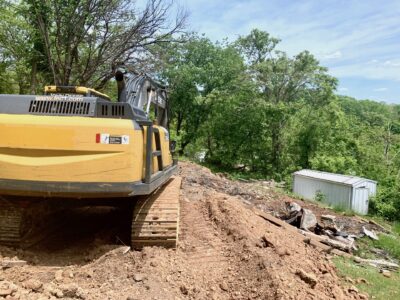
"We've made progress with numerous projects," he said. "We have done six demolitions already and have eight more to go, and we've done it by using state, city and American Rescue Plan Act funds. Demolitions take a lot of funding.
"But we're building the momentum with this," he said of the program. "Now it's not just demolition, it's remediation, demolition, revitalization. Working with the SeOPA group will let us take the next step, go after targeted areas. With the port authority helping us, we can take care of our neighbors and our neighborhoods."
Schlicher also made reference to a comment at an earlier meeting, when councilwoman Cassidi Shoaf acknowledged the tremendous number of blight issues that have slowly built up and encroached on the city. In the recent past, council has had to fight that "like we're using a machete to fight back the jungle," she had concluded.
Thursday, Schlicher built his own imagery, saying it wasn't a machete they would be using now.
"We can be using bulldozers and dump trucks," he said.