
Jury hears testimony on evidence, autopsy in day four of Hernandez Diaz murder trial

Chief Deputy Coroner Sean Swiatkowski, of the Montgomery County Coroner’s Office, points to where Abraham Olvera received a fatal wound during the trial of Oscar Hernandez Diaz Thursday. (Photo by Douglass Huxley)
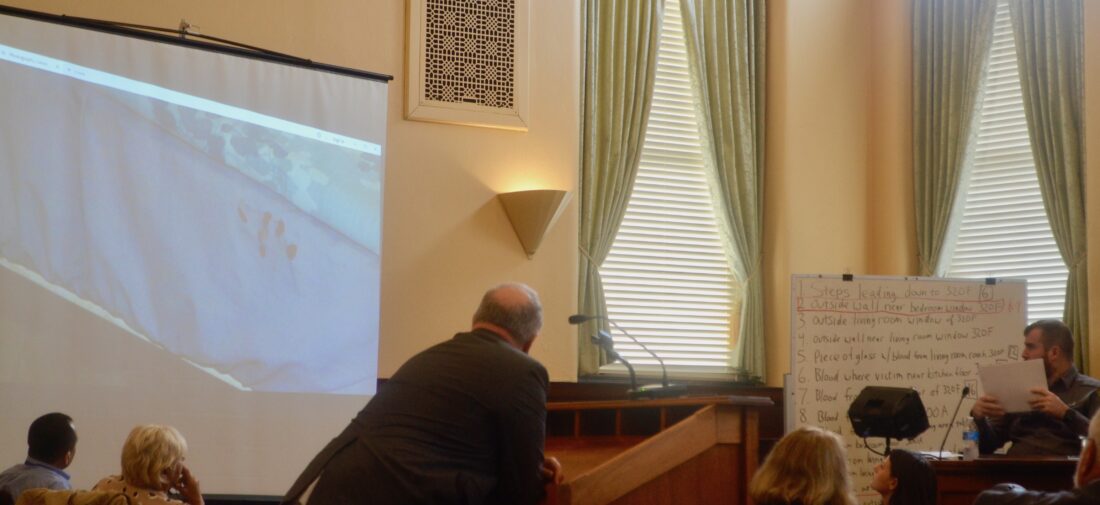
Defense Attorney Raymond Smith shows Patrolman Robert L. Ritchie a blood stain located on one of the beds in the bedroom of Oscar Hernandez Diaz and his brother Isaac Hernandez Diaz. (Photo by Douglass Huxley)
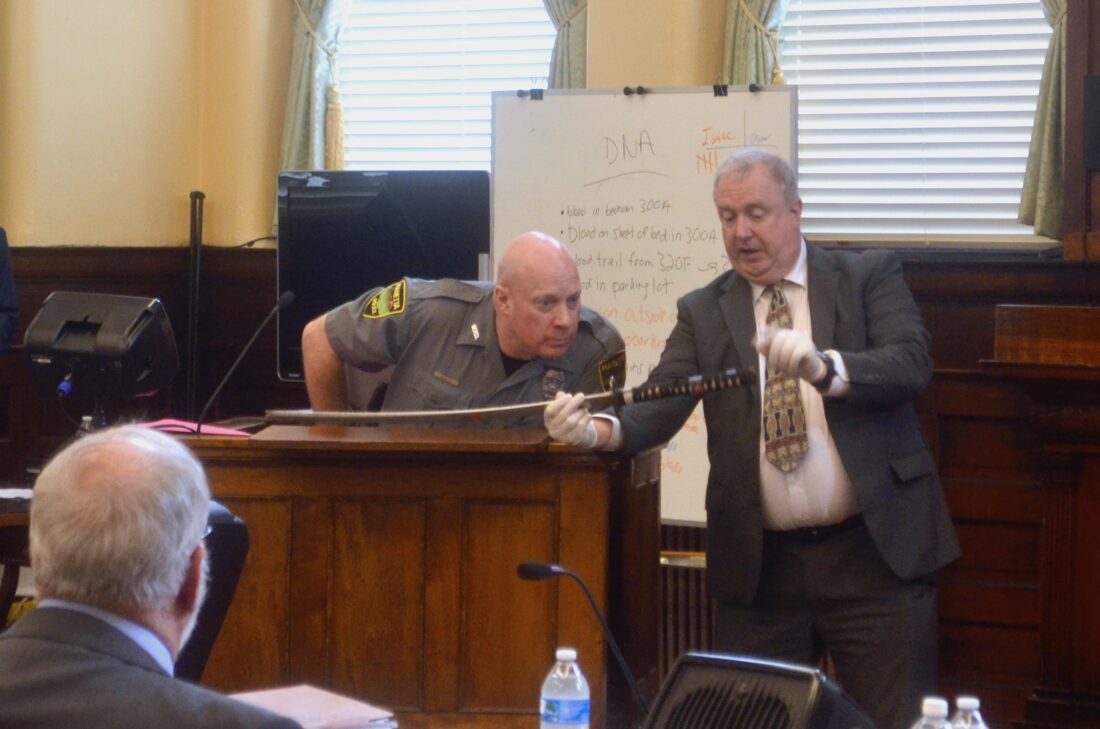
Patrolman Bradon Wenzel, who works in the evidence room of the Marietta Police Department, looks over the murder weapon with defense attorney Raymond Smith as the trial of Oscar Hernandez Diaz continued Thursday. (Photo by Douglass Huxley)
Chief Deputy Coroner Sean Swiatkowski, of the Montgomery County Coroner’s Office, points to where Abraham Olvera received a fatal wound during the trial of Oscar Hernandez Diaz Thursday. (Photo by Douglass Huxley)
Defense Attorney Raymond Smith shows Patrolman Robert L. Ritchie a blood stain located on one of the beds in the bedroom of Oscar Hernandez Diaz and his brother Isaac Hernandez Diaz. (Photo by Douglass Huxley)
Patrolman Bradon Wenzel, who works in the evidence room of the Marietta Police Department, looks over the murder weapon with defense attorney Raymond Smith as the trial of Oscar Hernandez Diaz continued Thursday. (Photo by Douglass Huxley)
Trending
The fourth day of the trial of Oscar Hernandez Diaz, 42, who is accused of killing Abraham Olvera on May 21, 2022, began Thursday with testimony from Chief Deputy Coroner Sean Swiatkowski, of the Montgomery County Coroner's Office, who performed the autopsy on Olvera.
Swiatkowski said Olvera died from a puncture to his aorta. He said he had a wound eight inches deep in the right side of his torso.
"The aorta was what the fatal injury was," Swiatkowski said. "So if you move it half an inch left or right, he may not have died from this injury."
Swiatkowski said no other major organs were damaged. He said the toxicology report showed a measurement of 0.01 of ethanol in Olvera's vitreous fluid. He said if a person had been drinking alcohol all day that number would be higher.
Patrolman Bradon Wenzel, who works in the evidence room of the Marietta Police Department, testified to how evidence is processed and transported for analysis. He said officers will place their initials on the seal of any evidence they collect and then place them in temporary lockers. Wenzel said he collected the evidence for this case from those lockers on May 24, 2022.
"After an officer puts it in the temporary evidence locker, he locks it, and no one else has a key to that but me," Wenzel said. "So, no one can get to it until I get back."
He said additional items from the case were put in over time as the investigation continued. He said anytime there is an interaction with an item in evidence, another seal with the initials of the person who opened it would be placed on it. He said the labels only indicate who collected the evidence, not who delivered it to the evidence room.
Wenzel said he transported items from the evidence locker to the Ohio Bureau of Criminal Investigation in Madison County on May 31, 2022.
Defense Attorney Raymond Smith pointed out a red dot label on the katana sword used to kill Olvera that appears in photos taken but is no longer on the sword. Smith also went through items of evidence he had Wenzel bring with him to court, including a piece of broken glass with fingerprints on it. He asked Wenzel if he took these items to the Ohio Bureau of Criminal Investigation which he responded he did not. Wenzel said he doesn't have control over the items sent to the crime lab and that they have a limit on the items they will take.
Patrolman Robert L. Ritchie said he received two weeks of training in 2018 to be certified as an evidence tech.
"Basically my responsibility whenever I get a call, or we have something like this, is to take photographs, collect evidence, things like that," Ritchie said.
Smith had Ritchie go through photos collected as evidence to indicate which ones he had taken. Smith then wrote on a whiteboard the 14 blood samples Ritchie had taken and circled two. He then asked Ritchie why only two of the 14 samples were sent to be tested. Ritchie said he has no control over the items sent for testing.
Smith then showed Ritchie a picture of the bedroom belonging to Oscar Hernandez Diaz, and his brother Isaac Hernandez Diaz, who took a plea deal in February and pleaded guilty to attempted felonious assault for his involvement with the murder of Olvera, which appeared to show an alleged blood stain on one of the beds.
Smith asked if Ritchie noticed this during his evidence collecting and he responded, no. He said he did not collect the sheet the stain was on, either.
"Does that appear to be a blood stain on that sheet," Smith asked.
Ritchie responded yes.
Smith then asked if it was consistent with four fingers in which Ritchie said it appeared so.
Smith then showed Ritchie a picture of someone's feet in a photo with blood stains on the floor. He asked Ritchie if he was the person who took the photo and if it was his feet, to which he replied yes.
"Are you standing in blood stain," Smith asked.
"I'm standing around blood stains, yes," Ritchie replied.
Testimony in the case will resume today at 9 a.m.