
Improved beacons installed at seven Marietta crosswalks
Trending
If some of the crosswalks in the City of Marietta look a little flashier lately, it's not just a style statement.
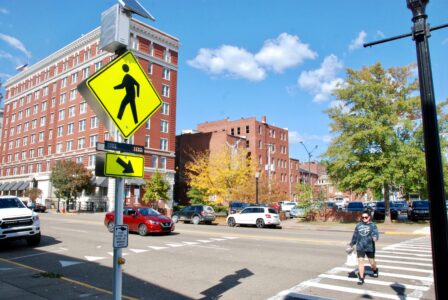
Seven crosswalks in town now have Rectangular Rapid Flashing Beacons, or RRFB, that improve pedestrian safety and motorists yielding to them at crosswalks.
RRFBs have two rectangular-shaped yellow indicators, each with a light-emitting diode (LED)-array-based light source. An RRFB's indicators flash with a changing, rapid frequency when activated, in order to increase the attention of approaching motorists.
The flash rates are regulated to avoid frequencies that might cause seizures.
RRFBs are placed on both sides of a crosswalk below the pedestrian crossing sign and above the diagonal downward arrow plaque pointing at the crossing. A pedestrian about to use one of the RRFB crosswalks can activate the flashing light pattern with a push button.
RRFBs have to be used judiciously, City Engineer Bob Heady explained, so that they're not so commonplace that they're eventually overlooked. They're not used in conjunction with other types of controls, such as stoplights, stop signs, yield signs and other versions of pedestrian beacons. RRFBs also are to be limited to locations with speeds of less than 40 mph.
But in certain conditions, they do quite a bit to draw more attention to the presence of pedestrians and increase driver awareness. The RRFB on Second Street between Putnam and Butler, for example, is coupled with a crosswalk that covers four lanes of traffic.
Heady thinks the RRFB on Lancaster Street west of Harmar Street is very important because it's near the Boys and Girls Club of Washington County.
Marietta's other RRFB's, in addition to Second Street and Lancaster Street, are:
¯ Glendale Road north of Seventh Street,
¯ Jefferson Street south of Pike Street,
¯ Virginia Street east of Franklin Street,
¯ Franklin Street south of Clinton Street and
¯ Third Street north of Sacra Via Street.
One is planned on Colegate Drive west of Academy Drive in FY 2026 as part of Safe Routes to School.
The average installation is about $15,000, Heady said. The city and its engineering department managed to pay for the RRFBs with a variety of funding approaches. Heady provided information on costs and funding methods for what has been done so far:
¯ Glendale Road north of Seventh Street -- Safe Routes To School (SRTS);
¯ Lancaster Street west of Harmar Street -- Lancaster Street crosswalk funded with Community Development Block Grant funds, the RRFB funded by Creating Healthy Communities through the Washington County Health Department, $9,996. There was $1,550 in local street funds used for foundations and the RRFB's were installed by city personnel;
¯ Jefferson Street south of Pike Street -- Signal/Fiber Phase 2 funded by Congestion Mitigation and Air Quality Improvement (CMAQ) Federal Clean Air Funds and State Toll Revenue Credits (bonds backed by toll revenue from the Ohio Turnpike);
¯ Second Street between Putnam Street and Butler Street -- WAS-Pedestrian Improvements -- Safety Funds;
¯ Virginia Street east of Franklin Street -- Ohio Department of Health Grant, $17,480 purchase and $1,875 pedestals, installed by city personnel;
¯ Franklin Street south of Clinton Street -- Ohio Department of Health Grant, price listed above in Virginia Street is for both locations; and
¯ Third Street north of Sacra Via Street -- Urban Paving Project, $21,300 purchase and installation (80/20 match of local dollars).