
Local surgeon emphasizes awareness, community at breast cancer info session
Trending
If there's a woman in this area who learns she has breast cancer, the last thing she should be is afraid. That is because she is not alone.
That is the observation of oncological surgeon Dr. Rajendra Bhati, MD, who has practiced in southeastern Ohio for the past 13 years and is proud of the care and the caring available.
Bhati, known to many through the Memorial Health System, said women here have a good hospital and a supportive, involved community.
"I'm proud of -- and everybody should be proud of -- our medical community, medical campus and community," Bhati said.
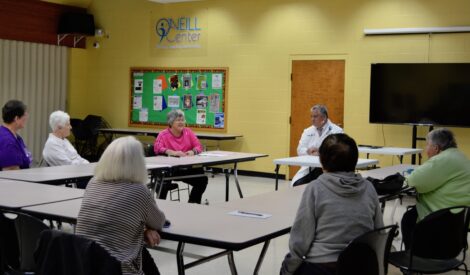
Bahti and Jane Kessler, MHS Breast Health Navigator, spoke to a group of women who gathered last week for an informational session the O'Neill Center offered on breast cancer, marking October Breast Cancer Awareness Month. Bhati and Kessler talked about the importance of awareness, early detection, self-examinations, mammography and the risk factors associated with breast cancer.
"I am a resource for the community. I work for the hospital and I have been a navigator for all types of malignancies, but working with breast cancer patients is my passion," said Kessler, who is a Registered Nurse, Oncology Certified Nurse and Certified Navigator.
A team of board-certified representatives from all disciplines involved in cancer care meet regularly to discuss each patient's case and treatment plan. This includes surgical oncologists such as Bhati and navigators such as Kessler, along with pathologists, radiologists, chemotherapists and personnel from any related health areas.
The new patients from each week are introduced to the system through a Breast Clinic held each Wednesday.
The result is better communication all around, minimizing of errors and a shorter time to deliver an individual's treatment plan.
"Jane is the quarterback for all of this," Bhati said, referring to Kessler.
"Sometimes healthcare seems fragmented and breast cancer is so complicated," Kessler said. "So we work as a team."
"We all have a friend or family member who has faced this," Bhati said of breast cancer.
It is the second-most common type in the U.S., after lung cancer. There are 600,000 cases diagnosed nationally each year and 130 to 150 a year in the MHS breast cancer program.
"Statistically, one in every eight women will deal with breast cancer," he said. "Most of those are survivors."
Men can get breast cancer as well, though many are likely to ignore initial symptoms as sports injuries. Theirs tends to be more aggressive, with more genetic mutations.
The average age when breast cancer is diagnosed in the U.S. is 62, he said.
"But we have a 24-year-old and a 94-old year old right now."
Those who practice good health habits also can be affected because genetics play a role.
Kessler and Bahti fielded a number of questions from those attending the O'Neill session. Their overall message to the audience was one of optimism:
MHS has "phenomenal" diagnostic equipment and "incredible" radiologists, according to Bahti.
Memorial is now affiliated with the Mayo Clinic and can consult with the tumor board there.
Cardio toxicity related to radiation dosage is nothing like it used to be 20 or 30 years ago; doses now are very small.
The 3-D mammogram system presents multiple slices to be examined, rather than a one-dimensional view.
The Wednesday breast clinics for new patients, the navigator program and the multidisciplinary physicians' treatment approach are all working toward a more effective outcome.
"Our medical campus, our outreach and our capabilities have really grown," Bhati said. "There's a lot of community awareness and hospital support. This is a resource-rich situation, which I love."