EPA announces new forever chemicals sampling agreement with Chemours
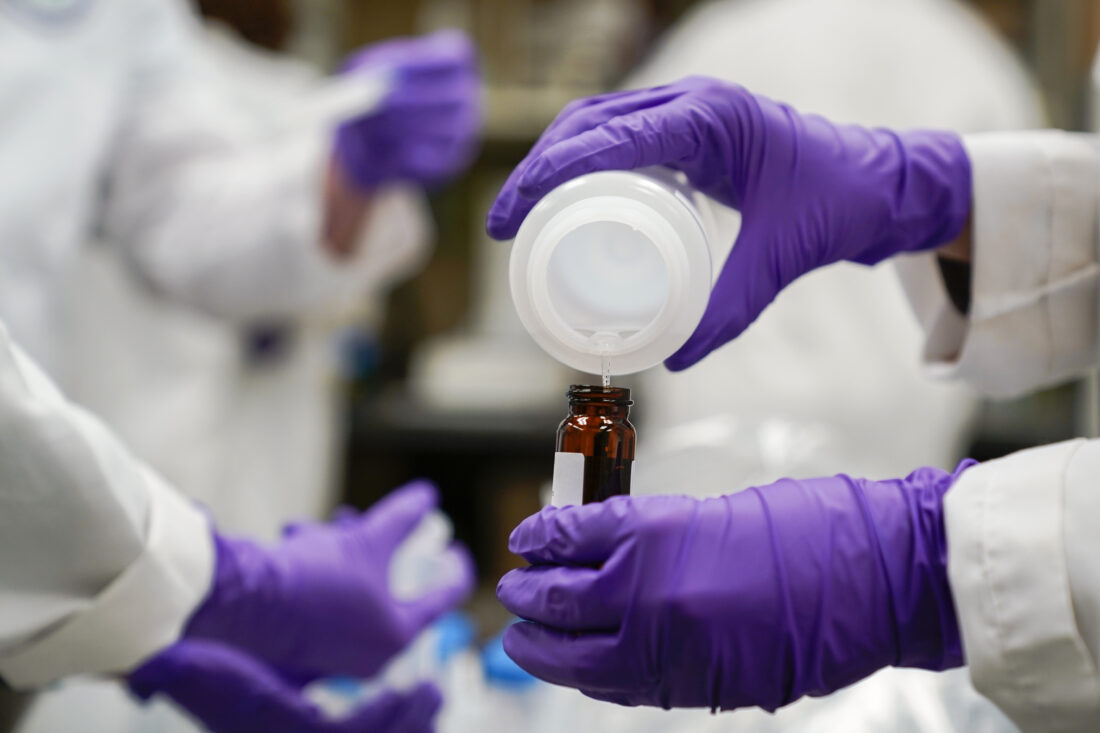
FILE - Eva Stebel, water researcher, pours a water sample into a smaller glass container for experimentation as part of drinking water and PFAS research at the U.S. Environmental Protection Agency Center For Environmental Solutions and Emergency Response, Feb. 16, 2023, in Cincinnati. Excessive compliance costs have forced Wisconsin regulators to stop developing standards limiting so-called forever chemicals, of PFAS, in groundwater, Gov. Tony Evers said Tuesday, Dec. 19. (AP Photo/Joshua A. Bickel, File)
PARKERSBURG — Chemours will conduct new sampling for “forever chemicals” around its Washington Works facility under an agreement announced this week by the U.S. Environmental Protection Agency.
Per- and polyfluroalkyl substances, or PFAS, are often called forever chemicals because of how long they last in the environment.
The agreement under Section 3013 of the Resource Conservation and Recovery Act requires the company “to take samples and analyze soil, surface water, sediment, groundwater and certain waste streams generated by the facility to collect information on known and potential PFAS contamination,” according to a release from the EPA.
The goal is to provide data to improve understanding of the extent of PFAS contamination and how migration of the substances may affect communities.
The Washington Works facility on the southeast bank of the Ohio River in Washington, W.Va., has been the site of the manufacture, production and use of a variety of PFAS since 1951, the release said. Perhaps the best known is C8, or perfluorooctanoic acid, which was used in the production of Teflon while the plant was owned by DuPont. It has been linked to adverse human health effects including some types of cancer.
C8 was replaced by another PFAS material, hexafluoropropylene oxide dimer acid, also known as GenX, in 2012. But C8 has persisted in the local environment, and GenX has been found in local water supplies as well.
The EPA has proposed new guidelines for PFAS this year, including a new maximum contaminant level of 4 parts per billion for C8. GenX and three other PFAS compounds – PFBS, PFNA and PFHxS – would be considered together, with their health risk evaluated using a hazard index. A combined value greater than 1 would exceed the recommendation.
“Chemours and other PFAS manufacturers must be held accountable for contamination from forever chemicals,” said Assistant Administrator David M. Uhlmann of EPA’s Office of Enforcement and Compliance Assurance.
“EPA is working closely with Ohio and West Virginia to determine the extent of PFAS contamination from the Washington Works facility and will ensure that Chemours takes steps based on the sampling results to better protect nearby communities from forever chemicals.”
In a statement Friday, Chemours emphasized the agreement was voluntary and “not based on any allegations of non-compliance.”
“Chemours continually strives to be an environmental leader within our industry and the communities where we operate,” the statement said. “Chemours voluntarily agreed to work with the U.S. Environmental Protection Agency to use our expertise in fluorinated chemistry to advance research into compounds found in soil and water at and around the Washington Works location. Through further sampling, analysis, monitoring and reporting, we hope to complete a more comprehensive environmental assessment and site conceptual model which will benefit us, the community and EPA.
“(The agreement) builds on the significant research Chemours and its predecessor have already done to advance knowledge of older legacy compounds around the site,” it said.
An EPA representative said Friday that no timeline for the testing has been established yet.
“Under the agreement, Chemours must submit an updated conceptual site model (CSM) for EPA approval,” she said. “Once the CSM is approved, Chemours has roughly three months (or 90 calendar days) to submit a sampling and analysis work plan. Sampling will occur after EPA approves the plan.”
It was not immediately clear Friday whether this agreement was related to an enforcement action against Chemours that EPA announced in April, after PFAS levels in discharges from Washington Works exceeded the levels allowed by the facility’s Clean Water Act permit multiple times between 2018 and March 2023. That required the company to implement a sampling plan approved by the EPA to analyze the presence of the chemicals in stormwater and effluent, then submit and implement a plan to treat or minimize the discharges to keep them within permitted limits.
Local News

Washington County Common Pleas Judge Mark Kerenyi announces retirement
Boil advisory for 400 city water customers near Ohio River
A boil advisory has been issued for hundreds of city water customers along the Ohio River due to a water main ...

Andrew Mountbatten-Windsor arrested on suspicion of misconduct in public office over ties to Epstein
Downtown Parkersburg bridge ramps to be replaced over 2 years

Vienna workshops to feature expert in belly dancing