
Academy projects: Marietta BOE shows potential school additions
Marietta BOE shows potential school additions
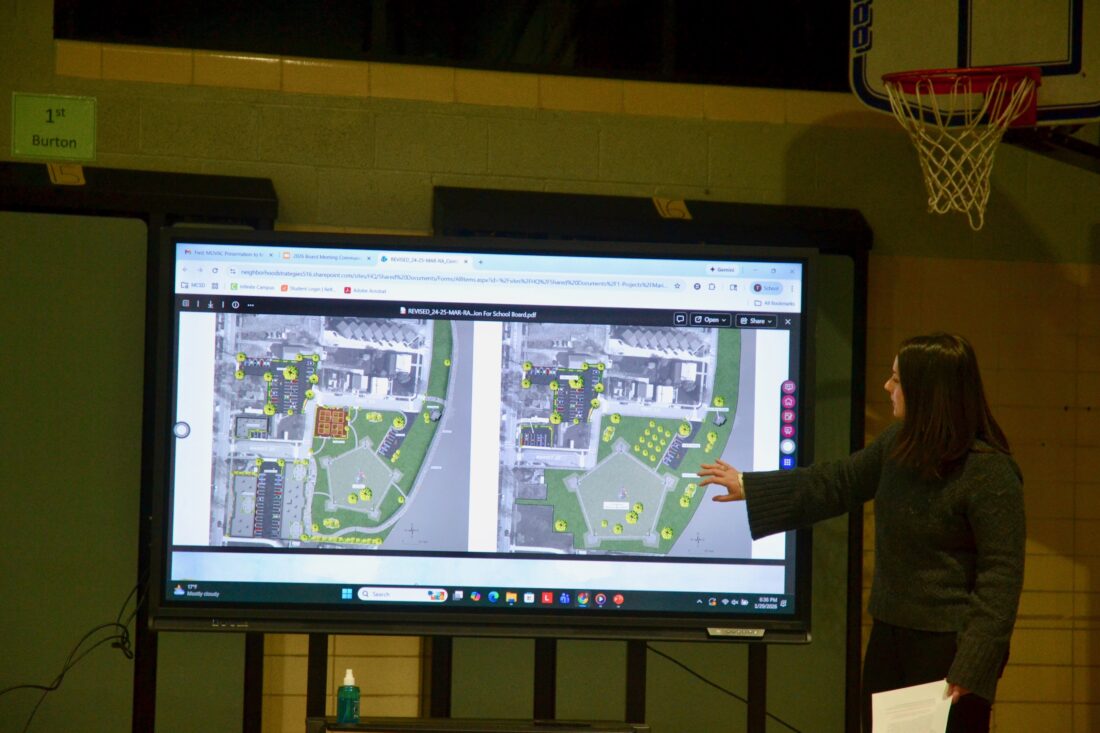
(Photo by Douglass Huxley) Stephanie McManus, managing principal for Neighborhood Strategies, shows the Marietta City Schools Board of Education two visual representations of what the former Harmar School property could become if it was made into a historical park during Thursday’s board meeting.
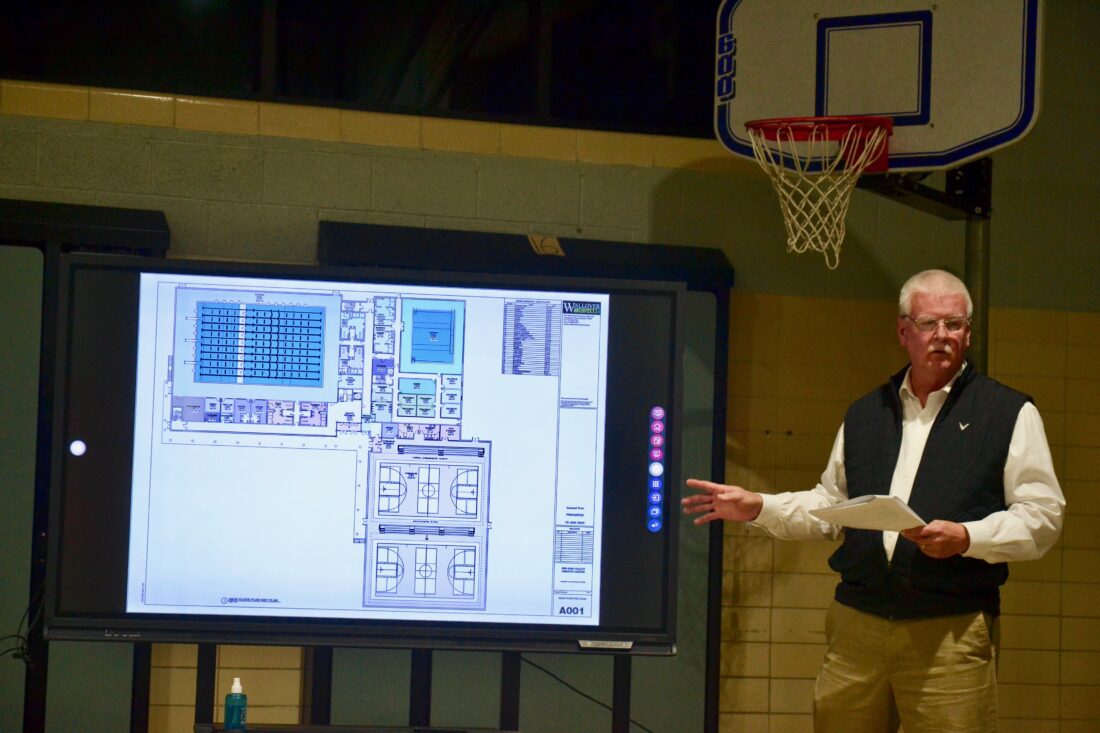
(Photo by Douglass Huxley) Gene Hollins, a board member of the Mid-Ohio Valley Aquatic Center, presented the Marietta City Schools Board of Education with an architectural design for what a new aquatic center could look like. Hollins, and others from the MOVAC, proposed they build the $25 million regional aquatic and recreation complex on the Colgate Street side of the Marietta High School building.
(Photo by Douglass Huxley) Stephanie McManus, managing principal for Neighborhood Strategies, shows the Marietta City Schools Board of Education two visual representations of what the former Harmar School property could become if it was made into a historical park during Thursday’s board meeting.
(Photo by Douglass Huxley) Gene Hollins, a board member of the Mid-Ohio Valley Aquatic Center, presented the Marietta City Schools Board of Education with an architectural design for what a new aquatic center could look like. Hollins, and others from the MOVAC, proposed they build the $25 million regional aquatic and recreation complex on the Colgate Street side of the Marietta High School building.
Trending
The Marietta City Schools Board of Education received a comprehensive community development assessment for the former Harmar School property Thursday night, outlining a vision that blends history, education, riverfront access and mixed‑use development.
The assessment, led by Neighborhood Strategies through the Mayor's Partnership for Progress at Ohio University, is not a final redevelopment plan, but a community-informed roadmap of what the site could become - and what steps might be needed to get there.
Former board member Sam Tuten and Marietta City Planning and Development Director Geoff Schenkel joined representatives from Neighborhood Strategies to talk about the assessment for the former elementary property. Tuten said this work was about ideas and options, not an immediate decision on the future of the property.
"Hopefully, it's the foundation of what you know the community would like to see," Tuten said. "And could help any future decision, as you have future deliberations about the property."
Tuten said by law, the state limits how the district can handle the former school property. He said the district can either transfer or sell the property to a public entity or do a public auction.
"It's only after the public auction that there is any kind of private sale," Tuten said.
Schenkel said as the planning and development director he took an early and proactive role by securing a grant to fund the assessment.
"It was a relatively easy thing for my department to write a little more than $51,000 grant to the Mayor's Partnership for Progress at the Voinovich School at OU, which we competed for and received, which allowed you not to have to do that work," he said.
He said whether the city wanted to be drawn into the discussion or not, they would be and to avoid being unprepared when and if the school board decides to dispose of the property, the city chose to "do its homework" now.
"We wanted to do whatever homework we could so that we would be armed with as much data as possible to make a decision," Schenkel said. "We did want to do what we could to get things started."
Stephanie McManus, managing principal for Neighborhood Strategies, said the depth of engagement that shaped the assessment involved many layers of community input. She said the methods to collect that input included two exploratory site visits, background research and analysis, ongoing public project website, six oversight steering committee meetings, two public meetings, two public interactive surveys, a stakeholder charrette planning workshop, youth focused websites, a youth survey, a youth drawing activity and stakeholder interviews.
She said from that input the group developed four preliminary concepts ranging from adaptive reuse of the existing school building with mixed‑use development, to a fully historic park focused on Fort Harmar.
"We started with four, and they sort of went across the spectrum of what it could be," McManus said. "There was broad support for multiple uses at the site that engage children, teens and adults, a desire for flexible green spaces and safe public access to the rivers that also celebrate Marietta's history."
The blended final concept included:
– Retaining the school building and adaptively reusing it as a shared home for community-focused nonprofits and flexible community spaces.
– A natural playscape and water-related play area for younger residents that safely references Marietta's rivers and history.
– A riverfront walkway improving public access to the water while honoring Fort Harmar and indigenous and local history.
– Flexible green space that could host events and programming, potentially including existing festivals.
– Potential mixed‑use development along Gilman Avenue, with housing and possible ground‑floor storefronts.
"We kept the building in the final concept that we're putting forward, and suggested that several local nonprofits could use, share the building, and have shared services there," McManus said. "So that it was flexible and served as many purposes as possible."
She said the potential mixed‑use along Gilman Avenue could be completely residential, or could have some storefronts below, which she said is really important for diversifying the tax base and reducing revenue pressure to the city if they were managing any parts of this site.
Schenkel said that vision could be linked to the city's ongoing zoning rewrite.
"The city is rewriting its entire zoning chapter... Now is the time where we could consciously lean into some of those trends, if Marietta chooses to do that," he said.
McManus said implementation of any plan would be dependent on partnerships, feasibility and funding. She said Neighborhood Strategies has identified potential funding avenues and packaging strategies that could help with the next steps in the process.
"We've tried to package these concepts into what would be likely to receive funding... to give you next steps or a map to move forward on this," she said.
Tuten closed by stressing both the opportunity and the reality that any future project will require significant outside effort.
Members of the Middle-Ohio Valley Aquatic Center (MOVAC), a nonprofit organization formed in response to the loss of local pools and what they say is a growing need for both competitive and instructional aquatic facilities, made a proposal to the board for a $25 million regional aquatic and recreation complex to be built on the Marietta High School property, aiming to address critical gaps in swimming access, gym space and youth recreation across the Middle-Ohio Valley.
"There was a real need in this community for kids to swim, for people to learn to swim, for swim teams in the county and the region to have a facility where they can do that," Jennifer Garrison, treasurer for the organization, said.
Garrison said the project has $5 million in funds already committed and that the effort was backed by a significant personal commitment from Dr. Greg Krivchenia, founder and board president of the organization.
"(He) recognized the need for a regional indoor facility to support competitive swimming, aquatic activities and teach kids how to swim," Garrison said. "He donated nearly $3 million, and that's seed money for this project to get started, which can make a huge difference in a small community like this."
The group, which included MOVAC board members Gene Hollis and Josh Jacobs, said it has evaluated multiple sites – including locations in Belpre and Parkersburg – and its consultants identified land adjacent to Marietta High School as the preferred option.
"Let me just cut to the chase. I think the high school site is the ideal location for this facility," Hollis said.
The group said the proposal envisions a separately owned, but closely integrated facility that connects physically and programmatically with the high school's academic and athletic campus. They said the site would allow students to walk under cover directly from the school to the new building.
Working with an architect that specializes exclusively in aquatic facilities and guided by a professional feasibility study, the group said it has developed a concept that includes:
– A 25-yard competition pool with a movable bulkhead, allowing simultaneous practice, warm-up, and competition configurations.
– Seating for spectators on a second level, with viewing for swim meets.
– A warm-water therapy and instructional pool, designed for learn-to-swim programs, physical therapy, and water aerobics and wellness programs
– Medical office space (initially ~2,500 sq. ft. on the first floor, with ~11,000 sq. ft. of additional leasable space above for medical, therapy, or related services).
– Two full-size gymnasiums, helping address chronic gym shortages created by prior school consolidations and supporting both school athletics and community recreation (including pickleball and senior activities).
– Multi-use rooms for parties, meetings, and community programming.
"I believe this is the first step towards a vision that can establish Marietta City School District as a regional leader, leveraging our assets and this recreational asset to move our community forward," Jacobs told the board.
Jacobs cited a projected financial statement indicating an estimated direct annual economic impact of $1.5 to $2.3 million from visitors spending on hotels, restaurants, gas and shopping tied to events and year-round activity at the site.
"This can provide life-saving water safety and skills to students and a direct economic impact to our community," Jacobs said.
The group said they envision a public-private partnership structure involving MOVAC, Marietta City Schools and likely the Southeast Ohio Port Authority. They estimate the core facility cost around $18 million plus an additional $5-7 million for the pool systems and related specialized equipment, yielding a working budget of roughly $25 million. They said they plan to obtain funds through grants, lease agreements and sponsorships and philanthropic gifts.
"You can never guarantee philanthropy," Jacobs said. "The thing that we can guarantee is our input... Because of the expertise that you're seeing here in front of you today... we can come up with an expectation and a benchmark and a plan."
Garrison said a key short-term pressure is a $750,000 state grant already awarded to the project, which requires the group to define how those funds will be used by the end of June.
"We got $750,000 from the state that we need to complete everything -- the paperwork -- for by the end of June, which means we really need to get this all worked through. So we need to pick a location soon," she said. "We can't move forward with a fundraising campaign until we have identified a location. So we are looking for a commitment that you will work with your attorneys and work with us to enter into a memorandum of understanding so that we can lease the land."
Board President Cody Parmen said the school board looks forward to continuing the conversation and sorting out all of the details. He said the board would add this matter to its Facility Committee meeting agenda next month.
"This is on the docket to have a more in-depth conversation," Parman said.
Garrison closed by framing the project as a rare, time-sensitive chance for the community to leverage significant local investment.
"When has this community ever had $5 million to leverage other dollars they're applying for to make it happen? There is real opportunity here," she said.