Building Bridges to Careers event highlights regional collaboration to support future workforce
Event highlights efforts to support future workforce
-
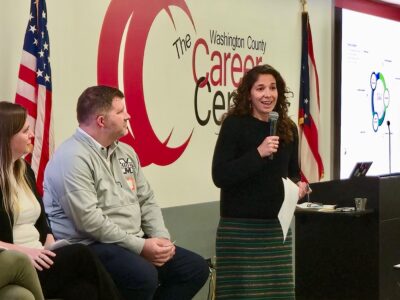
- (Photo by Gwen Sour) Emily Bentley, education engagement specialist for Building Bridges to Careers, introduces a panel of educators during the Building Bridges to Careers Community and Business Advisory Council meeting hosted at Washington County Career Center on Thursday.
-
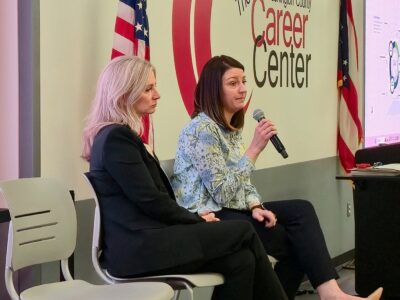
- (Photo by Gwen Sour) From left, Marietta College President Kathleen Dougherty and Appalachian Ohio Manufacturers’ Coalition Executive Director Dana Hermann discuss how state-level investments can strengthen the Appalachian workforce during a meeting Thursday.
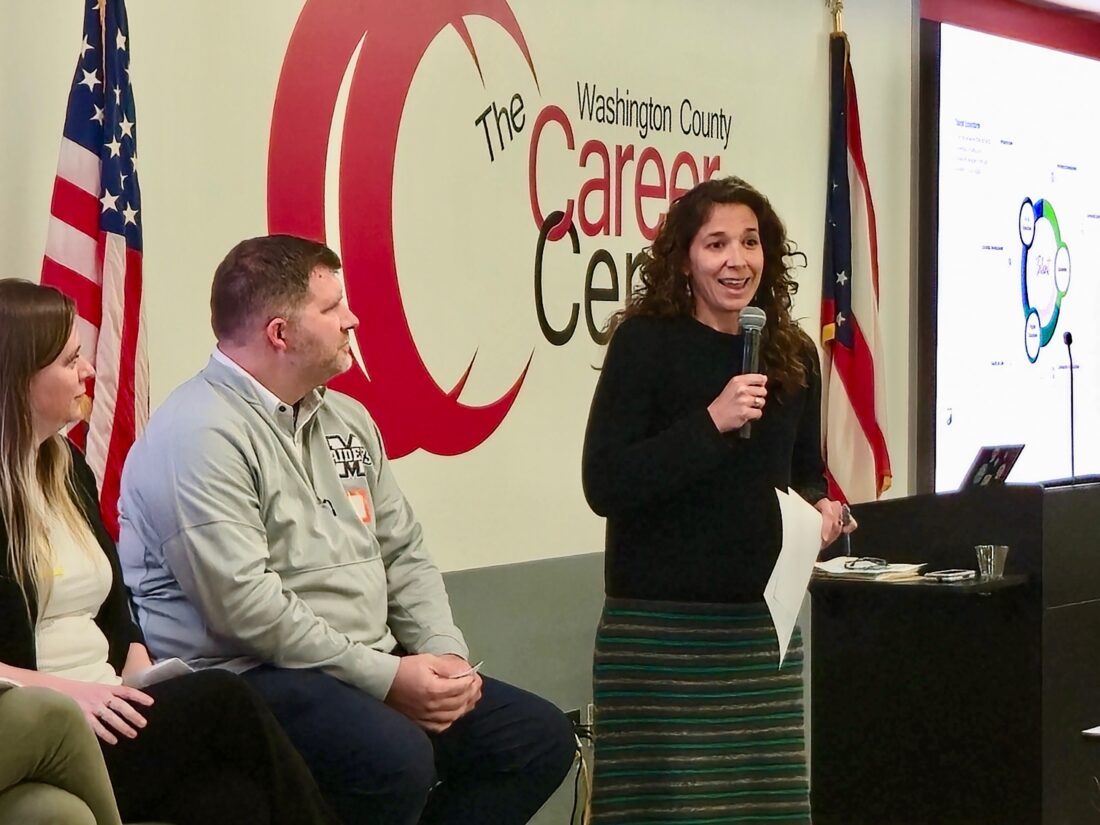
(Photo by Gwen Sour) Emily Bentley, education engagement specialist for Building Bridges to Careers, introduces a panel of educators during the Building Bridges to Careers Community and Business Advisory Council meeting hosted at Washington County Career Center on Thursday.
Educators, business leaders and community partners gathered at the Washington County Career Center Thursday evening for the Building Bridges to Careers (BB2C) Community and Business Advisory Council meeting, themed “Meeting in the Middle: Investing in Our Future Talent”, to discuss how schools, industry and communities can work together to strengthen the region’s talent pipeline.
The quarterly gathering brought together representatives from education, economic development and local businesses to examine how investments – financially, collaboratively and time-based – can support workforce development and long-term community growth.
Emily Bentley, education engagement specialist with BB2C, said the advisory council meetings are required for school districts across Ohio and serve as a forum for schools and employers to align workforce needs.
“Every school district in the state of Ohio is required to have a business advisory council, which is meant to be an opportunity for businesses and community and schools to come together and talk about the needs of our community and how we’re addressing the needs of our community and how we’re addressing those with what we do with our students,” Bentley said.
Bentley said the group’s quarterly meetings focus on a specific theme, with this session examining how communities invest in what she called the region’s “talent ecosystem”.
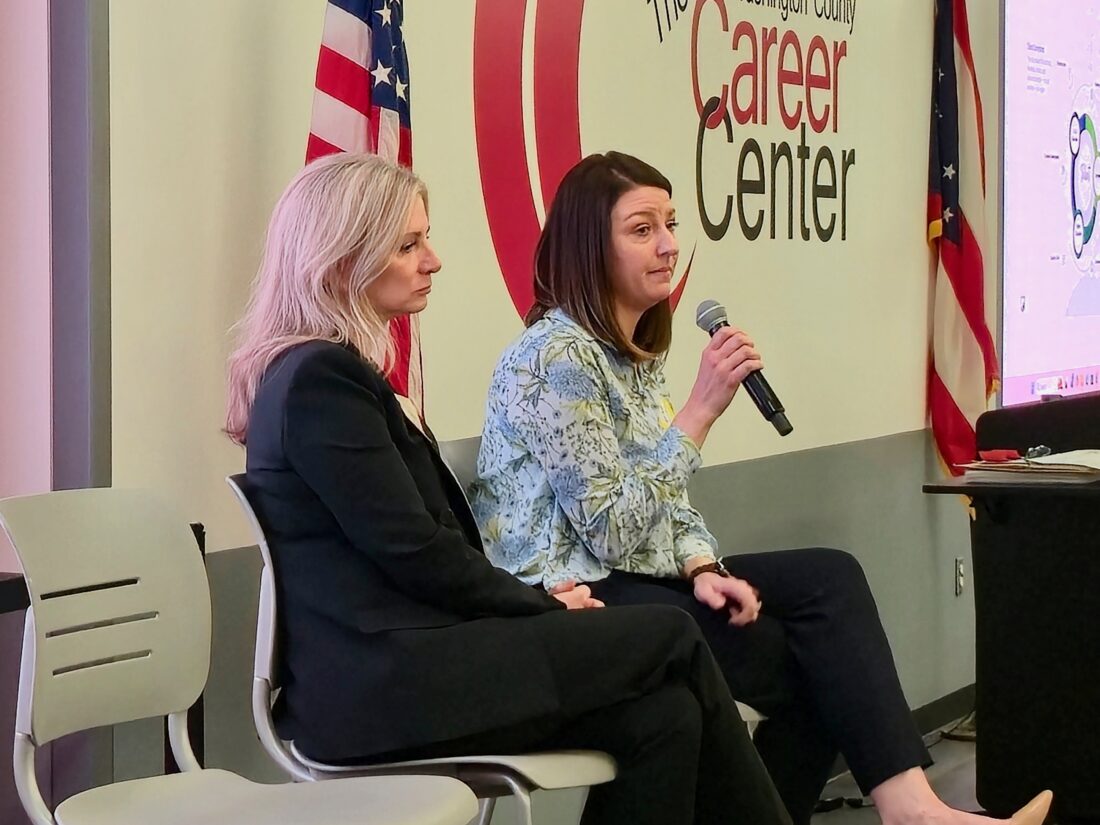
(Photo by Gwen Sour) From left, Marietta College President Kathleen Dougherty and Appalachian Ohio Manufacturers’ Coalition Executive Director Dana Hermann discuss how state-level investments can strengthen the Appalachian workforce during a meeting Thursday.
“Tonight is about thinking about the investment we see in our talent ecosystem – being future talent, our students,” she said. “We’re unpacking the word ‘invest’, because we’re not just talking about dollars. We’re also talking about the other ways we give back to our community and uplift our kids.”
The meeting opened with a presentation from Kara Willis of Ohio Southeast Economic Development, who explained how a “talent ecosystem” differs from traditional workforce development.
Workforce development typically focuses on immediate hiring needs, Willis said, while a talent ecosystem looks at long-term strategies for attracting, retaining and supporting workers across a region.
“When we’re talking about workforce development, we’re looking at immediate hiring needs – maybe the next few years,” Willis said. “When we talk about the talent ecosystem, we’re looking further into the future of what the whole system needs in order to attract and maintain that talent.”
Willis said the ecosystem includes schools, higher education institutions, employers, economic development organizations and community infrastructure working together to support individuals.
“The most important person in this picture is the person in the middle,” she said. “Every organization in that ecosystem has something to contribute to that person in order to give them a reason to come here or stay here.”
One panel focused on state-level investments supporting workforce and economic development efforts.
Dana Hermann, executive director for Appalachian Ohio Manufacturers’ Coalition, discussed a state budget line item funding the “Made in Appalachia” program, which is designed to train workers for manufacturing jobs through short-term training and career coaching.
The initiative also includes mobile training trailers that will bring education and certification opportunities to locations such as jails, shelters and other community facilities.
“The key to this program is we are not just putting people in jobs to get them a job,” Hermann said. “We want to make sure it’s the right job.”
Marietta College President Kathleen Dougherty also discusses the college’s Center for Appalachian Innovation, which received a $1.5 million state funding allocation. This funding supports student research and collaboration with businesses and government agencies on regional challenges.
“The center is supposed to help us advocate for Appalachia by bringing together education, the business community and government,” Dougherty said.
A second panel focused on community-level partnerships through the “Real World Problem Scenario” program, which connects classrooms with local businesses to address real-world challenges.
Teachers from Morgan Local Schools described how elementary students partnered with organizations and businesses to solve problems tied to economics, community development and environmental issues.
Haley Jordan, a third-grade teacher at Morgan West Elementary, said her students work with the Triple Nickel Diner to explore ways the business could increase revenue during slower seasons.
“I was really shocked by my students who specifically struggle academically but getting a hands-on project and seeing how they flourish with it,” Jordan said.
Community organizations are also supporting the effort. Kelsey Wells, executive vice president of Citizens National Bank of McConnelsville and chair of the Morgan Community Fund, said the fund helped support classroom projects and related field trips.
“Since I started with the Morgan Community Fund, it’s been about how do we get to the kids,” Wells said. “Through the real world problem scenario, they’ve been able to get outside the classroom and see different parts of their community.”
Bentley said the meeting highlighted the importance of collaboration across the region to support the budding workforce.
“We recognize that we cannot all do this by ourselves,” she said. “Opportunities like this allow us to come together across industries and talk about what the needs actually are and how we work together to address them.”
Local News

Bright spot
Ohio State Fire Marshal announces recipients of 2026 Equipment, Training Reimbursement Grants

Commissioners approve magistrate court funding, Belpre America 250 sub-grant
Marietta BOE holds special meeting
Building Bridges to Careers event highlights regional collaboration to support future workforce