
Marietta City Board of Education approves third grade move from electronic to paper testing
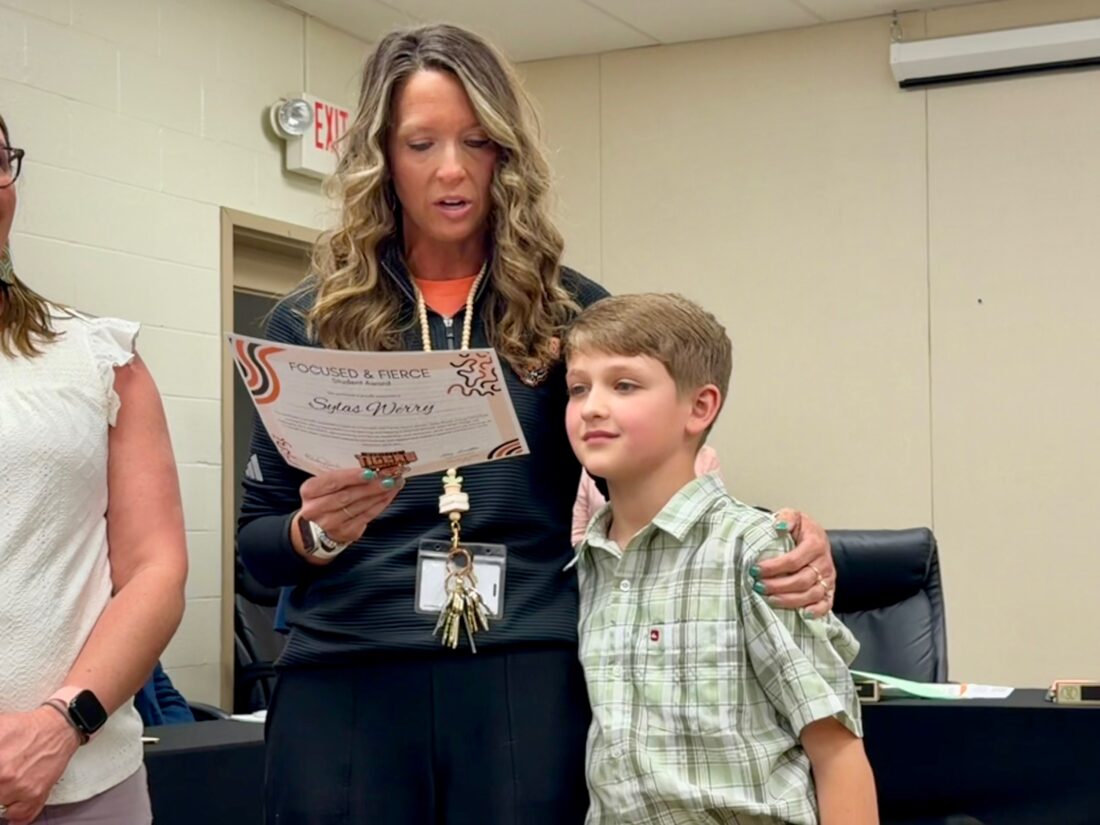
Marietta Elementary School Principal Brittany Schob presents student Sylas Werry with the monthly Focused and Fierce award during a regular Marietta City Board of Education meeting Monday. (Photo by Amber Phipps)
Marietta Elementary School third-graders will be doing more work with pencil and paper.
The Marietta City Board of Education on Monday approved Superintendent Mary Schaeffer’s recommendation to return to pencil-and-paper testing rather than electronic means. She said students could be struggling in academic areas due to their unfamiliarity with keyboards and not the content itself.
Schaeffer’s recommendation was addressed during a presentation from teachers at Phillips, Washington and Marietta Elementary on information they’d gathered from each grade level, based on data collected over a full year. Director of Curriculum and Technology Tim Fleming said the results provide staff with a better understanding of what areas need more attention.
“If there’s a flag, it just means we investigate further,” he said. “It doesn’t mean there’s an issue, but we do diagnose.”
Fleming said the data allows teachers to pinpoint areas that need attention as well as specific students who may need additional help in an area like math or reading.
Multiple Marietta Elementary School teachers said opting for pencil-and-paper state tests was ideal because there were keyboard shortcut differences between a Google Docs page and the state testing program that affected kids’ scores because they weren’t familiar with the technology.
“Our teachers are working hard to make sure the content knowledge is there,” said Schaeffer. “How do we parse that out if we don’t know (if) this is a keyboarding problem?”
She said the students at MES don’t have “consistent keyboard access” until they reach third grade. Testing those younger students on computers could pose a disadvantage for those who weren’t yet comfortable with how to use them.
Marietta Elementary Principal Brittany Schob said teachers fully embraced Schaeffer’s recommendation and began implementing pencil-and-paper writing and having the students transcribe what they wrote on paper by typing it on the computer.
The third-graders were focused on stamina writing whereas fourth and fifth began implementing those keyboard typing skills.
“I’ve been really impressed with how they’ve all taken the data and gone with it,” said Schob. “They saw that data and said, ‘We need to work on writing.'”
Derrick Huck provided transportation and facilities updates for the board with an overview of bus routes, maintenance and workforce. There are 15 bus routes that run every day and equate to 1,375 miles everyday.
“That’s a lot of mileage, a lot of fuel and a lot of time, but it’s for good reasons,” he said.
Due to the distances the buses are driving, the vehicles require daily upkeep which he said the drivers conduct at the start and end of each shift.
Huck said the department is looking for substitute bus drivers and they are always in need of help.
Schaeffer said the district was awarded a safety grant for over $9,000 which she proposed could be used for a visitor badge system.
“The system’s going to scan government-issued IDs and screen against 50 state defense registries and cross references databases for custody alerts or restraining orders,” she said. “We’re looking to improve control over building access … and enhance prevention of unauthorized entry in real-time.”
The board will meet for a special executive session April 20 to discuss details about a potential pool project with the Mid-Ohio Valley Aquatic Center.
The next regular meeting is scheduled for 6 p.m. April 27 at 111 Academy Drive.
Amber Phipps can be reached at aphipps@newsandsentinel.com
Local News
Marietta City Board of Education approves third grade move from electronic to paper testing

Opening arguments today for trial in 2025 killing

Ohio House approves food stamp funding that will leave big shortfalls in urban counties
Missoula Children’s Theatre to plant ‘Secret Garden’ at Smoot
Fort Frye BOE receives major donation, highlights student programs
Ohio State Highway Patrol Reports
- Linda J. Leonard, 77, 121 Quail St., Little Hocking, driving a 2017 Kia Sportage, owned by Richard L. Leonard, ...