MOV Climate Corner: No kings, no exceptions
By Jean Ambrose
Easter is the most important day in the year for Christians. It commemorates the state torture and execution of a political protester and agitator, Jesus of Nazareth, more than 2,000 years ago — and the disappearance of his body two days later.
No one could have anticipated that minor event would become the foundation of a religious and political movement spanning millennia, one that today claims about 62% of Americans as followers.
In historical terms Christianity’s spread was remarkable. Early Christianity created a radical community rooted in the belief that all people were made in the image of God and therefore deserving of dignity and respect. Their compassion was widely noticed. They cared for the sick, shared resources with the poor, and offered women, widows, and single people a place of honor and leadership that was rare in the ancient world. They challenged practices such as infanticide and caste systems.
Their faith spread not through force or political power, but through networks of relationships. They demonstrated their beliefs through the way they lived — through humility, generosity, and courage in the face of persecution. They offered hope: a vision of a loving God and a future shaped by redemption rather than endless cycles of suffering.
By the time the Roman emperor Constantine legalized Christianity in the year 313, the groundwork had already been laid by generations of ordinary people living out a countercultural ethic of compassion and justice.
Political scientists have identified a striking threshold known as the 3.5% rule. Research popularized by political scientist Erica Chenoweth suggests that nonviolent, sustained protests involving this percentage of a population almost always succeed in achieving political change. It is considered a tipping point — one that governments find nearly impossible to ignore.
Fast forward to the state of Christianity today. A years-long Pew Research Center study shows a clear trend. In 2007, 78% of adults in West Virginia identified as Christian. By 2023, that figure had fallen to 64%. Nationwide, only 62% of Americans identified as Christian. Belief in God also declined. In 2023, 86% of West Virginians said they believed in God, down from 93% in 2007. The number who were absolutely certain of God’s existence dropped sharply, from 76% to 56%.
In 2023, 70% of West Virginians said religion was important in their lives, compared with 89% in 2007. In the same period, the share who seldom or never attended services rose from 41% to 51%. There has also been a major increase in the number of people who describe themselves as religiously unaffiliated. In West Virginia, that figure grew from 19% in 2007 to 31% in 2023. Nationally, it reached 29%.
Another telling shift concerns morality. When asked whether belief in God is necessary to be moral and have good values, a majority said no. Increasingly, people believe they can make up their own minds about what is right and wrong without requiring an intermediary to tell them what to do.
According to the Gospel accounts, Jesus reduced the law to two commandments: love God and love your neighbor. That is the whole of it — no exceptions. The necessity for last weekend’s protests around the country would have been clearly understood by the early Christians.
And the question of who our neighbor is is about to become far more urgent.
Climate change is already displacing people from their homes through drought, wildfire, flooding, and rising seas. In the coming decades, millions — perhaps tens of millions — will become climate refugees, forced to leave the places they love not because of war or crime, but because their land can no longer sustain life.
Some will come to our borders. Some will move within our own country. All will be vulnerable.
How we respond to them will be one of the defining moral tests of this century.
So why are so many people who call themselves Christians making exceptions to Jesus’ command to love our neighbor? Why are they supporting mass arrests, incarceration in detention camps, and deportations, or policies that separate families and turn away the vulnerable — now, when the number of displaced people is only beginning to grow?
If we claim the name Christian, honesty requires that we measure ourselves against the teachings we profess to follow.
The qualities that allowed Christianity to grow so quickly are the very qualities that now seem diminished. It is not a coincidence that religion is declining in importance in the United States and in West Virginia. What once attracted people was not doctrine or political power, but the radical life that Jesus lived — and the example he inspired others to follow. His way of being a king was to enter Jerusalem on a donkey. He sided with the poor and sick. He told his disciples, before he was executed, that the true leader is the “servant of all.”
Who can doubt that he would have been a protester last Saturday?
Jean Ambrose is a member of the MOV Religious Society of Friends (Quakers). Stewardship of the earth is one of six Quaker testimonies for living.
Local News
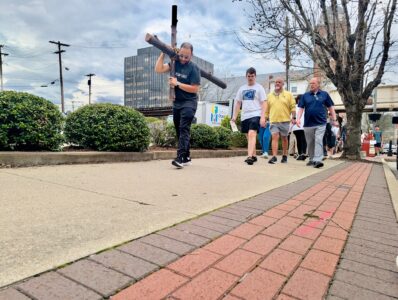
Faithful participate in cross walk for Good Friday

Ohio State investigating Epstein payments to gynecologist
MOV Climate Corner: No kings, no exceptions
By Jean Ambrose Easter is the most important day in the year for Christians. It commemorates the state torture ...

Reaching up

Monday deadline to register to vote in Ohio