
JQA Visits Marietta in 1843
Trending
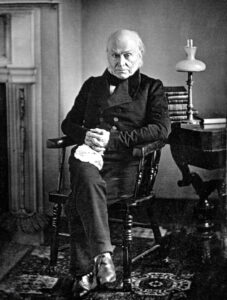
Shortly before 2:00 pm on November 15, 1843, the bell tolled at the First Congregational (“Two Horned”) Church in Marietta. Crowds rushed to the Ohio River landing. They were eager to see former President John Quincy Adams arriving on the steamboat BEN FRANKLIN. His journal reported “…a great crowd of people, guns fired, bells rung…” JQA (Adams referred to himself this way) was returning from Cincinnati where he had spoken at the cornerstone laying of the Cincinnati Observatory. Mariettans had invited him after learning of his Cincinnati engagement.
He was escorted to a crowded church by civic leader Nahum Ward. Judge William Rufus Putnam, son of Marietta founder Rufus Putnam, introduced the former President. JQA spoke without notes, praising the founders of Marietta, including Rufus Putnam. Those present were surprised by his knowledge of the original settlers and their experiences. He mentioned the familiar names of Tupper, Meigs, Varnum, Parsons, Devol, Greene, Fearing, and others. JQA’s interest in Marietta began decades before when he visited with Manasseh Cutler at Ipswich MA in 1788, shortly after Cutler’s return from Marietta. He said that from then on, “I had… a deep interest in the whole West, and watched its progress,…to its present great and flourishing condition.”
After the speech, he greeted people at the church. Many descendants of original settlers were present. One observer was moved by seeing “children and grandchildren of the very men Mr. Adams had been speaking of, come up and shake his hand.” George Dana, a descendant of Captain William Dana, brought his young son, John Quincy Dana. Dana said, “Here is my youngest son, whom I have named to show my esteem for you.” JQA placed his hand on the boy’s head and pronounced “God bless you my son.”
He toured the Marietta Earthworks, later writing about them in his journal, and returned to the boat. Marietta leaders Ephraim Cutler, Caleb Emerson, and Joseph Barker accompanied John Quincy Adams to Pittsburgh. Cutler observed that he “conversed with great ease and freedom on many topics.” Cutler credited JQA's father, John Adams, and others for their efforts in securing all lands west to the Mississippi River from Great Britain in the Treaty of Paris. This allowed for the formation of Northwest Territory – which became Ohio and four other states. Tears welled up in Adams’ eyes, and he thanked Cutler for remembering his “beloved father.”
They also discussed the issue of slavery. The former president was a lifelong opponent of slavery. Just prior to this trip, He recorded in his journal: “Before my lamp is burnt out, I am desirous that my opinions concerning… the abolition of slavery should be explicitly avowed and declared.” He presciently stated that allowing slavery to continue would lead to national conflict. Ephraim Cutler told him of his own successful efforts to prohibit slavery in the Ohio Constitution.
Other observations: JQA's trip to Ohio lasted over a month, testing the 77 year-old's endurance. His plan for the Cincinnati Observatory speech was ambitious: a 3 hour oration to "turn enthusiasm for astronomy into a permanent national pursuit.” A driving rain shortened the speech, but he spoke for 2 hours indoors the next day. This former president never retired. After leaving office in 1829, he served in the US House of Representatives until his death in 1848. JQA kept a diary from age 12 until his death in 1848. It comprises 14,000 pages in 51 volumes. It's now a digitized reference document. John Quincy Adams, an introvert with a stern appearance, was not charismatic. But on that day, he was treated like a rock star in Marietta.