
The first draft of history sometimes needs a rewrite
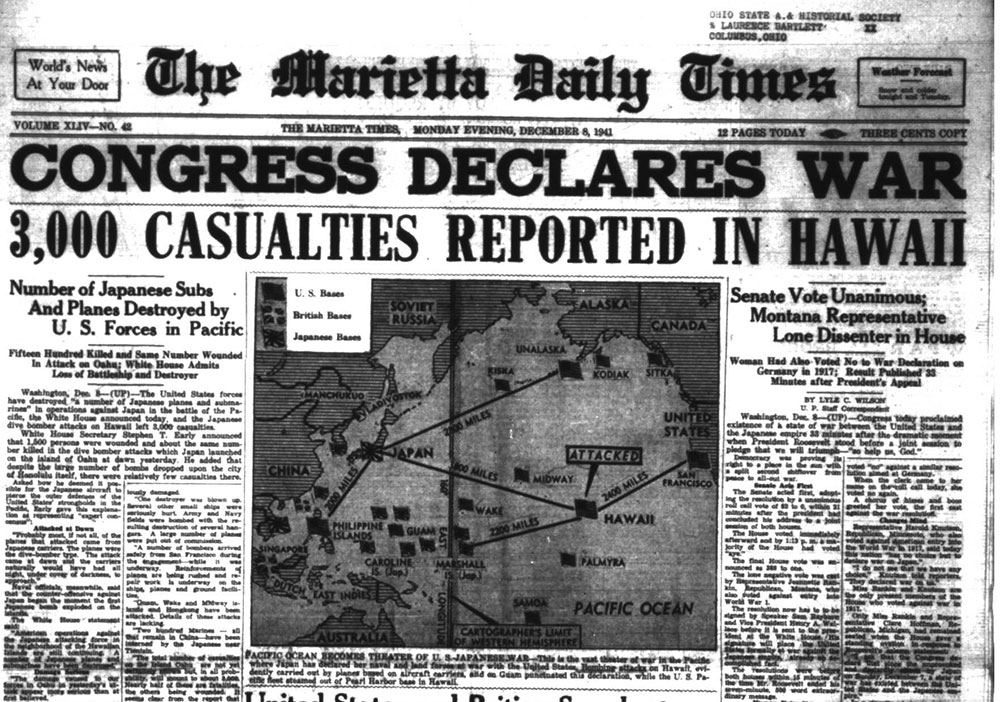
The front page of The Times from Dec. 8, 1941. (File Photo)
Newspapers have been called the first drafts of history because they are typically the first permanent record of an event. Mass produced, they are printed and delivered to homes sometimes while an event is still going on. Like all first drafts, sometimes they are not 100% correct. They are correct based on the knowledge available at the time a story is written, but the facts frequently change in the hours, days and years that follow.
Wednesday marks the anniversary of the attack on Pearl Harbor on Dec. 7, 1941. I thought it would be interesting to look back on some big events and see how close the first draft was to the final version of the story.
Marietta Times, Dec. 8, 1941. CONGRESS DECLARES WAR – 3000 CASUALTIES REPORTED IN HAWAII. At the start of any major news event, it is hard to get accurate information. The coverage provided by the United Press wire service reported more (the actual number was 2,403 dead and 1,000 injured) The coverage of the day also painted a more successful response by the United States than actually happened with one headline reading “United States and Britian Smash at Japan on 6,000-mile Pacific Front.”
Marietta Times, April 15, 1912. Great Liner With 1470 Passengers Runs into Iceberg — Help reaches her and all are reported to have been received. The first stories of the sinking of the Titanic were wrong. Newspapers, including The Times, reported all were safe and were transferred from the ship to the steamer Virginia. The stricken ship was reported to be under tow to Canada. This of course did not happen. The ship sunk with the loss of more than 1,500 people.
Marietta Times, March 26, 1913. GREAT FLOOD COMING DOWN THE MUSKINGUM VALLEY, Forecaster predicts stage at 45 feet. This number was off a little. The actual level during the flood crest was 60.3. It would flood nearly the entire town and wash out bridges from Marietta to Zanesville. The difference between the predicted and the actual flood is roughly the height of a two-story house. The flood caused great damage to Marietta, but remarkably took no lives here.
Marietta Times, July 8, 1938. 100,000 HEAR ROOSEVELT SPEAK. President Franklin Roosevelt traveled to Marietta to speak during the dedication of the Start Westward monument. The 100,000 people number has always bothered me because it is so large, and we are talking about Marietta, Ohio in the 1930s. How did the people get here, where did they park? There were not 100,000 people in the whole county then, there still aren’t. I have seen photos of him speaking and the crowd does not seem that dense. Of course, the editors in 1938 did not have high tech crowd estimating websites like we do today. A crowd tends to have about 2 people per square meter, which would mean that there were around 43,000 people in Muskingum Park, which is still an impressive number.
Early numbers in any story are hard to pin down. Until everything and everyone is accounted for, it is nearly impossible to be completely accurate. Early death totals for the September 11 attacks were much higher than the final number because so many people got out of the World Trade Center Towers before they fell.
Reporters and editors depend on other people to give accurate information. Bad information can lead to numbers that need corrected later on. We once had a security official tell us that 100,000 people watched the Sternwheel Festival fireworks at the levee. Unlikely, the space from Ohio Street to the River will hold around 20,000 people. If we truly think a number is that far off, we will not print it.
As a reader it is important to realize with any news story that the information in it was the best information available at the time. Newspapers and other news organizations will use multiple sources to write the most accurate story with the facts available at the time of writing. A story printed in a newspaper is a story frozen in time and gives the reader an accurate record of what the facts were thought to be at the time that the story was written.
Big stories take days, even years, to fully tell the whole story. World War II dominated the front page of The Times every day until Aug. 14, 1945 when it printed a giant headline that read THREE YEARS OF WAR END. I happen to have that and other historical editions hanging on my office wall. People tend to keep historical front pages for the rest of their lives. Sometimes the pages find their way home.
Art Smith is online manager of The Times, His column appears on Saturday. He can be reached at asmith@mariettatimes.com.