
Just my type – letters make a difference
Trending
The written word has preserved the thoughts of humans for thousands of years. The first example of writing was in the Middle East around 4,000 years ago. Early writing depended on humans called scribes to copy important texts.
Type that could be rearranged would come much later, as would paper. The early printed word was based on how the scribes drew the letters. The physical way they moved their hands had a direct impact in how the strokes of the letters varied in thickness.
I had a basic idea of how current typography was tied to the past work of scribes and stone masons. Several years ago, on a trip to Rome, I visited the Roman Forum. In the middle of the remarkable ruins is a group of large stones with large type carved into them. My first thought was wow, that is really old outdoor advertising. My second thought was that I recognized the typeface that was used to carve the letters more than 2,000 years ago. Times New Roman, a font used world-wide today, clearly had its origin back to the time and place and somehow had lasted 25 centuries for me to stand on a hot summer day in awe of the connection between the past and the current day.
The road from when people carefully copied the printed word by hand and carved it into stone is long and complex, each innovation, however, always brings with it elements of the past. The fact that Times New Roman was used by both the Roman stone carvers and modern designers is remarkable. If you are reading this in print you are reading it in a variation of that font. The variation in the stroke width, the lines that make the letters, was at first determined by how a scribe would hold the tool to draw the letter. Take a paint brush and draw an "O" without changing the angle of the brush and you will see what I mean.
When Johannes Gutenberg perfected the use of movable type and the printing press around 1450 it brought on the information age that continues to this day. Movable type had been in use in Asia before, but Gutenberg, and the Bible that he printed, were the spark that set things in motion to allow the masses to share information.
Using reusable letters and artwork, printers could put together pages to be printed on presses. The processes would improve with time, but the general principle, printing from raised letters, would remain much the same for the next 500 years. Offset printing in the 1960s made it a lot simpler, but pages were still put together by hand, with stories being attached to large layout sheets with wax and then photographed to make printing plates.
It wasn't until the personal computer improvements in the 1990s that it was practical to produce an entire newspaper page on the screen. Today printing plates are made using a single pdf computer file of the page.
Through advancements, many of the terms used have stayed the same, with many of them making their way into the general language.
Here are a few examples.
Mind your Ps and Qs.
Until the offset era, everything on a plate was backwards, making it hard to mentally check them to make sure the right letters were used. The (lowercase) Ps looked like Qs and vice-versa.
Make a good impression.
It's good when you meet your future in-laws, it is also good when you print something. The inked type makes an impression on the paper, hopefully a good one.
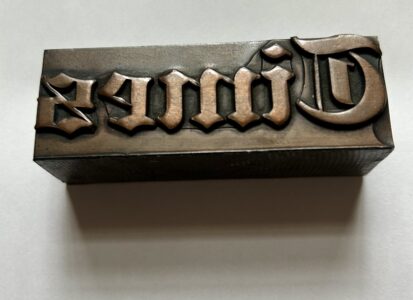
Cliche. The word comes from pieces of artwork to be reused many times. Also called print blocks, a lot of them are pretty cool. It will shock no one who knows me; I collect them.
Upper and lower-case letters. We call capital letters upper case because they were kept in the upper part of a cabinet that held letters. The small letters, the ones not capitalized, went in the bottom of the cabinet.
Cut and paste. To move a paragraph in the 1970s you would use an X-ACTO knife to cut and then paste it where you wanted it to be with the sticky wax holding it together. The wax, I was told, was bee wax. Sometimes letters would simply fall off, likely because someone wasn't minding their Ps and Qs.
The tools used within computer programs tie back to past actual tools. Every time I explain Photoshop to people, I explain that the cropping tool is a picture of a real tool that we once used. The Magic Wand tool I can't explain though. I've worked in the industry a long time and have yet to see any tool that will magically make things happen.
Art Smith is online manager of The Times, he can be reached at asmith@newsandsentinel.com