
Flood devastated Ohio 110 years ago
Trending
The flood of 1913 was one for the record books.
110 years ago on Sunday, The Marietta Times published the last edition that they would be able to get out before the press and all of Marietta was covered with the muddy swirling waters of the great flood of 1913.
No one alive today witnessed the horrific natural disaster. The flood devasted cities all over Ohio. The effects would be felt for decades. The incredible flood is still considered by anyone developing anything near the water, both in Marietta and around the state.
Residents must have been terrified by the news on the front page of The Times on March 26, 1913. The newspaper was the main and, in many cases, only connection people had to know what was going on elsewhere and the news that day was grim.
"GREAT FLOOD COMING DOWN THE MUSKINGUM VALLEY
DISASTER AMONG CITIES OF OHIO IS STILL GROWING"
A flood bulletin in the middle of the page listed death totals from around the state. The first one was Dayton, The Times reported between 500 and 10,000 people were dead from the flood waters of the Great Miami River in the southwest Ohio town. Fortunately, both numbers were high. The actual number of deaths was around 100 lives lost.
The flood waters destroyed nearly all forms of communications at the time, making accurate reporting very difficult.
In Marietta, the river was rising at a rate of 10 inches per hour. Residents were preparing for a double hit as the Muskingum was already ravishing Zanesville with the worst flood in the city's history. The rail tracks heading up Duck Creek Valley toward Cambridge had already been washed out when Duck Creek overflowed its banks.
Phone and telegraph service in Marietta had already been crippled by the flood waters, which were inaccurately predicted to crest at 45 feet.
And then it hit.
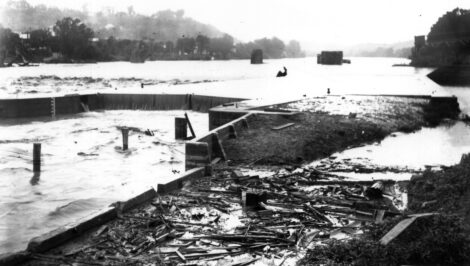
The river level eventually reached 60 feet. Covering the city and forcing homeowners and business to their second stories, then to their attics and finally to their roofs as the water continued to rise. Some streets were covered with 25 feet of water. Nearly all the downtown was covered. Buildings floated free and ran into other structures. All the bridges were destroyed, including the Putnam Street Bridge, its superstructure in ruins.
The city was under martial law by the time The Times returned to publishing on April 9. Officials were distributing mattresses and tents to those made homeless by the flood. Camps had been set up in Camp Tupper and in Harmar, but most people preferred to stay near their homes.
The Times of April 10 reported on the city struggling to return to normalcy. A temporary bridge on the rail span piers would permit both foot and wagon traffic, allowing the two sides of Marietta to be connected again. A floating bridge would later serve as a temporary Putnam Street Bridge.
Martial law was expected to end soon and the bars were set to reopen after being closed by the flood.
Gov. Cox visited the city with a team of state officials. Meeting with local leaders, they promised to help those people that had no other source of aid.
It would take years for the city and the valley to recover from the flood. The flood is remembered today by markers on downtown businesses. Look high up the walls of Front Street businesses and you will see them.
Take a walk across the north side of the Putnam Bridge and look at the marker along the railing at the eastern observation point. It shows where the level of the water would be on the current bridge. The structure would be nearly covered, as would the Ohio River Museum three blocks north. A pole between the structure and the sternwheeler W.P. Snyder Jr. indicates where the water would reach. During the flood in 1913 a large building that was near there broke loose and floated into the Putnam Street Bridge that was destroyed. The replacement bridge served Marietta served Marietta until it was replaced by the current one in 1999.
Hopefully Marietta will never again experience a flood like the one in 1913, because unlike communities like Parkersburg, we never built anything to block the river out.