
Trending
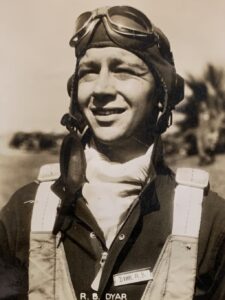
Roger Dyar was born in Lowell to Dwight and Marie (Barnhart) Dyar. Graduating from Lowell High School, Roger attended Ohio State for two years before joining the Army Air Corps in April 1941. Receiving his pilot's wings before the Pearl Harbor attack, he and his fellow pilots flew air patrols around New York City, similar to those repeated nearly 60 years later on September 11.
On Nov. 13, 1942, he and Lieutenant Harry Comstock would conduct flight tests for the new P-47C Thunderbolt prototype using new radio antennas. Reaching nearly 50,000 feet, Comstock put his plane into a dive. Passing 40,000 feet, his controls froze, requiring manually rolling back his trim tabs with the aircraft finally recovering above 20,000 feet. Lieutenant Dyar repeated the test and encountered the same difficulties.
Comstock reported his "plane shuttered as though it had been hit by a truck. Frankly, I wondered whether the tail section was still there." Dyar recounted, "My body was pushed back against the rear armor plate and I had a feeling that any second the plane was going to pull away from me and leave me stranded right there, five miles above ground." After both safely landed and reported their maneuvering issues, an engineer performed calculations and reported his results. The airplane manufacturer excitedly issued a press release claiming Comstock and Dyar had achieved 725 mph, breaking the speed of sound (roughly 700 mph at that altitude). Although the two pilots received acclaim in newspapers published across the country, a telegram from Commanding General "Hap" Arnold quickly followed saying, "there will be no more discussion about the dive." It was the Army equivalent of "Loose Lips Might Sink Ships!" The actual speed they attained that day is uncertain, but their "record" would stand until Chuck Yeager's jet flight in 1948. However, it is now known that their extreme speed was the direct cause of their maneuvering problems. Their control surfaces underwent "compressibility," something experienced when approaching the sound barrier. This effect was documented by other P-47 combat pilots, but training and procedures developed after the Dyar/Comstock flight taught others how to recover from it.
As squadron leader on June 26, 1943. Roger's unit was providing support for a bombing mission near Paris. With his wing man Lt. Janson, Roger broke formation and attacked four German fighters. After a notice to return home was given, both planes headed north and into a cloudbank. When Lt. Janson emerged, he saw no signs of Roger, calling out, "I have lost you." "O.K" was his last radioed reply. Roger's twenty-first and final combat flight would see him posthumously awarded his tenth air medal and a unit citation for his actions against the one of the most decorated German air unit, Jagdgeschwader 26 (aka "The Abbeville Boys").
Frenchmen discovered his remains and took them to Evreux for burial. Bafflingly, they misidentified Roger as an Australian. In 1948, the remains of that "Australian pilot" were disinterred and taken to England for identification. After confirmation, Captain Dyar's body was buried in the famous American Cemetery at Normandy. Today he rests beneath a beautiful white cross overlooking Omaha Beach among nearly 9,400 other Americans. At some unknown date, Roger's bereaved parents honored their son by installing lights in both towers of Marietta's First Congregational Church. They are still illuminated each night in his memory as an enduring legacy to this local hero's commitment to God and country.
Scott Britton is executive director of The Castle and a member of the Washington County Historical Society. To learn more about the Washington County Historical Society, call 740-373-1788 or visit wchshistory.org.