
Trending
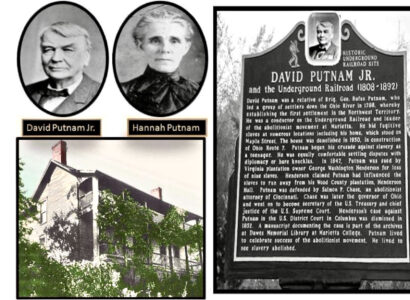
David Putnam, Jr., prominent Harmar merchant, and his wife Hannah were anxious. On a dreary November night in 1844, she was in labor with their 6th child, Hannah. The Putnams' apprehension grew because of David's other vocation: he was a "conductor" on the Underground Railroad (UGRR). That was a code name for the network of people who helped escaped slaves from the South find freedom in the North.
Slavery was prohibited in the Northwest Territory and Ohio. But Virginia, a few hundred yards across the Ohio River, was a slave state. Putnam knew some of the slaves in neighboring Wood County and had seen them "sold down the river" to the deep south, often separated from their families. He became a zealous abolitionist.
Most locals opposed the practice of slavery, but many tolerated slavery in the South as a fact of life. Live-and-let-live; don't rock the boat. When the Abolitionist Movement to end slavery became active in the 1830s many here actually opposed it, fearing (correctly, it turned out), that it would lead to violence and civil unrest.
David Putnam, Jr.'s large home on Maple Street in Harmar was a "station" on the UGRR, meaning that he sometimes harbored escaped slaves. Unlike many below-the-radar UGRR participants, Putnam was quite public in his role, putting himself and his family at considerable risk. He even bragged that he invited slaves to sit in his parlor. More likely they were spirited away to secret compartments, tunnels, and fake partitions. Author David McCullough noted that Putnam's home "became a famous first stop for fleeing slaves."
The Fugitive Slave Law of 1793 allowed owners to "pursue and reclaim" escapees. That law didn't require cooperation with slave hunters, but the UGRR's aiding and abetting of fugitive slaves was clearly illegal. That didn't faze Putnam.
That November day there was a slave hidden in the Putnams' house. The escapee had been tracked to Ohio, and Putnam's house was the obvious place to search first. Angry "slave catchers" (slave bounty hunters) from Wood County gathered at the house, shouting racial epithets, throwing stones, and threatening to storm the house and extract the slave. Putnam peered out into the darkness as a cold rain began. He watched as shrouded figures surrounded the house to guard against an escape.
Dr. John Cotton arrived to deliver baby Hannah, who as a child a few years later would open a closet door while playing with a friend and discover the startled face of a hiding slave. Dr. Cotton warned those in the house that a home invasion could endanger mother and child. Putnam sought help. Several prominent Marietta residents including Dr. John McCoy arrived after dark to calm the crowd. Dr. McCoy was an imposing figure who wore a wide brimmed hat and a flowing black cape.
The night wore on. Entreaties from the Marietta residents -- and the rain -- calmed the crowd. About midnight, Dr. McCoy in his signature hat and cape departed. The onlookers gradually left, too. Only the ardent slavers remained until dawn, when the real John McCoy, minus his hat and cape, emerged. They realized that the "Dr. McCoy" who left at midnight was the disguised slave, now long gone. They'd been tricked and sullenly departed.
The Putnams were relieved.
Baby Hannah was born that morning. Such was a day in the life of this conductor on the Underground Railroad. David Putnam, Jr. lived to see slavery abolished.