
Campus Martius: Marietta’s first community
Trending
Imagine a small self contained mini-city with houses, public buildings, school, church, court, water well, recreation area, and protection from attack -- all contained within one city block. That was Campus Martius at Marietta in 1788.
When the pioneers arrived, there was nothing here in the vast wilderness that comprised five future states. Author David McCullough observed, "There were no roads ... bridges, towns, churches, schools, stores, or wayside taverns." No problem: Workers fanned out and started building a settlement. Git 'er done! They began laying out streets, clearing land for planting, building bridges and roads (paths, really), and surveying land for future settlers.
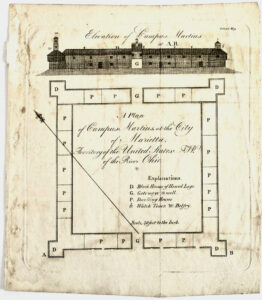
Rufus Putnam realized that Native Americans could pose a threat, though some seemed friendly enough as they visited soldiers at Fort Harmar. So workers began construction of the pioneer mini-city on the northwest corner of today's Second and Washington streets. The structure had the look of a military fort, but it wasn't. Inside the heavily timbered walls were houses for settlers. I call it the first gated community in the country.
Campus Martius is a Latin term meaning "Field of Mars." Mars is the Roman god of war. The term was applied to military training grounds; it was also a district in Ancient Rome. Why that particular name was chosen is not clear.
At each corner was a sturdy blockhouse, an 18 foot square, two-story structure. These were buildings for public functions -- court, church, school, public meetings, territorial offices. They also had defensive features: a watch tower, sentry box, and heavy construction to withstand small arms fire. The southwest and northeast blockhouses had a small 4 pounder cannon, which was to be fired as an alarm in case of attack.
The interior of Campus Martius was 144 feet square - about half an acre. There was a well, sun dial, and possibly a whipping post. Yes, there was strict discipline. The courtyard served as a playground for children, social space, and later as a drill ground for the militia. The outside walls of the stockade were thick hand sawn planks for protection against an attack.
Campus Martius served as the de facto headquarters of the early Marietta settlement. Directors of the Ohio Company -- functioning like a city council -- met there. Committees worked on everyday details. Court sessions took place there. Religious services were held every Sunday, to the chagrin of militia members who were obliged to attend every Sunday. Mary Bird Lake started a Sunday school for children -- the first such in Ohio.
Occasionally there were spirited disagreements, even shouting. One such controversy was how to manage salt springs on the Scioto River. Salt was a valuable and scarce resource in the early days. Turned out all of the vitriol was for naught when it was discovered they didn't own the spring.
In 1795, the Treaty of Greenville ended Indian fighting in Ohio. So, the fortified Campus Martius enclosure was no longer needed. Residents moved their homes or repurposed the structures. There is one relocated Campus Martius house still in Marietta. Know where? The blockhouses were sold off.
One home remained after the others were gone: that of Rufus Putnam, considered Marietta's founder. It's still there, in the same place, as part of Campus Martius Museum.
Function, protection, and stability: that's what made Campus Martius the critical first community in Ohio's first city.