
Law and Order and the Great Bobery*
Trending
When the first settlers arrived in April 1788 to create the town they would call Marietta, the territorial government had not been established yet. So, of necessity the pioneers set up temporary "laws" and regulations. Details are hazy. Several sources mention a "code of regulations;" others refer to a "Code of Thirteen Laws." Hildreth's Pioneer History: "…regulations for the government…were written out and posted up on the smooth trunk of a large beech tree, near the mouth of the Muskingum (River), on the 4th of July 1788." Nancy Allison Frost, newly arrived in 1789 as a precocious 5-year-old, recalled "running down to the Point" with other children to see that beech tree. They were excited to learn that "The twelfth law founded schools."
A more formal legal system began when the Territorial Governor Arthur St. Clair took office in July 1788. Colonel Ebenezer Sproat was appointed Sheriff of Washington County. Sproat was 6' 4" tall, extremely tall for that time. Local Indians nicknamed him "Hetuck," or Big Buckeye. Some say that's how Ohioans became known as Buckeyes - true or false?
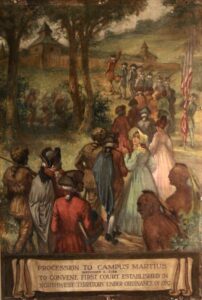
Sproat opened the first court ever held in the new territory with grand ceremony. Hildreth: "He led a procession to court with his drawn sword and wand of office, at the head of the judges, governor, secretary, &c, preceded by a military escort."
James Backus was appointed a deputy sheriff in November 1788 by Sproat: "I do hereby depute and authorize you to serve all writs and execute processes of every kind within the County of Washington….Ebn. Sproat, Sheriff." Deputy Backus was busy from the start. Here are examples of his deputy activities, from Backus' own records:
Nov 24, 1788: "Got a warrant for apprehending of Mr. Comstock, Seth Comstock, and Russel Arlington, and to search their house. The two Comstocks convicted of theft and fined; Arlington was acquitted.
Dec 16: "Warrant of his Excellency the governor for seizing spirituous liquors." Governor St. Clair ordered that all liquor in town be seized to prevent unruly behavior from disrupting treaty negotiations with Indians who were then present. Backus dutifully collected and gave receipts to each person, then returned the liquor to the owners later. Miraculously, all complied with this prohibition order.
Dec 19: "Served writ on Mixer, in favor of Mooney." Infraction not mentioned. Mixer was a tavern keeper. "Received $3 from Mixer for Mooney's account."
Dec 22: Too cold for criminal mischief: "Tea frozen in cup five feet from good fire kept going all night."
Jan 8, 1789: Received two warrants, one for John White, and...Simeon Wright, for selling liquor to the Indians.
Jan 16: "Went to Fort Harmer after Duncan in case of O'Neal for assault and battery. Brought him before E. Tupper. Court fined him $3."
March 10: "Court of Quarter Sessions sat today at twelve o'clock. Summoned and collected fifteen grand jurors. Attended the court."
James Backus later submitted an invoice to the court for his services. For March 10, he listed "Venire Facias for Calling Grand Jury." Homework for you, the reader: What does "Venire Facias" mean in court proceedings?
April 7: "First anniversary of (Marietta's founding). Dr. Drown gave an oration. A great bobery* kicked in the evening by firing guns, overturning carts, etc."
April 9: Served warrants on 8 persons for riot on April 7.
Now you've learned about Marietta's First Birthday Riot, an underreported event in our local history. Law and order had been established in the new town. As George Washington predicted about the Marietta settlers in a letter to Lafayette, "From such beginnings much may be expected."
*Bobery, actually bobbery: a commotion, disturbance, or noisy squabble.