
Two patriots and a liquor license
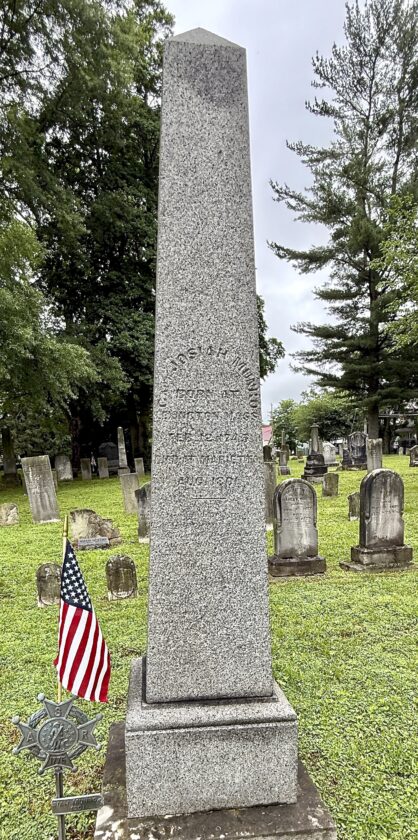
(Photo by David Baker) Grave marker of Josiah Munro in Mound Cemetery.

To learn more about R. J. Meigs scan this QR code.
(Photo by David Baker) Grave marker of Josiah Munro in Mound Cemetery.
To learn more about R. J. Meigs scan this QR code.
Trending
Sometimes history research happens by accident. One day I noticed a framed document at the Wine Cellar Restaurant. I squinted at the yellowed paper. It was a liquor license dated 1793. Below is the wording:
To Whom It May Concern
Know Ye that Josiah Munro having obtained a recommendation from the Justices of the Court of General Quarter Sessions of the Peace for the County of Washington as a Retailer of Spirituous liquors in Marietta in said County. I do hereby agreeably to the powers in me vested therefore License the said Josiah Munro as a retailer of spirituous liquors in Marietta aforesaid for the Term of one year from the date hereof.
Given under my hand and seal of office at Marietta aforesaid the twenty third day of December in the year of our Lord one thousand seven hundred ninety three.
R. J. Meigs one of the commissioners for granting licenses in the County of (seal) Washington
I thought anyone then could buy, sell, or make liquor. Not true after August 1, 1792, when a Territorial law requiring a license for retail sales, including the sale of "spirituous liquors," was passed. Applicants had to be "well qualified in person and character" and their business services "well provided in accommodations of guests," and "well situate(d)...for the convenience of the public." After the Court approved an application or renewal, the Commissioner issued the license.
The document lists two of Marietta's original settlers.
The license was granted to Josiah Munroe (also Munro and Monroe). He served as Captain in the Revolutionary War and was on the staff of Marquis de Lafayette for a time. Historical Samuel Hildreth includes Munroe in a list of residents: "Josiah Monroe, wife and two children, adults. He was a good and useful man."
His grave marker in Mound Cemetery at Marietta has this inscription:
"Captain Josiah Munroe, born at Lexington, Mass., February 12, 1745; died at Marietta August 1801. He was an officer in the Revolutionary Army, and became a friend of Lafayette, who recognised his services by the gift of a sword.
He was one of the original Ohio Company settlers who landed at Marietta, April 7, 1988, and was appointed postmaster at Marietta, 1794, which office he held at the time of his death."
Return Jonathan Meigs signed the liquor license. He was one of the original settlers of Marietta, serving as surveyor and later in civic offices.
He was a decorated officer of the Revolutionary War. Meigs was a division commander in Benedict Arnold's grueling expedition to Quebec in 1775. Rough terrain, bad weather, sickness, and faulty maps nearly wiped them out. Some survived by "eating leather, bones, the bark of trees, and soup made of the flesh of their dogs…" Meigs worked tirelessly to provide help and encouragement to his men.
He was captured in the Battle of Quebec and held as a prisoner of war. His journal January 1, 1776: "The first day I knew confinement. I hope I shall bear it with becoming fortitude." He did and months later returned to serve with the Continental Army.
His less well known but important role was as Indian Agent for the Cherokee Nation in Tennessee. One biographer: "His 23 year career as agent was devoted to the Cherokee's well being, defending their rights during treaty negotiations, and assisting them in establishing their own...government."
Something as ordinary as a liquor license can remind of us of our heritage - the courage of veterans, and the perseverance of our pioneers.